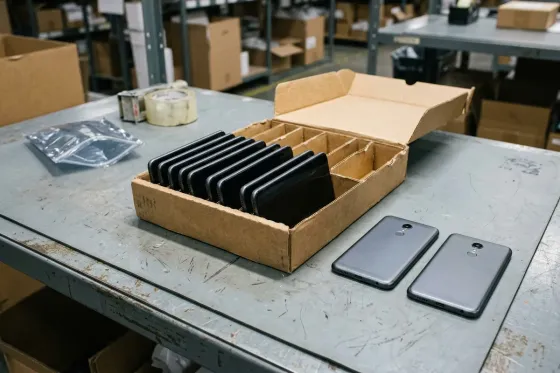
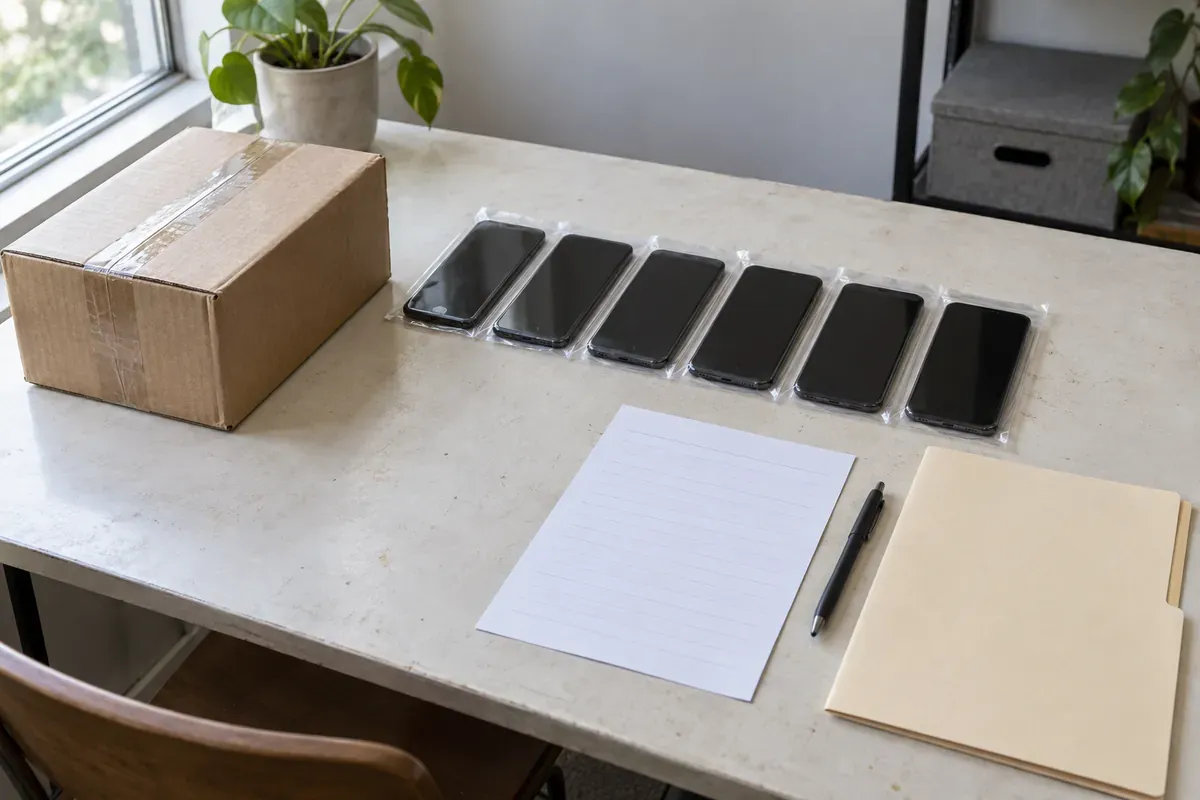
For a cross-border lot of new, used or refurbished phones, the safer method is the one whose release trigger you can meet with evidence you control. A TT wire releases money when you send it, so a short, locked or wrong-version lot leaves you chasing a refund; escrow releases it when you accept or let an inspection period lapse; a letter of credit pays when the seller presents documents that appear to comply. None of the three tests a single phone. This guide compares the three for resellers and importers buying existing stock, explains the escrow and LC rules that most often catch buyers out, and lists what to agree before any money moves. It is compiled from published bank, government and provider terms, not from trades we have made.
Start with the phone-sourcing decision guide if the seller, version or stock location is still open. This page assumes you have a candidate lot and need to decide how to pay for it.
Which payment method fits a cross-border phone lot?
Choose the method by asking where you can produce evidence. If you can test units only after they reach your own warehouse, escrow or a small final balance fits better than full prepayment. If the seller wants bank-backed payment and you can name an independent inspector at origin, an LC can work. Verify the payee first in every case.
The table below pairs common buying situations with a starting method. These are editorial recommendations built from the mechanisms described later on this page, not rules from any bank or provider.
Before you weigh any of these, run the supplier verification checks. A method changes when money moves. It cannot make an unverified payee legitimate.
Takeaway: Pick the method whose release event you can control with evidence, after the payee is verified.
What does a TT wire leave you exposed to?
A wire moves money to the account in the bank routing instructions. It does not hold anything back for inspection. Once your bank starts processing it, you may lose the ability to cancel it. Staging the payment limits how much is exposed at each step, but the stages exist only in your contract, not at the bank.
The U.S. International Trade Administration describes cash in advance as the most secure method for the exporter, because the importer pays before shipment. ITA also calls it the least attractive option for the buyer, and describes the wire transfer as a commonly used way to pay it. That is the seller’s view of safety. On the buyer’s side, the money and the leverage leave together.
Cancellation depends on the bank and on timing. Wells Fargo’s digital wire FAQ says a wire can be canceled while its status is Scheduled, and one held Under review for extra verification may also be canceled by phone. Once it shows Pending, it is being processed and can no longer be canceled. Other banks publish their own rules, and an international business wire may have no cancellation window you can use after release. Plan as if the transfer is final once you approve it.
A staged TT, such as a deposit followed by a balance, helps only when each stage is tied to evidence you can check before approving the next transfer. Write those triggers out before the first payment. The payment terms guide for phone orders has a worked deposit-and-balance clause; use it rather than inventing a split. No source establishes a standard deposit percentage for phone lots.
Before each transfer, check:
- the beneficiary name matches the contracting company, or a documented related party;
- the evidence agreed for this stage is in your hands, such as a dated inspection report for the identified lot;
- the account details match a record you confirmed earlier through a channel you already trusted.
If the seller pushes to skip a stage or to wire to a new account, treat that as one of the supplier red flags to resolve before paying.
Takeaway: Treat every wire as final once you approve it, and approve it only against evidence for that stage.
How does escrow release money on a phone shipment?
In escrow, a third party holds your money until the agreed conditions are met. Under Escrow.com’s published merchandise terms, your inspection period starts when delivery is confirmed, either by tracking or by you. You must actively accept or reject. If you do nothing until the period ends, you are treated as having accepted, and the seller is paid.
ITA’s overview of an escrow service describes the general sequence: the importer deposits the agreed amount, the exporter ships after the deposit is verified, the importer has a set time to inspect, and funds go to the exporter after acceptance or once that time runs out. ITA also advises checking that the escrow firm is appropriately licensed or accredited, and notes that either party can pay the fee or they can split it.

The specific rules come from the provider’s own terms. As one published example, Escrow.com’s General Escrow Instructions, retrieved October 11, 2026, set out these points for merchandise:
The seller then has five calendar days, counted from when the return is delivered, acknowledged or refused, to inspect it. If the seller accepts the return, or does nothing until those days end, you are refunded the deposit less the escrow fee and any shipping costs you agreed to pay. The seller can reject a timely return only if the goods come back in a different condition. That sends both parties to a negotiation period and, if unresolved, arbitration, so a refund is no longer a given. None of this is a rule for every escrow provider. Read the terms of the provider you will actually use, on the day you use it.
Eligibility is a separate check. Escrow.com’s country support FAQ lists regions whose bank accounts it will not pay or accept payments from, and sanctioned regions where users cannot open accounts. A seller whose only account is in one of those places cannot be paid through it, whatever both parties prefer.
Common mistake: Pressing Accept as soon as the carrier scan shows delivery, before anyone has powered on and checked the units. Confirming receipt only starts the inspection clock; acceptance, or letting the period run out, is the release.
Decide in advance what you will do with failed units. Read the DOA, warranty and returns guide for how remedies are usually written for phone lots, then check whether the escrow provider will support that remedy or whether it can handle only a full return.
Takeaway: Fund escrow only after the inspection period, delivery address and return route fit where and when you can test.
What should the lot acceptance record say before you fund?
Write down, unit by unit, what a passing phone is, before you fund escrow, open an LC or wire a deposit. A record both sides signed lets you decide accept or reject inside a fixed window. It also gives a bank or escrow provider something concrete to reference. Without one, a dispute turns into competing opinions about “good condition.”
The fields below are our recommended minimum for an existing-stock phone lot. They are a buyer’s checklist, not an industry standard, and the thresholds belong to you and the seller.
Use the bulk phone QC checklist to define the tests, and record each unit’s result in the downloadable QC checklist tool. Attach the agreed version of this record to the purchase order. For escrow, put the inspection period and any partial-acceptance arrangement into the signed transaction instructions. A side agreement that the provider has not executed does not change its release rules.
Takeaway: Agree a unit-level pass record first, then make the payment method point to it.
Why does a letter of credit check papers rather than phones?
An LC is your bank’s undertaking to pay the seller when documents that comply with the credit’s conditions are presented. The bank examines the documents. It does not open the cartons. If you need evidence about the phones, require a document that states it, such as a pre-shipment inspection certificate. Even then, the bank checks the certificate, not the devices.
HSBC’s letter of credit guidance says payment is made once the goods are shipped and the seller presents shipping documents such as invoices and proof of transport. It lists documents an LC commonly calls for, including a signed commercial invoice, packing list, bill of lading or air waybill, insurance policy and beneficiary’s certificate. It also says a buyer can tailor shipping, delivery, insurance and quality-inspection terms, and advises keeping terms simple, wording clear and required documents to the key ones. An irrevocable LC cannot be cancelled or changed unless every party agrees.

The limit is written into one bank’s own customer terms. HSBC’s Standard Trade Terms for the USA treat documents as compliant if they appear to be in order and, taken as a whole, conform to the credit. The same terms exclude HSBC’s responsibility for whether documents that appear in order are genuine, and for the description, quantity, quality, condition or existence of the goods. Other banks have their own terms; read your issuing bank’s.
Common mistake: Treating a paid LC as a QC pass. A compliant invoice and bill of lading say the seller shipped something described correctly on paper; they say nothing about Activation Lock or battery condition.
Some buyers ask whether an LC can say payment happens only after they inspect the goods in their own country. Raise it with your bank before the seller signs anything. Under the sequence HSBC and ITA describe, the bank pays against shipping documents, and you receive those documents to claim the goods. A condition that depends on your own opinion after arrival is hard to turn into a document the bank can check. HSBC says a buyer can tailor quality-inspection terms in the LC, so ask your bank which inspection documents, issuers and dates it can accept as conditions. A report from a named independent inspector at origin is a document, and it fits that sequence.
If your bank accepts an inspection document, propose these fields for it to review with the seller:
ITA warns that LC documents are detailed and prone to errors and discrepancies, which can cause payment delays and extra fees. Ask your bank what transaction types and sizes suit an LC, what it costs, who pays the fees and how disputes are handled. Line up the LC’s shipment terms with the Incoterm and named place in your order so the transport document it calls for can actually be produced.
Takeaway: Use an LC to make payment depend on documents, and add an inspection document if you need it to say something about the phones.
What should you do if payment details change or a wire goes wrong?
Stop before paying any new or changed account, and confirm the change through a phone number you already had, not one in the message. If money has already gone to a wrong or fraudulent account, call your bank straight away to request a recall, then report it. Recovery is possible but not assured.
The FBI’s Internet Crime Complaint Center describes business email compromise as criminals taking over legitimate business email accounts to redirect transfers. Its cloud-email advisory explains that attackers read compromised mailboxes for pending payments, then ask for them to be sent to a different account. IC3’s advice is to verify any change of payment details in person or through a known telephone number, and to use secondary channels or two-factor authentication. Applied to a phone order, that means:
- Hold the payment when the beneficiary, bank or country changes, even if the email thread looks genuine.
- Call the seller on a number from your earlier records or the company’s verified listing, and confirm the change with a person you have dealt with.
- Ask for the reason in writing and keep it with the order. A new beneficiary that is not the contracting company needs a documented relationship.
- Record the result in your supplier scorecard before releasing any payment.
If a transfer has already gone, IC3 says to contact your financial institution immediately and ask for a recall, along with any indemnification documents the bank needs. Policies differ between banks. File a complaint at ic3.gov regardless of the amount. IC3 says it may be able to help banks and law enforcement freeze funds, which is not the same as a refund. Readers outside the U.S. should also report to their own national authority.
Takeaway: Verify every change of payee by a known phone number, and act within hours if money has already left.
When this does not apply
This guide covers business-to-business payment for an existing lot of phones shipped across a border, where someone can test the units before money is released. When the buyer, the goods or the payment channel fall outside that, the mechanisms above work differently or not at all:
- Consumer purchases by card or marketplace checkout carry their own chargeback and buyer-protection rules, which this page does not cover.
- A marketplace’s own trade-assurance or payment-holding program follows that platform’s terms. Read them directly, because they may differ from a standalone escrow.
- Custom manufacturing or OEM orders, where payments follow production milestones, need a different schedule from ready stock.
- If the escrow provider does not support one party’s bank location, or the goods, use a different method instead of a workaround account.
- If nobody can test the units inside the escrow period or before shipment under an LC, no release condition can protect you. Reduce the lot until someone can.
- Legal enforceability of a specific contract, sanctions screening and tax treatment need a qualified adviser in the relevant country.
Takeaway: Use a different process when the trade is not a B2B purchase of ready stock with a testable lot.
Before you choose a method
Settle the order of decisions, then the paperwork. Verify the payee first. Then write the unit-level acceptance record. Then pick the method whose release trigger matches where and when that record can be completed. Draft the payment clause last, so it points to evidence that already has a time and place.
- Confirm the seller and beneficiary with the supplier verification steps and score the evidence.
- Request model code, version, lock status and IMEI list format in your phone wholesale RFQ, so every quote describes the same goods.
- Build the acceptance record with the QC checklist tool and agree it with the seller.
- Match the method: escrow if the period and address fit your test bench; an LC if your bank accepts an inspection certificate; staged TT if the seller is known and each stage has evidence.
- If none fits, buy a smaller lot first.
Takeaway: Choose the payment method last, after the payee and the acceptance record are settled.
Related reading
- Payment terms for wholesale phone orders: draft deposit, balance and retention triggers for whichever method you choose.
- Phone supplier verification: confirm the counterparty and payee relationship before any transfer.
- Bulk phone QC checklist: define the unit tests that your acceptance record refers to.
- Incoterms for phone importers: align the delivery point with the documents an LC will require.
Method and sources
This guide was compiled on October 11, 2026 from the U.S. International Trade Administration’s payment-method guidance and Incoterms overview, Escrow.com’s General Escrow Instructions, country FAQ and company verification page, HSBC’s letter of credit guidance and U.S. Standard Trade Terms, Wells Fargo’s digital wire FAQ and two FBI IC3 public service announcements. Provider and bank terms are quoted as published examples; they change, and other providers and banks set different rules. The comparison tables, acceptance record and decision sequence are editorial recommendations. PhoneBulk has not made, held or inspected payments or phone lots for this guide, and it does not recommend a provider.
Fees, deposit percentages and inspection-period lengths are left out on purpose. No source we used sets a standard for phone lots, and the right values depend on your lot, route and counterparty.
Takeaway: Check the current terms of your own bank and provider before you rely on any rule summarized here.
Key takeaways
- None of the three methods tests the phones; the evidence you make a condition of payment decides what you are protected against.
- Under Escrow.com's published terms, the inspection period starts at confirmed delivery and doing nothing counts as acceptance.
- A letter of credit pays against documents that appear to comply, so add an inspection document if you need one about the units.
- Confirm any new or changed payee through a phone number you already had before approving a wire.
Frequently asked questions
What are LC and TT payment terms?
TT (telegraphic transfer) is a bank wire: the buyer sends money to the payee's account, and the contract decides whether it is a deposit, a balance or full prepayment. An LC is the buyer's bank's undertaking to pay the seller when documents that comply with its conditions are presented. Neither one checks the phones.
Is escrow better than a wire for a first order with a new supplier?
It can be, if the provider accepts the transaction and both parties' bank locations, and if its inspection period starts where you can actually test the units. Escrow does not inspect the phones, guarantee that the seller delivers or replace your own supplier checks. Escrow.com, for example, asks company account holders for ID and proof of company registration, which confirms who holds the account, not the quality of the lot or the seller's trading record. A wire to a verified payee, staged against inspection evidence, can carry less exposure than escrow terms you cannot meet.
What happens if some phones in the lot don't meet the requirement?
Start with the failed-unit remedy you agreed before funding and the payment provider's own rules. Under Escrow.com's published merchandise terms, rejection works through a return of the goods, so partial acceptance needs explicit instructions all parties sign. In your contract, name the remedy for failed units, such as replacement, credit or refund per unit, and the evidence that triggers it.
If the balance is due on delivery, what date counts as delivery under EXW or FOB?
Write the date into the payment clause instead of relying on the Incoterm. ITA's Incoterms overview says each rule sets when delivery takes place and when risk passes, but not the method or timing of payment. EXW names a place of delivery and FOB a port of loading, so delivery can happen long before the phones reach you. If you mean arrival or inspection, name that event and the document that proves it.
The supplier's bank details don't match the platform or contract. Is it a scam?
Not necessarily, but pause until you can explain it. Confirm through a phone number you already had, not one in the new message, that the account holder is the contracting company or a documented related party. An unexplained third-party or personal account is a reason not to pay yet.
I paid by wire outside the platform. Did I lose its protection?
Check the platform's own buyer-protection terms to see whether a payment made outside its channel is covered at all. A direct wire follows your bank's rules and your contract with the seller. If you suspect fraud, call your bank at once to ask about a recall and keep every message and receipt.
The seller asks me to confirm receipt before the goods arrive. Should I?
No. Under Escrow.com's published terms, acknowledging receipt starts the inspection period, so confirm receipt only when the phones have actually arrived. Acceptance is a separate step and is what releases the money: completing Accept, or completing neither Accept nor Reject before the period ends. Hold back Accept until the units pass the checks you agreed.
Sources and methodology
- Cash-in-Advance: wire transfer and escrow service — U.S. International Trade Administration Accessed October 11, 2026.
- Know Your Incoterms — U.S. International Trade Administration Accessed October 11, 2026.
- Letter of Credit — U.S. International Trade Administration Accessed October 11, 2026.
- General Escrow Instructions — Escrow.com Accessed October 11, 2026.
- Company Verification — Escrow.com Accessed October 11, 2026.
- What countries / regions are not supported by Escrow.com? — Escrow.com Accessed October 11, 2026.
- Letters of Credit (Documentary Credit) — HSBC Accessed October 11, 2026.
- Standard Trade Terms (USA) — HSBC Accessed October 11, 2026.
- Digital wires FAQs: wire status and cancellation — Wells Fargo Accessed October 11, 2026.
- Business Email Compromise: The $55 Billion Scam (I-091124-PSA) — FBI Internet Crime Complaint Center Accessed October 11, 2026.
- Business Email Compromise through exploitation of cloud-based email services (I-040620-PSA) — FBI Internet Crime Complaint Center Accessed October 11, 2026.
Update history
- — First published. Official sources on this page were accessed on this date unless a later note says otherwise.
Factual corrections after publication are listed on the corrections page. Editorial responsibilities and review methods are described in the editorial policy.