
Key takeaways
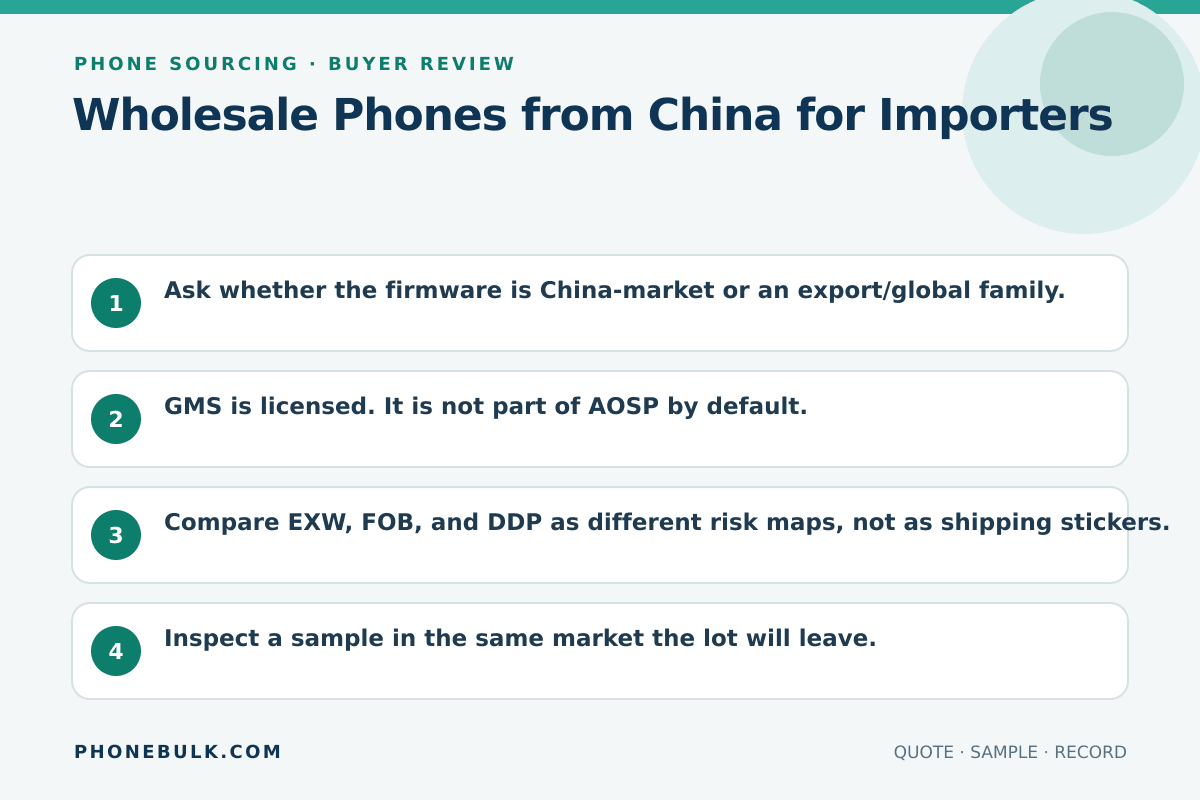
- Ask whether the firmware is China-market or an export/global family.
- GMS is licensed. It is not part of AOSP by default.
- Compare EXW, FOB, and DDP as different risk maps, not as shipping stickers.
- Inspect a sample in the same market the lot will leave.
- Lithium-ion phones need a named shipper who can classify the cargo.
China is a source market, not a product grade. A lot in Shenzhen can be unused export stock, China-ROM unused, or used phones. Write which one you are buying.
Who this guide is for
Importers who already know their destination market. If you do not yet know which firmware your customers can use, read global vs China versions first.
What “from China” must specify
| Field | Why it matters |
|---|---|
| Inventory type | Unused, used, refurbished, or mixed |
| Firmware family | China-market, HK, global, or carrier |
| GMS / Play certification | Selling into a Google-app market |
| Model codes | The unit you can import and service |
| Incoterm and place | Who owns freight and loss |
| Inspection | Whether you can open a sample before the balance |
| Documents | Commercial invoice, packing list, and any licenses your route needs |
| Battery cargo plan | Who ships UN 3481 phones |
Version risk
Google states that GMS is not part of AOSP and is available only through a Google license. China-market Android phones are commonly sold without preinstalled Google apps. Sideloading is not the same as a Play Protect certified device. Google also says uncertified devices may not be eligible for official Google apps.
If your buyer needs Play Store, YouTube, and Google account services on day one, a China-ROM lot is a different SKU. Price it that way.
Incoterms that show up on China quotes
- EXW. Buyer takes the goods at the seller’s premises and handles export.
- FOB. Sea term. Risk moves when goods are on board at the named port.
- CIF. Sea term. Seller pays carriage and minimum insurance. Risk still moves at origin boarding.
- DAP / DDP. Seller carries further. DDP includes import clearance.
Name the place. “FOB China” is not a place.
Inspection
Do not let the first power-on happen in your shop if you can avoid it. A sample should use the same QC checklist as the lot. For unused export phones, still check model code, firmware, Play certification, and charger.
Related guides
Frequently asked questions
Are China-version phones cheaper because they are lower quality?
Not automatically. They are built for a different software, app, and often radio set. The discount can disappear if your customers need Play services or local bands.
Should I buy on EXW because the unit price is lowest?
Only if you can run export, main carriage, insurance, and import. ICC and ITA materials treat EXW as the term that leaves the most work with the buyer.
Sources and methodology
- Android Google Mobile Services — Android / Google Accessed August 22, 2026.
- Incoterms 2020 — International Chamber of Commerce Accessed August 22, 2026.
- Know Your Incoterms — U.S. International Trade Administration Accessed August 22, 2026.
- IATA Lithium Battery Guidance — International Air Transport Association Accessed August 22, 2026.
Update history
- — First published. Official sources on this page were accessed on this date unless a later note says otherwise.
Factual corrections after publication are listed on the corrections page. There is no separate reviewer identity on this desk. See the editorial policy.

About the author
Frank Dean
Frank Dean researches manufacturer, standards, and trade documents for PhoneBulk, then turns them into accept / clarify / reject buying guidance for resellers.
- Source-backed wholesale research
- Claim-level fact review
- Separation of official rule and trade practice