
Key takeaways
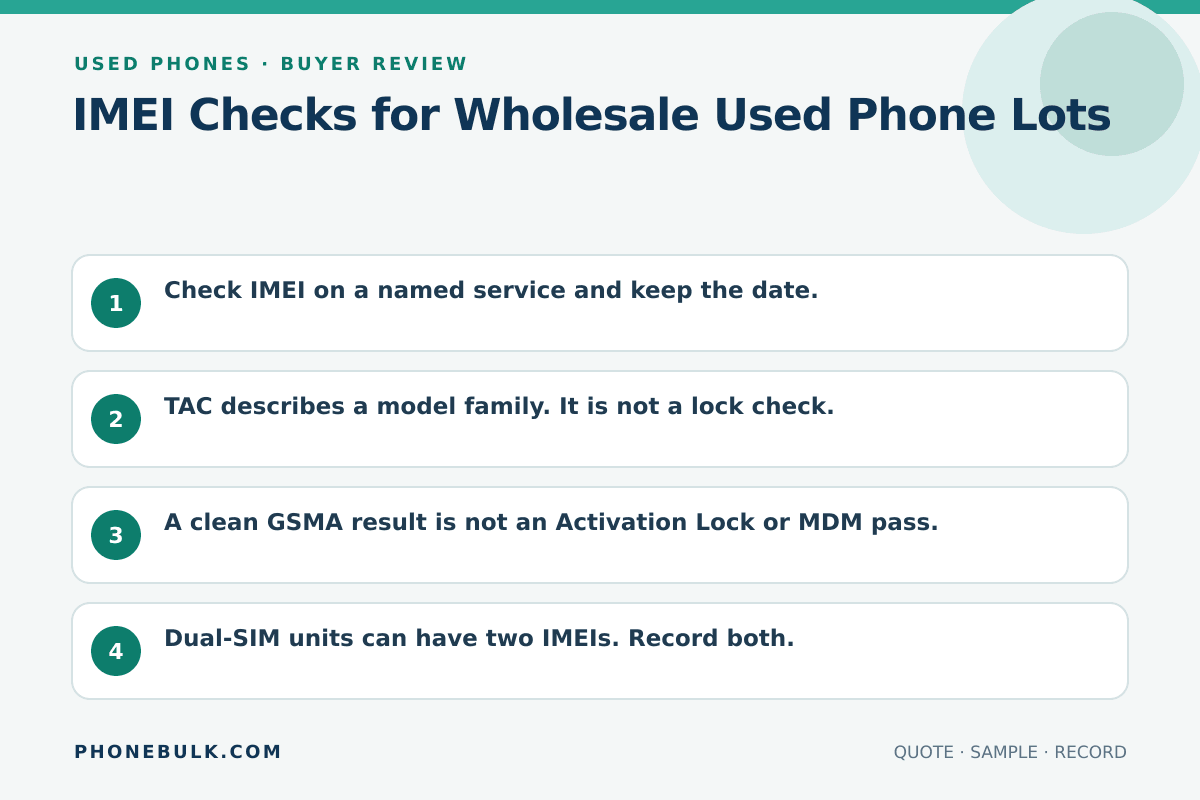
- Check IMEI on a named service and keep the date.
- TAC describes a model family. It is not a lock check.
- A clean GSMA result is not an Activation Lock or MDM pass.
- Dual-SIM units can have two IMEIs. Record both.
- A flagged unit is a Reject unless the contract already priced that risk.
IMEI is how networks and buyers name a specific radio device. It is not a cosmetic grade and not a lock status.
What the risk means
GSMA describes the IMEI as a 15-digit identifier. The first eight digits are the Type Allocation Code (TAC). GSMA, through appointed reporting bodies, is the allocator of TAC for 3GPP devices. Manufacturers then generate the rest of the IMEI for that model. GSMA says you must not implement an IMEI without an official TAC, and that a false IMEI can make a device inoperable or invite enforcement.
GSMA Device Check lets eligible users query IMEI, MEID, or ESN against the GSMA Block List. Results include a not-flagged status or a flagged status with a reason such as lost or stolen.
Why bulk buyers should care
A flagged IMEI can be denied on participating networks. One bad carton policy can strand a shop’s week. A clean check still leaves carrier lock, Activation Lock, and MDM unsolved.
Accept / Clarify / Reject
| Result | Accept | Clarify | Reject |
|---|---|---|---|
| Not flagged on named GSMA check | Matches quote | Check not run yet | — |
| Flagged lost/stolen | Only if contract allows scrap | Reason unclear | Sold as clean |
| Possible tamper / identity mismatch | — | Need a second method | Model and IMEI disagree |
| Second IMEI missing | Dual-SIM recorded | Only one IMEI listed | Seller hides the second |
How to test it
- Read IMEI from the device (
*#06#or Settings > General > About). - Match it to the packing list.
- Query the named service. Record date, service, and result.
- If Device Check reports a flag, stop that unit.
- Do not use an unofficial IMEI website as Apple coverage. Apple Check Coverage uses a serial number.
What evidence to request
- IMEI column before the balance
- Dual-SIM policy
- What happens if a unit flags after payment
- Who pays return freight on flagged units
Common supplier wording
- “IMEI clean” with no service name
- “Blacklist only in one country”
- “We can change IMEI” — treat as Reject
Related checks
Frequently asked questions
Does a matching TAC prove the phone is authentic?
No. TAC identifies the allocated model type. Counterfeit or tampered units can still show an IMEI. GSMA Device Check can also report that an identity may have been tampered.
Is a national carrier blacklist the same as GSMA Device Check?
Not always. GSMA compiles block-list data from participating operators. A local carrier can still have its own EIR rules. Name the service you used.
Sources and methodology
- GSMA Device Check FAQs — GSMA Accessed August 22, 2026.
- GSMA TAC allocation — GSMA Accessed August 22, 2026.
- IMEI Database — GSMA Accessed August 22, 2026.
- Mobile devices theft, GSMA policy — GSMA Accessed August 22, 2026.
Update history
- — First published. Official sources on this page were accessed on this date unless a later note says otherwise.
Factual corrections after publication are listed on the corrections page. There is no separate reviewer identity on this desk. See the editorial policy.

About the author
Frank Dean
Frank Dean researches manufacturer, standards, and trade documents for PhoneBulk, then turns them into accept / clarify / reject buying guidance for resellers.
- Source-backed wholesale research
- Claim-level fact review
- Separation of official rule and trade practice