
Key takeaways
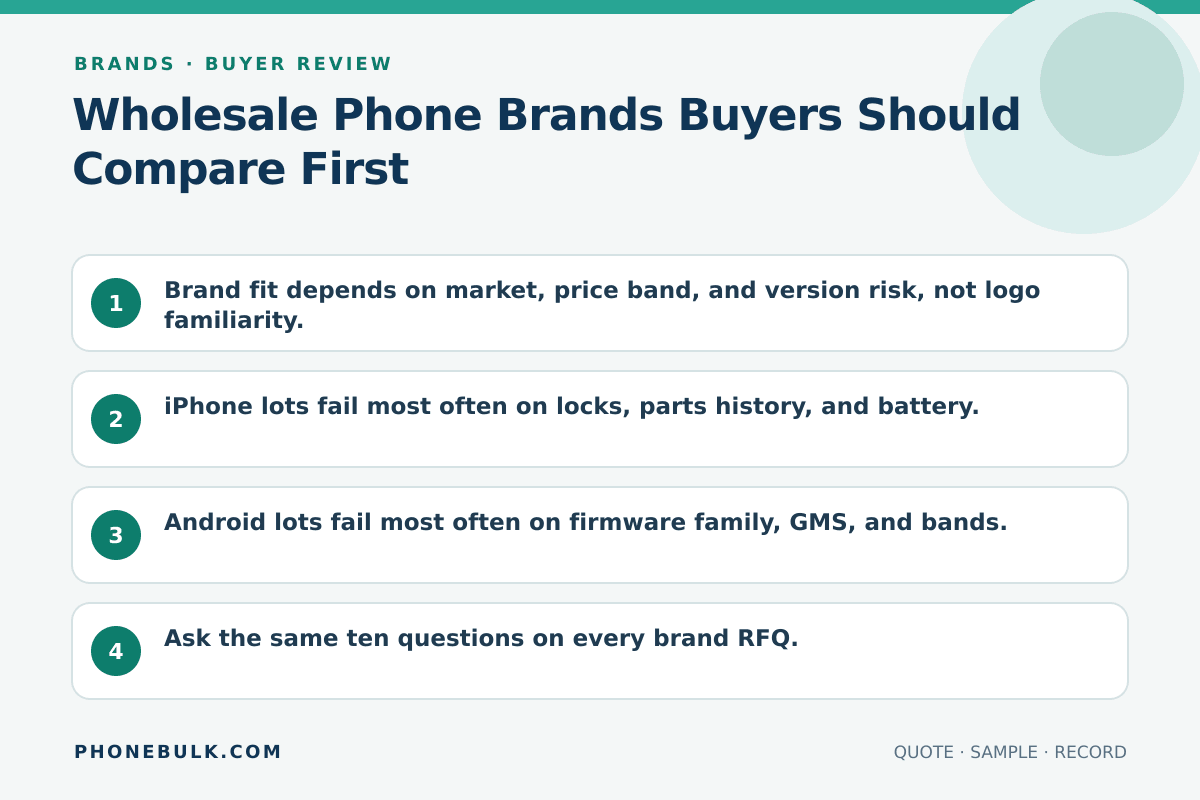
- Brand fit depends on market, price band, and version risk, not logo familiarity.
- iPhone lots fail most often on locks, parts history, and battery.
- Android lots fail most often on firmware family, GMS, and bands.
- Ask the same ten questions on every brand RFQ.
- Leave model-level pages alone until you have a reason to maintain them.
Brand pages on PhoneBulk answer a reseller question: is this brand fit for a bulk order in your market, and what must the quote disclose? They are not product catalogs.
A familiar logo does not make two regional versions interchangeable. Start with the sales channel and destination, then check the model code, software family, bands, locks, warranty route, and inventory condition. The brand page tells you which of those fields deserves the first question.
First brands
| Brand | Start with | Typical bulk risks |
|---|---|---|
| Apple iPhone | iPhone wholesale | Activation Lock, MDM, carrier lock, battery, parts history |
| Samsung Galaxy | Samsung wholesale | CSC/region, Knox/warranty state, carrier variants |
| Xiaomi / Redmi | Xiaomi and Redmi wholesale | China ROM, GMS, bands |
| POCO | POCO wholesale | Firmware family and twin-model claims |
| Honor | Honor wholesale | Regional software and GMS |
| Tecno | Tecno wholesale | Model mix and after-sales path |
| Infinix | Infinix wholesale | Sibling-brand mix-ups |
| Motorola | Motorola wholesale | Carrier variants and family mix |
The same brief on every brand
- Which reseller the brand fits.
- Main markets and price bands.
- Which families are actually bought in bulk.
- Global, regional, or China-version risk.
- Bands and language.
- GMS, OTA, warranty, and packaging.
- New, used, and refurbished differences.
- Mandatory RFQ fields.
- QC priorities.
- Related sourcing guides.
If a supplier cannot answer those points, you do not have a brand quote. You have a price.
Screen a brand before requesting stock
Write down where the phones will be sold and what the customer expects to work on day one. For Android stock, that may include official Google apps and Play Protect certification. For iPhone stock, lock state, battery, parts history, and region may decide whether the unit belongs in the channel.
Next, choose the inventory state. An unused carton needs version and identity checks. A used lot adds per-unit lock, IMEI, battery, parts, function, and cosmetic work. A refurbished lot also needs a written process and disclosure of what was replaced. The new, used, and refurbished comparison keeps those promises apart.
Send the same RFQ fields for every brand you compare. Do not let one seller quote a model code while another quotes only a family name. The second price is not cheaper until the missing version and condition are known.
When to open a model-level page
A model page needs a reason to exist beyond a specification list. Useful reasons include a version split, a recurring lock or certification check, a distinct buyer channel, or a documented QC issue that the brand page cannot explain. Without that material, keep the model inside the brand guide.
For mixed-brand cartons, list counts and state per SKU before comparing the average price. The mixed-SKU order guide explains why an assortment without a packing-list draft is not a usable quote.
Related guides
Frequently asked questions
Should I create a page for every iPhone or Samsung model?
Not at launch. Model pages only help when you can add version, QC, or market facts that a brand page cannot hold. A thin model page is a doorway risk.
Which brands are safest for a first bulk order?
Safety is in the quote and inspection, not the logo. Start with a brand whose version and lock checks you can actually perform.
Sources and methodology
- Check and fix Play Protect certification status — Google Play Help Accessed August 22, 2026.
- Activation Lock for iPhone and iPad — Apple Support Accessed August 22, 2026.
Update history
- — First published. Official sources on this page were accessed on this date unless a later note says otherwise.
- — Substantive revision of the buying fields or source notes.
Factual corrections after publication are listed on the corrections page. There is no separate reviewer identity on this desk. See the editorial policy.

About the author
Frank Dean
Frank Dean researches manufacturer, standards, and trade documents for PhoneBulk, then turns them into accept / clarify / reject buying guidance for resellers.
- Source-backed wholesale research
- Claim-level fact review
- Separation of official rule and trade practice