Key takeaways
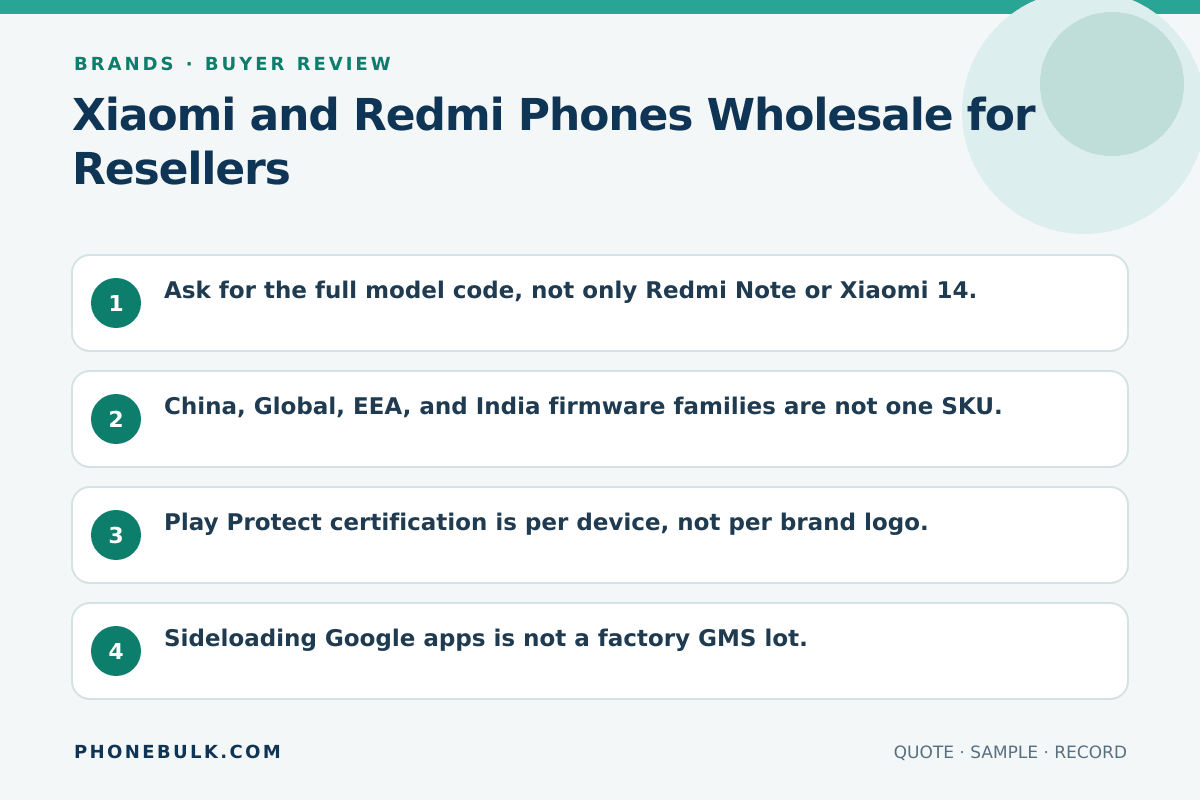
- Ask for the full model code, not only Redmi Note or Xiaomi 14.
- China, Global, EEA, and India firmware families are not one SKU.
- Play Protect certification is per device, not per brand logo.
- Sideloading Google apps is not a factory GMS lot.
- POCO is a related export brand. Use the POCO page when that is the label on the box.
Xiaomi and Redmi move in volume because the names are familiar. They fail in wholesale when the firmware family is not the one your customer can use.
Who this guide is for
Resellers who already sell Android in a price band where Redmi and Xiaomi appear on invoices. If you are still choosing unused versus used, start at wholesale phones. For the firmware problem itself, read global vs China versions.
Best-fit reseller profiles
| Buyer | Often fits | Watch |
|---|---|---|
| Mid-band retail | Global Redmi unused lots | Model code and charger |
| Importer | Named export SKUs | Bands and Play certification |
| Used-phone shop | Mixed Xiaomi used lots | Accounts, locks, batteries |
| China-channel reseller | China firmware on purpose | Disclosure to the next buyer |
Markets and price bands
Xiaomi number series sit in a higher unused-stock band than Redmi Note, Redmi number, and Redmi A. POCO is a sibling export badge and belongs on its own page. Typical wholesale demand is mid-band retail in markets that already know Redmi, plus importers who want a named export SKU.
Do not mix Xiaomi number series and Redmi Note, or mix storage and color, in one line item unless quantities are listed by exact model code. A “Redmi lot” without codes is a remainder bin.
Xiaomi’s public HyperOS 3 page lists Xiaomi, REDMI, and POCO models on a global schedule and states that the page applies to global versions available outside the Chinese Mainland. Features and timing vary by model and region. That is a software-family statement, not a stock list.
Version and regional differences
Ask for:
- Model code on the device and box
- Firmware family: China, Global, EEA, India, or another named region
- Whether Play Store is factory-present
- Play Protect certification on a sample
- Language packs, charger, and plug
- Bands for the destination network
Google describes GMS as licensed apps and APIs, not a default part of AOSP. Play Protect certification is per device record. Uncertified units are a different selling story even if a worker installed an APK.
Network, language, and software
Name the destination bands before you accept a China or India unit for an African or EU shop. Language packs that omit the store language become a return. OTA follows the firmware family: a China HyperOS build does not become a global update path because someone sideloaded Play Store.
Warranty is regional. A Xiaomi.com / mi.com warranty story is not a Shenzhen carton warranty. Packaging should match the firmware you will disclose: charger, plug, and printed language. A global-looking box around a China board is a Disclose field.
New, used, and refurbished
Unused Xiaomi and Redmi lots still need model code, firmware, and Play Protect on a sample. Used lots add FRP / account lock, battery, and cosmetic versus functional grades. Refurbished lots need the process: which parts, which test list, and whether the firmware was changed during repair. Do not put unused, used, and refurbished Xiaomi on one SKU line.
QC priorities
- Model code versus packing list.
- Play Protect certification if you will sell Google apps as official.
- Account lock and FRP on used units.
- Battery and charge behavior.
- Radios, cameras, display, ports.
- Disclosure language that matches the firmware you actually received.
Questions for the supplier
- What is the exact model code for each quantity?
- Is this China or a named export firmware?
- Will every unit show as Play Protect certified?
- If Google apps were added after factory, who did it and how is that disclosed?
- For used units, what account-removal proof will we see before the balance?
Related guides
Frequently asked questions
Can I buy China Xiaomi and sell it as global if Google Play works after sideload?
You can describe the work you did. You cannot honestly describe the result as a factory global or Play Protect certified device unless that is what it is. Google says uncertified devices may not be eligible for official Google apps.
Does HyperOS on Xiaomi.com prove every Redmi has Google apps?
No. Xiaomi states that the HyperOS 3 marketing page applies to global versions available outside the Chinese Mainland, and that features vary by model and region. Check the unit you will receive.
Sources and methodology
- Xiaomi HyperOS 3 — Xiaomi Accessed August 22, 2026.
- Android Google Mobile Services — Android / Google Accessed August 22, 2026.
- Check and fix Play Protect certification status — Google Play Help Accessed August 22, 2026.
- Google Play supported devices — Google Play Help Accessed August 22, 2026.
Update history
- — First published. Official sources on this page were accessed on this date unless a later note says otherwise.
Factual corrections after publication are listed on the corrections page. There is no separate reviewer identity on this desk. See the editorial policy.

About the author
Frank Dean
Frank Dean researches manufacturer, standards, and trade documents for PhoneBulk, then turns them into accept / clarify / reject buying guidance for resellers.
- Source-backed wholesale research
- Claim-level fact review
- Separation of official rule and trade practice