

Key takeaways
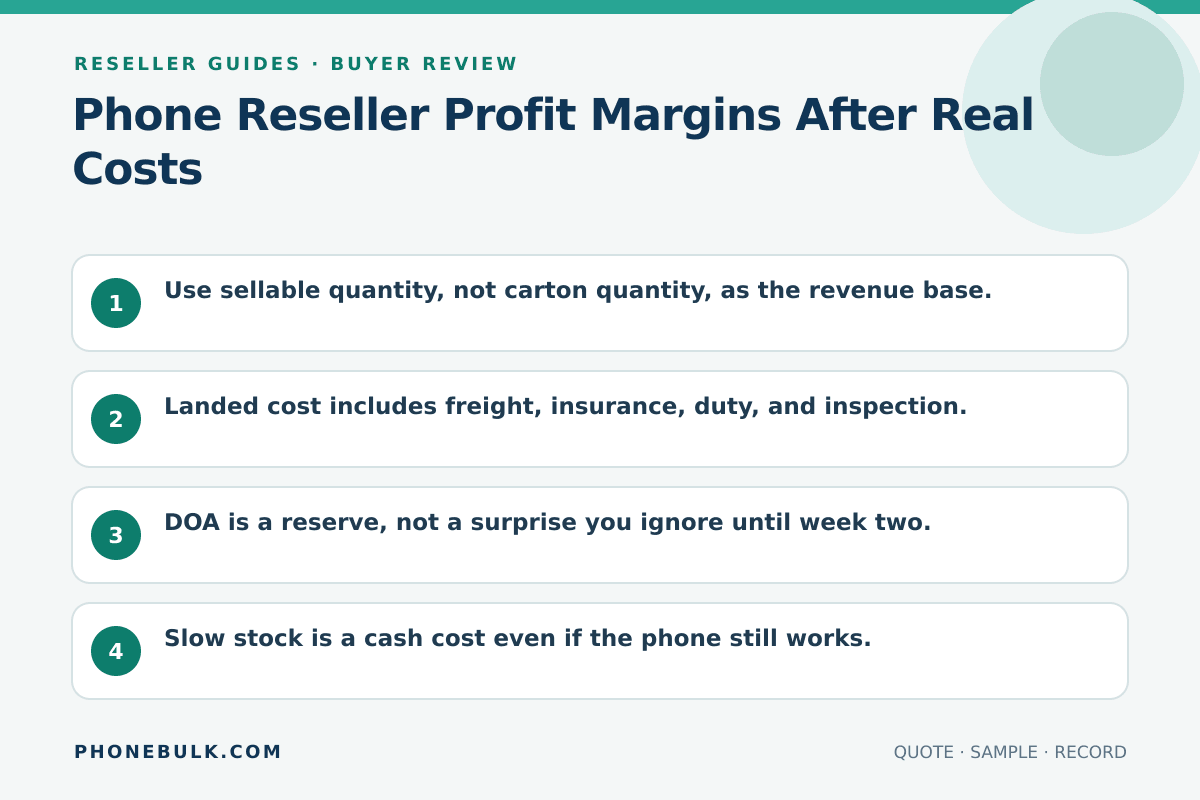
- Use sellable quantity, not carton quantity, as the revenue base.
- Landed cost includes freight, insurance, duty, and inspection.
- DOA is a reserve, not a surprise you ignore until week two.
- Slow stock is a cash cost even if the phone still works.
- The calculator on this site is a worksheet, not a forecast.
Margin is a leftover. If you count it before freight and dead units, you are counting someone else’s problem as your income.
Who this guide is for
Resellers who already sold at least a sample or a small lot and want a cleaner number. New buyers should start with how to start.
The lot formula
Use the profit calculator for arithmetic. The meaning is here.
- Total landed = goods + freight + insurance + duty and tax + destination and inspection fees. Incoterms decide which of those are already inside the unit price.
- Sellable quantity = units bought × (1 − expected unsellable rate). Unsellable includes DOA, locks you cannot clear, and IMEI flags you will not sell.
- Gross revenue = sellable quantity × expected selling price.
- Channel fees = gross revenue × fee rate.
- Estimated lot profit = gross revenue − fees − total landed.
- Profit per unit bought = lot profit ÷ units bought. This includes the units that failed.
A pretty per-unit markup that uses only the phones that sold will lie.
Keep one worksheet for each inventory state or SKU group that carries a different selling price or failure rate. Averaging unused and used phones can hide the inspection cost and unsellable units in the used line. The mixed-SKU guide explains how to split an assortment before calculating it.
Accept / Clarify / Reject on a “good margin” story
| Story | Accept | Clarify | Reject |
|---|---|---|---|
| Full landed + DOA + fees | Worksheet attached | “About 20 percent” | Screenshot of one sold unit |
| Unused and used mixed | Split margins | One average | Used losses hidden in unused |
| Slow models | Named outlet or reserve | “They will sell” | Counted as cash today |
What people leave out
- Return freight on lithium packages
- Time to turn the lot
- Discount on the last colors
- Payment timing. A high margin you fund for 90 days is a different business from a 14-day turn
Test the assumptions that can move
Run the profit calculator with the price and unsellable rate you expect, then change one input. Lower the selling price or raise the failed-unit rate and see whether the order still leaves room for costs the worksheet excludes. This does not predict the market. It shows which assumption is carrying the result.
Write the source of each input beside the result. The goods amount belongs to the quote, landed lines belong to the cost sheet, and the selling price belongs to a named channel. If a number comes from a different version, condition, or market, it does not belong in the same calculation.
Review the lot after it closes
Replace estimates with the actual sellable count, fees, returns, and selling prices. Record why units failed and which models needed discounts. That review gives the next inventory plan a better starting point than a general claim that the lot was profitable.
Do not erase unsold working phones from the review. They still hold cash. Give them a current outlet or a reserve rather than counting them at the original expected price.
Related guides
Frequently asked questions
What margin should a phone reseller expect?
There is no honest published average that applies to your channel and version. Run your numbers. Anyone selling a universal percentage is guessing for you.
Is a 30 percent unit markup a good lot?
Not if 10 percent of units fail, fees take 12 percent, and freight was missing from the quote. Recast the lot.
Sources and methodology
- Incoterms 2020 — International Chamber of Commerce Accessed August 22, 2026.
- Know Your Incoterms — U.S. International Trade Administration Accessed August 22, 2026.
Update history
- — First published. Official sources on this page were accessed on this date unless a later note says otherwise.
- — Substantive revision of the buying fields or source notes.
Factual corrections after publication are listed on the corrections page. There is no separate reviewer identity on this desk. See the editorial policy.

About the author
Frank Dean
Frank Dean researches manufacturer, standards, and trade documents for PhoneBulk, then turns them into accept / clarify / reject buying guidance for resellers.
- Source-backed wholesale research
- Claim-level fact review
- Separation of official rule and trade practice