
Key takeaways
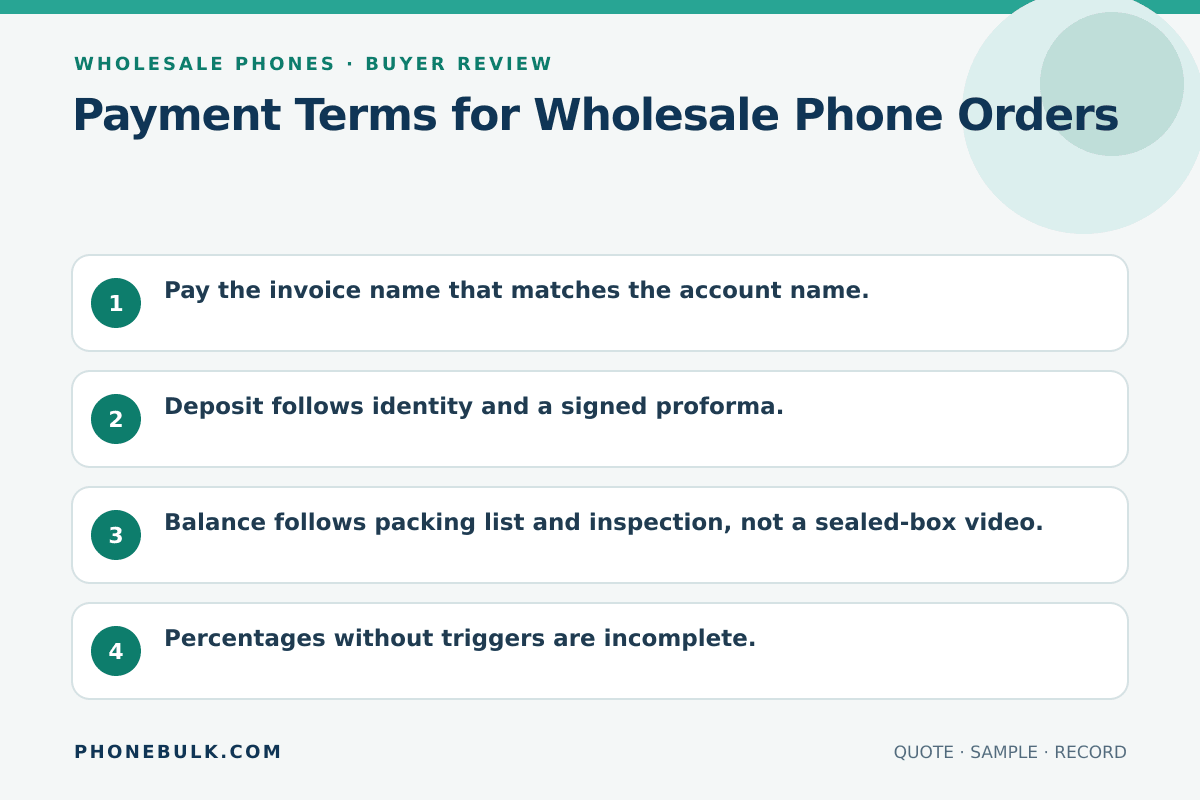
- Pay the invoice name that matches the account name.
- Deposit follows identity and a signed proforma.
- Balance follows packing list and inspection, not a sealed-box video.
- Percentages without triggers are incomplete.
- Letters of credit are a bank product. They still need a matching goods description.
Payment terms decide when you still have leverage. After the balance leaves, the carton is the supplier’s problem only if the contract says so.
Who this guide is for
Importers and resellers writing a first or second lot. Use supplier verification before you argue about percentages.
Triggers that belong in the order
| Trigger | Typical evidence | Accept | Clarify | Reject |
|---|---|---|---|---|
| Deposit | Identity pack, matching account, signed proforma | Names match | “Pay now, papers later” | Personal account for a company invoice |
| Sample release | You pick units, same SKU as the lot | Written | Supplier picks “the good ones” | Sample after full payment only |
| Balance | Packing list, inspection, agreed photos | Written | “We are flying tonight” | Full prepay, first order, no open |
| Retention | Small holdback until arrival QC | Named days | Informal promise | Silent after you ask |
Incoterms allocate delivery cost and risk. They do not replace these triggers. A DDP price still needs a named payee.
Methods, not slogans
Name the method you will actually use:
- Telegraphic transfer to a matching corporate account
- A documented letter of credit, if your bank will issue one against a goods description that matches the RFQ
- A platform escrow only if you can read who holds the funds and what releases them
Do not invent a “safe unofficial channel.” If a supplier asks you to split a payment across unrelated accounts, stop.
How to write the clause
- Legal name, invoice name, account name. One string.
- Deposit amount and what documents you must have first.
- What happens if the sample fails. Refund, replace, or stop.
- Balance amount and the inspection event that releases it.
- Currency, bank charges, and who pays them.
- What happens if the lot fails after the balance. Point at DOA terms.
Common supplier wording
- “Friends price, full payment today”
- “Company account is busy, use my cousin”
- “LC is too slow, TT is how this business works”
TT can be fine. Urgency is not a term.
Related guides
Frequently asked questions
Is 30 percent deposit standard?
No. The useful term is what the 30 percent is paid against. A deposit with no identity pack and no sample right is still a blind payment.
Should I pay a personal account because the company account is “being updated”?
No. That is a Clarify that usually becomes a Reject. The account you pay must match the invoice name.
Sources and methodology
- Know Your Incoterms — U.S. International Trade Administration Accessed August 22, 2026.
- Incoterms 2020 — International Chamber of Commerce Accessed August 22, 2026.
Update history
- — First published. Official sources on this page were accessed on this date unless a later note says otherwise.
Factual corrections after publication are listed on the corrections page. There is no separate reviewer identity on this desk. See the editorial policy.

About the author
Frank Dean
Frank Dean researches manufacturer, standards, and trade documents for PhoneBulk, then turns them into accept / clarify / reject buying guidance for resellers.
- Source-backed wholesale research
- Claim-level fact review
- Separation of official rule and trade practice