

Key takeaways
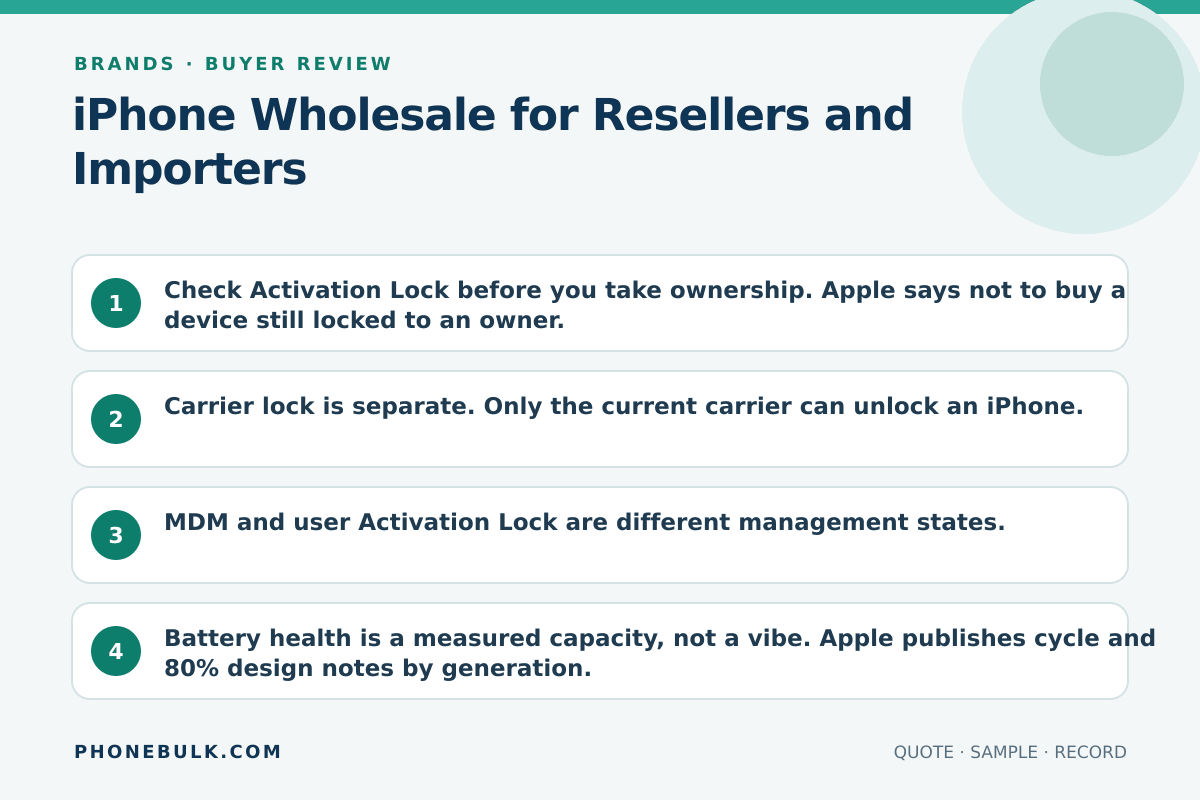
- Check Activation Lock before you take ownership. Apple says not to buy a device still locked to an owner.
- Carrier lock is separate. Only the current carrier can unlock an iPhone.
- MDM and user Activation Lock are different management states.
- Battery health is a measured capacity, not a vibe. Apple publishes cycle and 80% design notes by generation.
- Parts and Service History can show Genuine, Unknown, Used, or Unverified parts.
iPhone lots look simple because the model names are familiar. They fail for reasons that never appear in the model name.
Who this guide is for
Resellers who already have an iPhone channel and need a buying brief. If you are new to locks and IMEI, read the used iPhone checklist before you send a deposit.
Best-fit reseller profiles
| Buyer | Fit | Watch |
|---|---|---|
| Retail shop with walk-in unlock demand | Used and unlocked units | Battery and cosmetic grade |
| Carrier shop | Carrier-locked stock only if that carrier is your channel | Unlock eligibility later |
| Cross-border reseller | Region and band match | Warranty and charger |
| Refurbisher | Units with disclosed parts needs | Unknown parts and unfinished repairs |
Markets and price bands
Current unused iPhone lots sit in a high capital band. One- and two-generation-back used lots are the volume reseller band. Older units only work if lock, battery, and parts history are cheap to clear. Carrier shops, unlocked retail, and cross-border importers are different buyers even on the same model name.
Do not mix storage, region, or lock state in one line item. An “iPhone 14 lot” without those fields is a remainder bin.
Version and regional differences
Ask for the model number, not only “iPhone 14 128.” Region changes bands, charger, documentation, and sometimes warranty path. A US carrier unit and an unlocked international unit are not interchangeable stock.
Network, language, and software
Name destination bands, including whether the buyer needs eSIM-only or a physical SIM. Language is rarely the failure on iPhone; carrier firmware and warranty region are. iOS updates follow the device, but Activation Lock, MDM, and carrier lock decide whether the unit is stock.
Warranty is Apple regional coverage plus any seller warranty. Apple Check Coverage uses a serial number. Packaging should match charger, plug, and whether the box is carrier-branded. A new-looking box does not prove unused stock or Apple Certified Refurbished.
New, used, and refurbished
Unused iPhones still need lock and IMEI checks if the box has been opened. Used units need the full lock and battery set. Refurbished units need a process, not the word. Apple Certified Refurbished is Apple’s own program, with testing, genuine parts as needed, a new battery and shell on iOS devices, and a one-year limited warranty. A third-party “refurb iPhone” lot is not that program unless Apple processed it.
QC priorities
- Identity. Model, storage, color, IMEI, serial.
- Activation Lock. Do not buy a unit locked to an owner.
- MDM or supervision. Ask who can release it.
- Carrier lock. Settings > General > About.
- Battery. Settings > Battery > Battery Health. Apple describes maximum capacity relative to when the battery was new. iPhone 14 and earlier batteries are designed to retain 80% at 500 cycles under ideal conditions. iPhone 15 and later are designed for 80% at 1,000 cycles under ideal conditions.
- Parts and Service History on iOS 15.2 or later. Genuine, Unknown, Used, and Unverified mean different things. An Unknown part can affect trade-in value. An unverified logic board can affect Apple Pay.
- Function. Radios, cameras, Face ID or Touch ID, charge, display.
- IMEI status on a named block-list check.
Questions for the supplier
- What is the exact model number and region for each line?
- Will every unit show No SIM restrictions, or is lock disclosed per IMEI?
- Will you demonstrate Activation Lock off on a sample, then the lot?
- What battery-health floor is in the grade?
- Have parts been replaced? Will you accept returns on Unknown or Unverified parts?
- Which IMEI service will you use, and what happens if a unit is flagged after payment?
Related guides
Frequently asked questions
How do I see if an iPhone is carrier locked?
On current iOS, open Settings, tap General, then About. If Carrier Lock says No SIM restrictions, the phone is unlocked. Apple cannot unlock it. The current carrier can.
How do I check Activation Lock before buying?
Apple says the device should be erased and no longer linked to the previous owner's account. On iOS 15 or later, a locked device can show iPhone Locked to Owner. Do not take ownership of that unit.
Does Apple check coverage use IMEI?
Apple's Check Coverage tool asks for a serial number. Serial and IMEI are both identifiers. Do not treat a third-party IMEI website as Apple's coverage record.
Sources and methodology
- Activation Lock for iPhone and iPad — Apple Support Accessed August 22, 2026.
- How to unlock your iPhone for use with a different carrier — Apple Support Accessed August 22, 2026.
- iPhone battery and performance — Apple Support Accessed August 22, 2026.
- About the battery and performance of iPhone 11 and later — Apple Support Accessed August 22, 2026.
- iPhone Parts and Service History — Apple Support Accessed August 22, 2026.
- View Coverage — Apple Accessed August 22, 2026.
- Why Refurbished — Apple Accessed August 22, 2026.
Update history
- — First published. Official sources on this page were accessed on this date unless a later note says otherwise.
Factual corrections after publication are listed on the corrections page. There is no separate reviewer identity on this desk. See the editorial policy.

About the author
Frank Dean
Frank Dean researches manufacturer, standards, and trade documents for PhoneBulk, then turns them into accept / clarify / reject buying guidance for resellers.
- Source-backed wholesale research
- Claim-level fact review
- Separation of official rule and trade practice