
Key takeaways
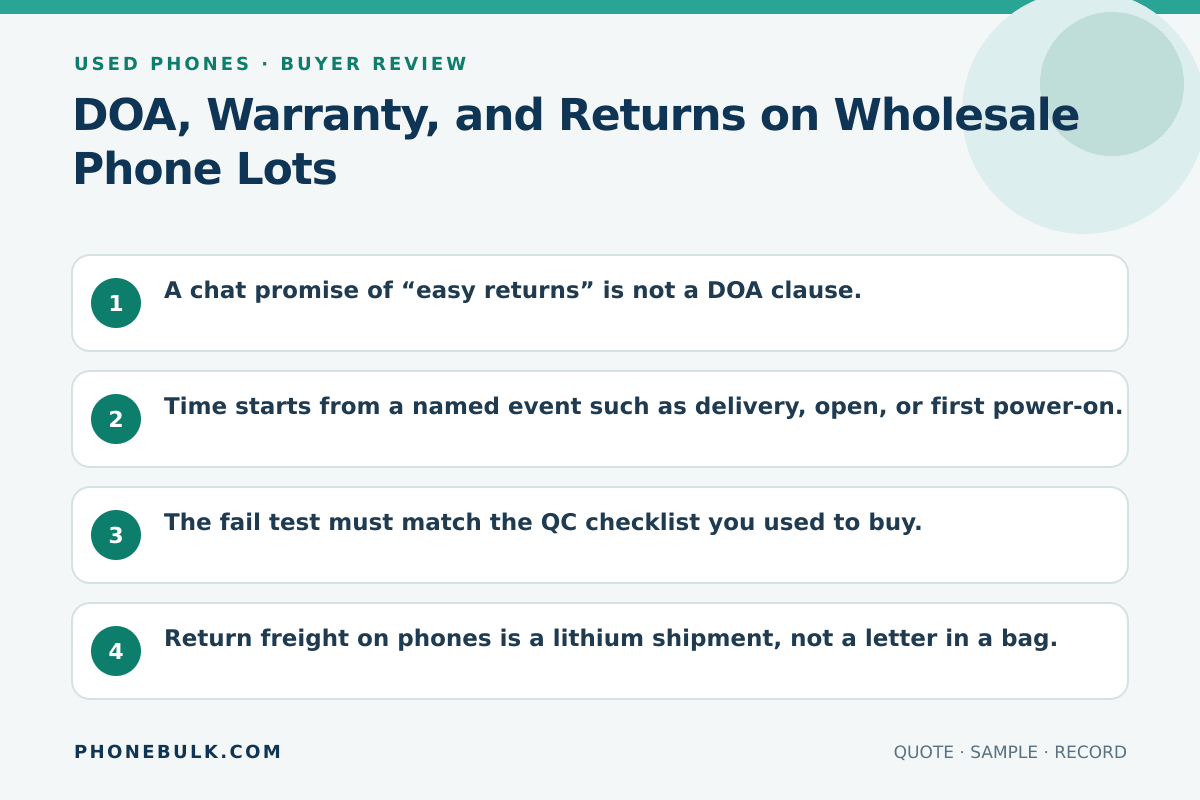
- A chat promise of “easy returns” is not a DOA clause.
- Time starts from a named event such as delivery, open, or first power-on.
- The fail test must match the QC checklist you used to buy.
- Return freight on phones is a lithium shipment, not a letter in a bag.
- Seller warranty and manufacturer warranty are different documents.
DOA is where a cheap quote becomes an expensive carton. Write it before the phones move.
What the risk means
Dead on arrival should mean: a named unit failed a named test, inside a named window, after a named delivery event, and the seller will credit, replace, or refund under a named process.
It is not:
- A consumer cooling-off right
- Proof the lot was refurbished
- The same thing as Apple Certified Refurbished, which Apple describes as its own process and limited warranty
- Automatic under the Incoterm you used to ship the first leg
The U.S. International Trade Administration notes that Incoterms describe obligations for delivery, risk, and cost on the contracted movement. They do not replace a claims clause.
Why bulk buyers should care
Phones fail in the first week more often than in the brochure. If the return window is “tell us soon” and the freight is on you, you will eat locked, dead, and wrong-version units.
Return cargo with lithium-ion cells is still a dangerous-goods movement. IATA publishes lithium battery transport rules, including UN 3481 for equipment packed with or contained in equipment. A WhatsApp “send them back” is not a shipping plan.
Accept / Clarify / Reject
| Term | Accept | Clarify | Reject |
|---|---|---|---|
| Window | Hours or days from delivery, written | “Reasonable time” | No window |
| Test | Same QC list as the buy | “Doesn’t work” | Seller’s secret retest only |
| Remedy | Credit, replace, or refund named | “We will see” | No remedy |
| Freight | Who books and who pays | “Share later” | Buyer pays all, including seller error |
| Cap | % or unit count written | Silent cap after arrival | Hidden 0% after you paid |
How to write the clause
- Name the start event: carrier delivery scan, warehouse open, or first power-on.
- Name the tests that count as DOA. Point at your bulk QC checklist. Locks and IMEI flags belong here if they were Accept conditions.
- Name photos and IMEI evidence you will send.
- Name the remedy and the cap.
- Name who arranges the lithium return and under which packing instruction.
Seller warranty versus manufacturer warranty
A 30-day seller warranty is a commercial promise from the person you paid. A manufacturer warranty is a brand program that may be void outside a region, after a lock, or after a third-party part. Do not assume one covers the other.
Refurbished lots need both the process and the warranty. See refurbished phones.
Common supplier wording
- “Easy DOA, we are partners”
- “No returns on Grade C”
- “Warranty starts when we ship, not when you receive”
Related checks
Frequently asked questions
Is 3% DOA a standard?
No. Percentages are negotiated. A low DOA with a narrow test is not kinder than a higher DOA with a clear test. Write both.
Does Incoterms decide who pays a DOA return?
Incoterms 2020 allocate cost and risk for the original movement of goods. They do not automatically write your after-arrival claim. Put the return party in the order.
Sources and methodology
- Incoterms 2020 — International Chamber of Commerce Accessed August 22, 2026.
- Know Your Incoterms — U.S. International Trade Administration Accessed August 22, 2026.
- Lithium battery guidance — IATA Accessed August 22, 2026.
- Why Refurbished — Apple Accessed August 22, 2026.
Update history
- — First published. Official sources on this page were accessed on this date unless a later note says otherwise.
Factual corrections after publication are listed on the corrections page. There is no separate reviewer identity on this desk. See the editorial policy.

About the author
Frank Dean
Frank Dean researches manufacturer, standards, and trade documents for PhoneBulk, then turns them into accept / clarify / reject buying guidance for resellers.
- Source-backed wholesale research
- Claim-level fact review
- Separation of official rule and trade practice