An unrecorded exchange-rate shift between supplier quote and final wire settlement can erase a wholesale phone lot’s resale margin. Before approving a foreign-currency purchase order, record each payment leg by currency, amount, and release trigger, test how explicit exchange-rate scenarios change landed cost per phone on the same fixed lot quantity, and confirm your bank’s settlement, extension, and cancellation terms in writing.
Foreign exchange risk in phone importing is the cost variance created when exchange rates move between the date a purchase quote is agreed and the dates deposit, balance, freight, or customs obligations are settled. The U.S. International Trade Administration notes that forward contracts typically lock in a pre-agreed exchange rate for delivery 3 days to 1 year in the future, removing rate uncertainty for a committed cash flow without guaranteeing a profit if spot rates move favorably. This guide provides a commitment-to-settlement exposure register, a fixed-quantity landed-cost sensitivity worksheet, and a bank question checklist.
Our landed-cost calculator and reseller profit margin guide calculate total lot cost and contribution margin after you enter amounts in a single currency. Use this page before freezing those single-currency numbers whenever a supplier quote, freight bill, or customs declaration involves another currency or a gap between quote approval and final settlement.
Why does foreign exchange risk hit a phone lot between quote and final wire?
Foreign exchange transaction exposure arises whenever a committed purchase is priced or settled in a foreign currency across separated dates. In wholesale handset sourcing, a single lot rarely settles at the moment a quote is compared:
- Quote comparison and sample check: A supplier quotes a batch in EUR, GBP, HKD, JPY, or CNY while the buyer evaluates sample provenance or lot manifests.
- Deposit transfer: The buyer wires an initial deposit on order signing.
- Inspection and balance release: The remaining balance waits until pre-shipment grading and functional verification pass under the bulk-phone QC checklist.
- Export, customs entry, and freight settlement: Carrier charges and import duties settle on their own billing schedules.
The U.S. International Trade Administration’s Foreign Exchange Risk guide explains how currency movements between deal conclusion and payment alter cash outcomes. Because ITA writes for U.S. exporters receiving foreign currency, its example shows a €500,000 receivable dropping from $0.85 to $0.84 per euro, reducing the exporter’s U.S. dollar proceeds from $425,000 to $420,000 (a $5,000 loss).
Importer arithmetic adaptation (explicitly adapted from ITA’s exporter mechanics, not an attributed ITA importer strategy): When you are the importer paying a fixed foreign-currency invoice, the exposure runs in the opposite direction. If the foreign settlement currency strengthens against your home currency between quote approval and settlement—meaning each unit of foreign currency costs more U.S. dollars at wire time—your home-currency cash outflow for the exact same phone lot increases. If the foreign currency weakens against the U.S. dollar, an unhedged spot wire costs fewer U.S. dollars, whereas a pre-locked fixed forward contract still obligates you to settle at the contracted rate.
Quoting and paying in U.S. dollars shifts the direct conversion step onto the foreign seller, as Trade.gov notes. However, trade-finance research summarized by Duke University’s FinReg Blog and supply-chain payment analyses from TransferMate point out that suppliers paying their own local acquisition or refurbishment costs in another currency still face exchange revaluation. When you ask a foreign wholesaler for a USD quote as well as a local-currency quote, record both numbers on the quote comparison sheet so you can see how much conversion cushion the seller built into the USD price.
How do you register foreign-currency commitments across a phone order?
List every non-domestic currency obligation tied to the lot before sending the deposit. City National Bank’s FX risk guide identifies a structured inventory of transaction exposures—by currency, timing, and amount—as the first step before choosing a payment or hedging tool.
Download the phone import FX exposure and sensitivity worksheet (CSV) or copy the exposure register below into your purchasing file.
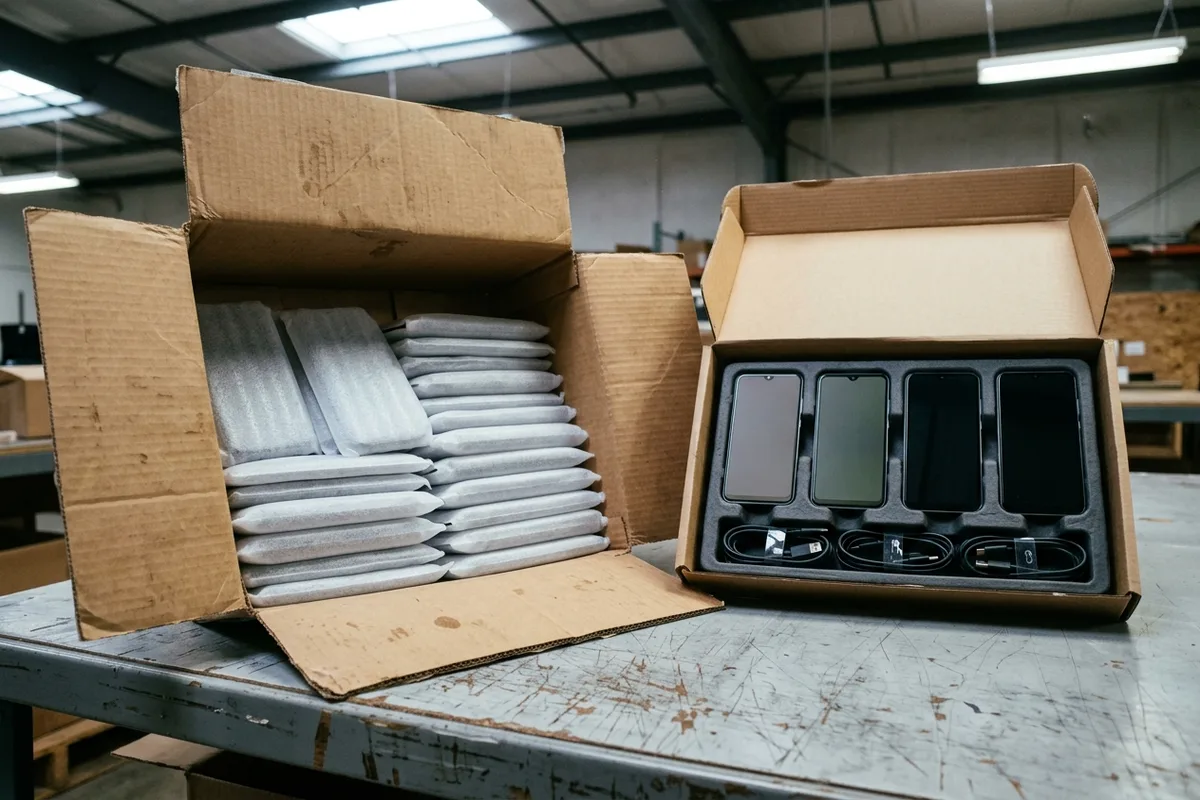
Keep the commercial payment lines separate from the U.S. customs entry line. Under the April 1, 2025 edition of 19 CFR Part 159 Subpart C, U.S. Customs and Border Protection (CBP) converts foreign currency for customs valuation using only a proclaimed rate or a rate certified by the Federal Reserve Bank of New York (19 CFR 159.31), fixed on the date of exportation (19 CFR 159.32 and 19 CFR 152.1(c)). For countries listed in 19 CFR 159.34(a)—which include China, Hong Kong, Japan, the United Kingdom, and Eurozone states—CBP applies the certified quarterly rate unless the certified daily rate on the date of exportation varies by 5 percent or more from the quarterly rate (19 CFR 159.34(b)(2)). Locking a forward contract with your bank fixes the U.S. dollars required to wire the supplier’s euro or pound invoice, but your customs broker still converts foreign-currency invoice values under 19 CFR Part 159 when filing the entry described in the used-phone HS code and tariff guide.
How do exchange rate scenarios change landed cost per phone on a fixed lot?
Test exchange-rate sensitivity on a fixed quantity basis before committing to the order. Hold the lot’s purchased unit count, expected sellable unit count, and domestic-currency logistics lines constant, then calculate total landed cost and per-unit cost across explicit exchange-rate scenarios.
Hypothetical sensitivity example (explicitly assumed inputs, not live rates or a forecast)
Suppose a U.S. importer evaluates a lot of 200 used smartphones quoted by a European supplier at €300 per unit (€60,000 total goods) on FCA seller’s facility terms:
- Fixed quantity basis: 200 units bought; the buyer budgets an assumed 2% unsellable / DOA reserve (4 units), leaving 196 expected sellable units.
- Payment split: 30% deposit (€18,000) paid at order signing; 70% balance (€42,000) due 45 days later after pre-shipment inspection passes.
- Deposit settlement (already executed at signing): Assume the €18,000 deposit settled at an assumed spot rate of $1.0800 per EUR with $0 wire fee = $19,440.00.
- Non-goods landed lines (billed in USD): Assume freight, cargo insurance, destination handling, and pre-shipment inspection total $1,400.00 (and assume $0 ad valorem customs duty for this smartphone classification example; verify actual tariff treatment per shipment).
- Remaining currency exposure: €42,000.00 balance due in 45 days.
The table below calculates how four explicitly assumed settlement scenarios on the €42,000 balance affect the same 200-phone lot:
What this sensitivity check proves:
- Unhedged rate movement hits per-sellable-unit cost harder than per-carton cost. Under Scenario B, a 5% strengthening of the invoice currency on the 70% balance alone adds $2,268.00 to the lot, raising the cost per sellable handset from $337.76 to $349.33 (+$11.57 per sellable phone). Enter that stressed landed total into the bulk-phone profit calculator to see whether your expected resale price and channel fee still leave positive contribution.
- A forward hedge fixes cost certainty; it does not guarantee savings over spot. In Scenario D, locking the €42,000 balance at an assumed forward rate of $1.0830 plus a $50 fee fixes the landed cost at $66,376.00 ($338.65 per sellable unit). If the euro strengthens to $1.1340 (Scenario B), the forward prevents $2,092.00 of extra cost. If the euro weakens to $1.0260 (Scenario C), the importer is still bound to settle the forward at $1.0830, paying $2,444.00 more than an unhedged spot buyer would have paid on that date.
How do spot settlement, forward contracts, currency accounts, and options compare?
Choose the settlement mechanism that matches how certain your phone lot’s payment amount and release date actually are. Trade.gov, City National Bank, Duke FinReg Blog, and TransferMate describe five approaches used in cross-border trade:
In empirical surveys of small and medium-sized importers reviewed by Duke’s FinReg Blog, firms most frequently hedge short-term committed trade payables rather than speculative long-term forecasts, and many hedge partially rather than locking 100% of an uncertain order. For a wholesale phone buyer, that means separating confirmed, post-sample payables from tentative allocations that could still shrink during grading or SKU reconciliation.
What should you ask your bank or payment provider before locking an exchange rate?
Trade.gov advises consulting an international banker before negotiating a foreign-currency contract, and City National Bank’s FX disclosure notes that the business remains responsible for confirming pricing, fees, settlement requirements, maturity dates, early termination provisions, and collateral or margin obligations before entering a transaction.
Because a phone lot can be delayed in pre-shipment inspection, reduced in quantity under a mixed-SKU or MOQ revision, or held in a customs clearance delay, ask your bank or payment platform to answer the following questions in writing before booking any forward or hedging contract. Keep unconfirmed items marked Unknown in your transaction file:
Do not book a binding forward contract on the balance of a phone lot until supplier identity and bank payee verification are complete and you know how an inspection rejection or quantity reduction would be handled under both the purchase contract and the bank agreement.
Method and sources
Updated October 2026. This guide synthesizes foreign-exchange risk definitions and forward-contract tenor guidance from the U.S. International Trade Administration, customs currency-conversion rules from the April 1, 2025 edition of 19 CFR Part 159 Subpart C, transaction-exposure and contract-term disclosures from City National Bank of Florida, SME trade-payable hedging research from The FinReg Blog at Duke University, and supply-chain FX pass-through considerations from TransferMate.
All numbers in the sensitivity table and CSV template are explicitly hypothetical scenario inputs on a fixed 200-unit example lot; they are not live exchange rates, market forecasts, or measured lot outcomes. PhoneBulk does not provide banking, derivative, accounting, or legal advice. Complete the exposure register with your actual supplier quotes and obtain written contract terms from your bank before locking an exchange rate.
Sources and methodology
- Foreign Exchange Risk — U.S. International Trade Administration Accessed October 17, 2026.
- 19 CFR Part 159 Subpart C — Conversion of Foreign Currency (April 1, 2025 edition) — U.S. Government Publishing Office Accessed October 17, 2026.
- A Practical Guide to Managing Currency Risk with FX Payments and Hedging Tools — City National Bank of Florida Accessed October 17, 2026.
- Hedging of currency exposures: Lessons for SME exporters and importers — The FinReg Blog (Duke Financial Economics Center) Accessed October 17, 2026.
- Eliminating FX risk in global supply chains — TransferMate Accessed October 17, 2026.
Update history
- — First published. Official sources on this page were accessed on this date unless a later note says otherwise.
Factual corrections after publication are listed on the corrections page. Editorial responsibilities and review methods are described in the editorial policy.