
Key takeaways
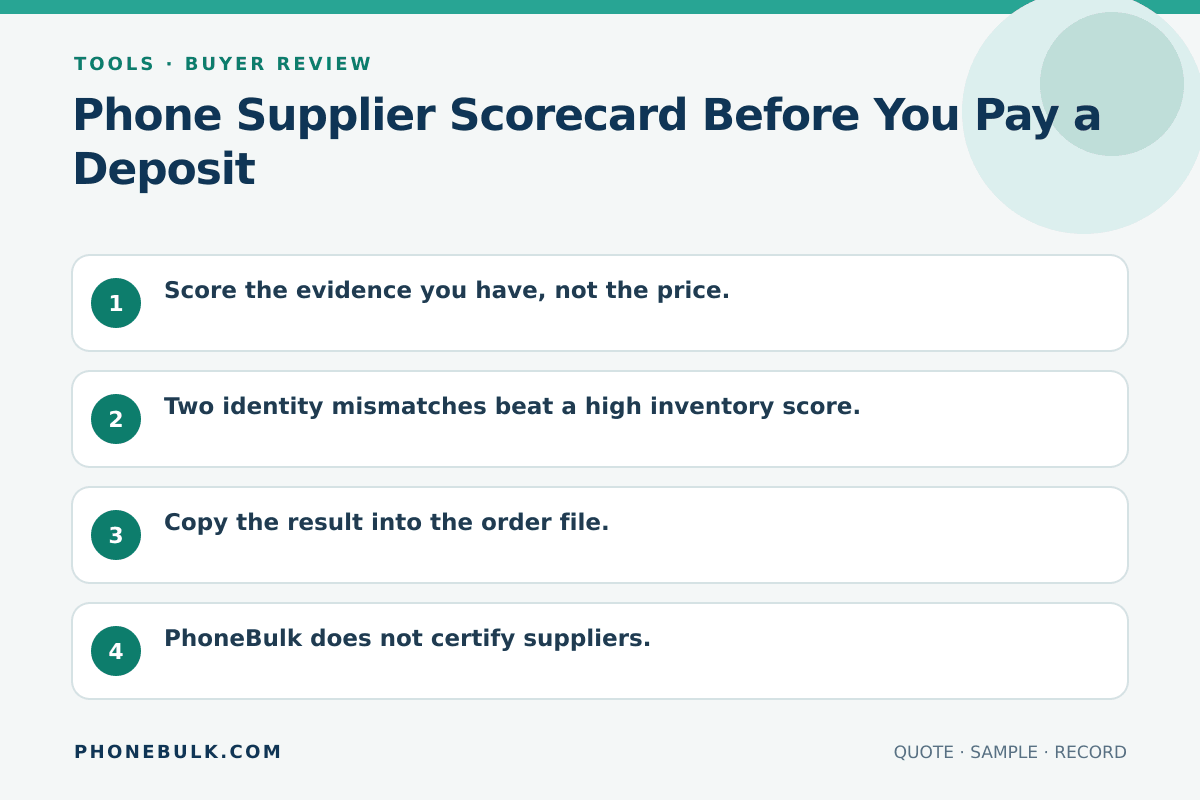
- Score the evidence you have, not the price.
- Two identity mismatches beat a high inventory score.
- Copy the result into the order file.
- PhoneBulk does not certify suppliers.
The tool
Use the scorecard above after you read verification and red flags.
Score one legal counterparty and one proposed order at a time. If the invoice name, account name, or stock source changes, start a new sheet. Carrying a good score from one company or lot into another hides the exact mismatch the scorecard is meant to expose.
Gather the evidence first
The scorecard is not a questionnaire for the salesperson to complete on your behalf. Collect the company document, proforma invoice, payee details, packing-list sample, inspection terms, and DOA clause. Then score what those records show.
A missing record is not a middle score by default. Use 1 when the supplier refuses the evidence or gives a conflicting answer. Use the middle of the scale when the answer exists but still needs a specific check. Keep a note beside every score so another person can see why you chose it.
How to score
| Row | 1 | 5 |
|---|---|---|
| Inventory | Price and a photo | SKU, version, state, counts |
| Identity | Chat handle only | Legal name = invoice = account |
| Payment | Full prepay today | Triggers and a matching payee |
| QC | Sealed boxes only | Sample you choose, written grade |
| After-sales | “We will see” | DOA window and lithium return |
Unlock or IMEI-change promises are not a 5 on after-sales. They are a red flag.
Example
A seller sends a complete RFQ, matching bank papers, and allows two sample IMEIs you pick, but has no DOA freight clause. Inventory, identity, and QC can sit at 4. After-sales stays at 2 until that clause exists.
The total does not erase a weak row. A supplier can have detailed inventory and still fail identity. Do not let four strong categories average away a payee mismatch, refusal to inspect, or an unlock promise. Those points belong on the red-flags page before they belong in arithmetic.
Compare suppliers without bending the scale
Use the same evidence standard for every seller. If one supplier earns an inventory score from a packing list, another supplier should not earn the same score from a video. Write the date of the evidence and the lot reference in the notes.
After scoring, return to the RFQ template and fill any commercial gaps. The scorecard covers whether the buying controls exist. It does not normalize unit price, Incoterm, version, grade, or shipping cost. Use the quote comparison guide for that work.
What to do with a low row
Ask one narrow question tied to evidence. For identity, request a corrected invoice or a document that explains the payee relationship. For QC, request a written inspection window and a sample you choose. For after-sales, request the DOA period, threshold, remedy, and freight party in the same clause.
Rescore only after the document changes. A reassuring call does not change a written 2 into a 4.
Risk note
A high score is not a warehouse visit. It is a reminder of which rows you have not earned yet.
Related guides
Frequently asked questions
Does a 25 mean I should pay in full?
No. A perfect score still needs triggers and a sample. It only says the paperwork looks complete.
Can I score a marketplace storefront?
Yes. Treat the storefront as one evidence type. You still need a matching payee and a sample.
Sources and methodology
- Know Your Incoterms — U.S. International Trade Administration Accessed August 22, 2026.
- Activation Lock for iPhone and iPad — Apple Support Accessed August 22, 2026.
Update history
- — First published. Official sources on this page were accessed on this date unless a later note says otherwise.
- — Substantive revision of the buying fields or source notes.
Factual corrections after publication are listed on the corrections page. There is no separate reviewer identity on this desk. See the editorial policy.

About the author
Frank Dean
Frank Dean researches manufacturer, standards, and trade documents for PhoneBulk, then turns them into accept / clarify / reject buying guidance for resellers.
- Source-backed wholesale research
- Claim-level fact review
- Separation of official rule and trade practice