
Key takeaways
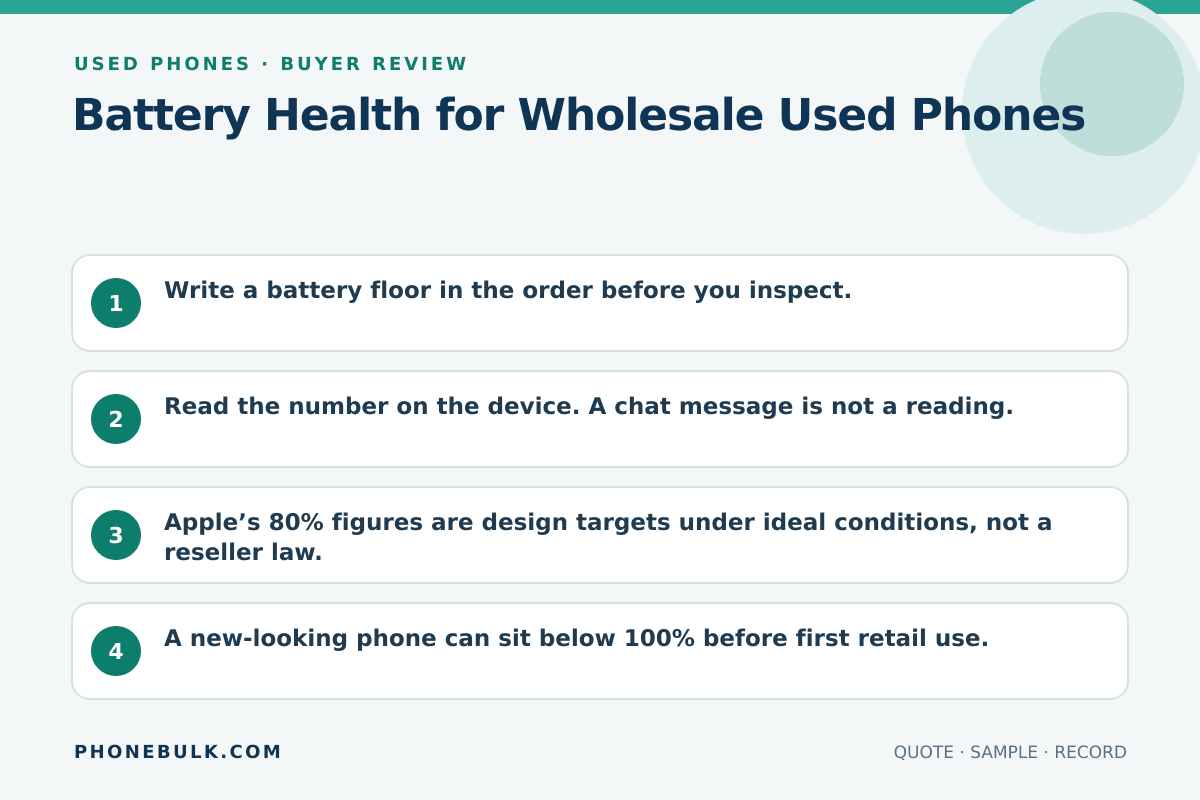
- Write a battery floor in the order before you inspect.
- Read the number on the device. A chat message is not a reading.
- Apple’s 80% figures are design targets under ideal conditions, not a reseller law.
- A new-looking phone can sit below 100% before first retail use.
- Android lots need a named method because OS screens vary.
Battery is a lot-level cost. One carton of low-health units becomes a service queue, not a bargain.
What the risk means
Lithium-ion capacity falls as the cell ages. Apple calls the on-device percentage maximum capacity: remaining capacity relative to when the battery was new. Peak performance can fall as well. Cold weather and a low state of charge can make a chemically aged battery look worse for a while.
Apple also notes that time between manufacture and first activation can show slightly under 100%. That is not automatically a swapped cell.
Why bulk buyers should care
- Retail buyers ask for a number.
- A replaced battery can change parts history.
- Shipping and storage abuse does not show in a cosmetic grade.
Accept / Clarify / Reject
| Evidence | Accept | Clarify | Reject |
|---|---|---|---|
| iPhone reading | Settings path used, at or above your floor | “Good battery” only | Far below floor, undisclosed |
| Cycle count | Shown on supported iPhone 15 and later | Not available on the model | Hidden after you asked |
| Replaced battery | Disclosed, history matches | “New if needed” | Secret swap, Unknown part |
| Android lot | Named app or service menu | Mixed methods | No method at all |
How to test it
iPhone. Settings > Battery > Battery Health, or Battery Health & Charging on older models. On iPhone 15 and later with a current iOS, Apple also exposes cycle count, manufacture date, and first-use date.
Apple’s published design notes, under ideal conditions:
- iPhone 14 and earlier: retain 80% at 500 complete cycles
- iPhone 15 and later: retain 80% at 1,000 complete cycles
A complete cycle is not “one overnight charge.” Apple describes it as using an amount equal to 100% of capacity, which can span more than one charge.
Android. There is no single official screen. Record the brand menu or diagnostic you used. Do not invent an iPhone-style percentage if the device does not show one.
What evidence to request
- Floor in the quote, for example “iPhone 85% or above, read on device”
- Sample readings with IMEI
- Disclosure of replacements
- Rule for units that boot-loop or will not charge
Common supplier wording
- “Original battery” with no reading
- “Like new health”
- “We replace below 80%” with no proof after arrival
Related checks
Frequently asked questions
Is 80% the official wholesale cutoff?
No. Apple describes 80% as a design point after a stated cycle count under ideal conditions, and discusses service when capacity is significantly degraded. Your floor is a commercial choice. Write it.
Does a replaced battery make the phone Grade A?
Not by itself. A replacement can restore capacity and still leave Unknown parts, unfinished calibration, or a mismatched cosmetic grade.
Sources and methodology
- iPhone battery and performance — Apple Support Accessed August 22, 2026.
- About the battery and performance of iPhone 11 and later — Apple Support Accessed August 22, 2026.
- Understand your iPhone battery usage and health — Apple Support Accessed August 22, 2026.
- iPhone Parts and Service History — Apple Support Accessed August 22, 2026.
Update history
- — First published. Official sources on this page were accessed on this date unless a later note says otherwise.
Factual corrections after publication are listed on the corrections page. There is no separate reviewer identity on this desk. See the editorial policy.

About the author
Frank Dean
Frank Dean researches manufacturer, standards, and trade documents for PhoneBulk, then turns them into accept / clarify / reject buying guidance for resellers.
- Source-backed wholesale research
- Claim-level fact review
- Separation of official rule and trade practice