
Key takeaways
- Write the SKU list before you ask for a price.
- Use one RFQ so every quote is comparable.
- Pay against inspection and documents, not against a video of sealed boxes.
- Name the Incoterm and the place.
- Treat phones as lithium-ion cargo.
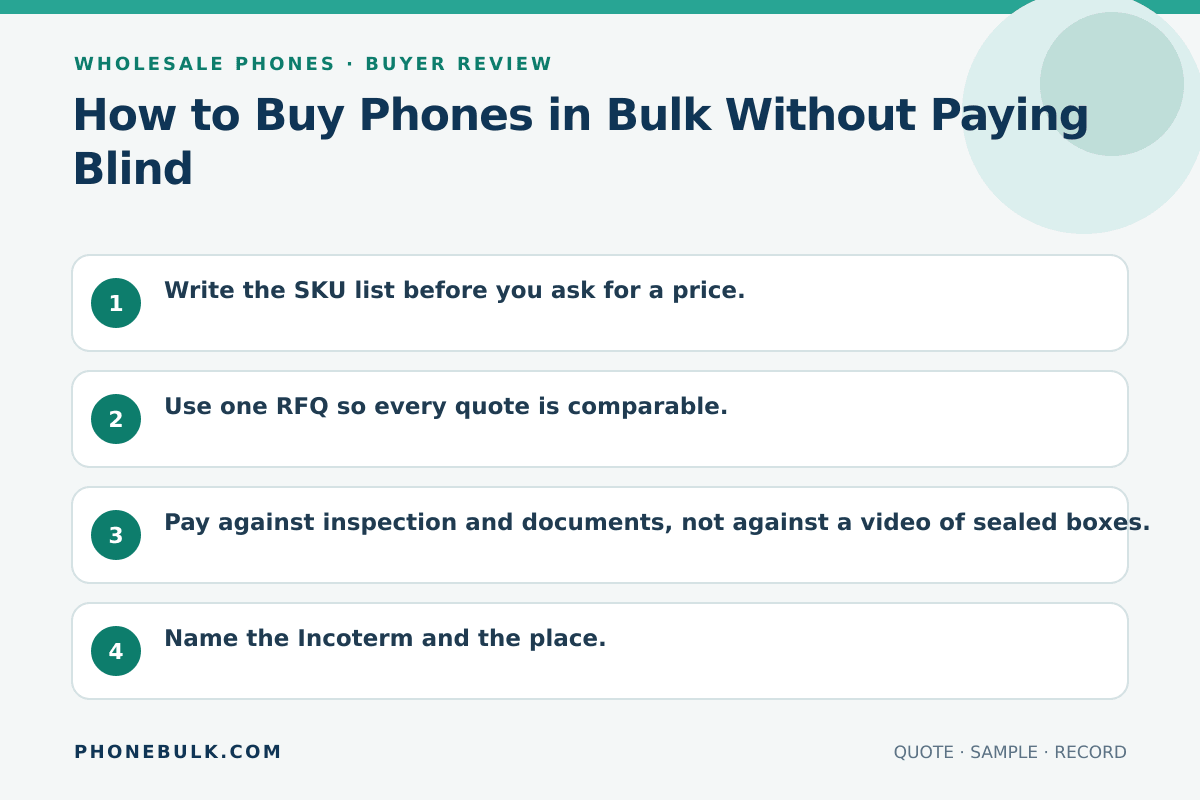
This is the unused-stock buying sequence. For used lots, add the QC checklist at the sample step.
Keep the steps in one order file. The SKU list, supplier identity, quote, sample result, payment approval, packing list, and shipping record should describe the same lot. If one of them changes, pause and update the documents before money moves.
Step-by-step
- Write the sell-through. Channel, destination bands, and whether customers need Google apps or a specific iPhone region.
- Freeze the SKU list. Model, storage, color, quantity. No “latest mix.”
- Freeze version and lock. Firmware family, model code, unlocked or named carrier.
- Send one RFQ. Use the RFQ template.
- Verify the supplier. Use the supplier checklist and verification guide.
- Compare quotes on matched fields. See the wholesale hub.
- Inspect a sample. Same tests you will run on the lot.
- Release payment on triggers. Deposit against identity and proforma. Balance against packing list, inspection, and agreed photos or reports.
- Ship with a named cargo plan. Phones are UN 3481 when batteries stay in the devices. Ask who is shipper of record.
What each checkpoint should produce
The SKU stage should end with a line-by-line request, not a message asking for a broad model family. The quote stage should end with comparable fields for price, currency, version, inventory state, inspection, DOA, Incoterm, and place. The verification stage should connect the company, invoice, and payee.
The sample stage should produce a saved result using the same acceptance rules planned for the shipment. A supplier-selected showroom unit may demonstrate a feature, but it does not test whether the quoted lot follows the same condition. Record the model code and version on the sample sheet.
Before the balance, compare the final packing list with the accepted RFQ. Use the mixed-SKU guide if extra models or colors appear. Do not treat an unwanted substitution as a free upgrade until you know the version and your sales channel can use it.
Questions to ask the supplier
- Can you fill every RFQ field, or only unit price?
- Where can we inspect, and who opens the carton?
- What happens if the sample fails?
- What is the DOA rate, window, and freight party?
- Who classifies the lithium shipment?
Ask the questions in writing and keep the replies. If an answer changes on a call, request the corrected version in the order document. This is especially important for the payee, inspection right, DOA remedy, and shipping responsibility.
Common mistakes
- Asking for “best price for 500 phones” with no model list.
- Paying the balance because the supplier is in a hurry for a weekend flight.
- Using CIF language on an air lot.
- Inspecting only the top layer of a carton.
Another common mistake is comparing prices before the offers match. An EXW quote and a delivered quote carry different tasks and costs. Recast both with the landed-cost calculator after the SKU and version fields are complete.
When to stop the order
Stop when identity names do not connect, the supplier refuses a sample or packing list, the required version cannot be confirmed, or the balance trigger arrives before the agreed evidence. The red-flags guide separates missing detail from a first-order hard stop.
Stopping is also reasonable when your own inspection capacity is smaller than the lot. Lower the quantity or narrow the mix. A larger order does not repair a process that cannot finish the sample.
Related guides
Frequently asked questions
How many units is a bulk order?
Bulk means a lot you will inspect as a lot. That can be 20 units or 2,000. The process does not change because the carton count changed.
Should I start with a mixed-SKU trial?
Only if the mix is written. An unlisted mix is how leftover models appear.
Sources and methodology
- Incoterms 2020 — International Chamber of Commerce Accessed August 22, 2026.
- IATA Lithium Battery Guidance — International Air Transport Association Accessed August 22, 2026.
Update history
- — First published. Official sources on this page were accessed on this date unless a later note says otherwise.
- — Substantive revision of the buying fields or source notes.
Factual corrections after publication are listed on the corrections page. There is no separate reviewer identity on this desk. See the editorial policy.

About the author
Frank Dean
Frank Dean researches manufacturer, standards, and trade documents for PhoneBulk, then turns them into accept / clarify / reject buying guidance for resellers.
- Source-backed wholesale research
- Claim-level fact review
- Separation of official rule and trade practice