
Buying a wholesale lot of “Factory Unlocked” smartphones without auditing regional model suffixes and 8-digit IMEI Type Allocation Codes (TACs) will cost a reseller margin when US prepaid dealers return the shipment as unactivatable. In the post-3G US wireless market, a clean baseband SIM-lock screen (No SIM restrictions on iOS or unlocked NCK state on Android) is only the first of four technical gates required for retail activation across Verizon, AT&T, T-Mobile, and their Mobile Virtual Network Operators (MVNOs).
This procurement reference answers what unlocked phones work with Verizon, which unlocked phones are compatible with AT&T under its post-3G model-suffix whitelist, and which unlocked phones for T-Mobile carry the mandatory 600 MHz Band 71 / n71 hardware needed to prevent suburban and indoor RMA returns. Use it alongside our phone-sourcing hub and wholesale phones purchasing controls before approving any domestic or cross-border purchase order.
1. Why “Factory Unlocked” (SIM-Free) Does Not Guarantee US Carrier Activation
When overseas trading desks in Dubai Deira, Hong Kong, or Miami pitch wholesale unlocked phones at $18 to $35 below domestic US spot prices, they almost always equate “Factory Unlocked” with universal US carrier compatibility. In practice, baseband carrier lock checks test only whether the cellular modem demands a Network Control Key (NCK) when a foreign SIM card is inserted.
Since Verizon, AT&T, and T-Mobile shut down their legacy 3G CDMA and UMTS voice networks in 2022, every handset sold into US prepaid or MVNO channels must pass four sequential hardware and database layers:
- Gate 1: SIM unlock and financial clearance. Check the device’s lock status and original carrier account or financing evidence separately from the bulk IMEI blacklist check. For iPhone, Apple documents the Carrier Lock field. Under Verizon’s device unlocking policy, current postpaid unlocking depends on full purchase/payment and prepaid unlocking on 365 days of paid, active service, with exceptions and payment holds. Verify historical inventory against the rule in force for its purchase or activation date. Other carriers and MVNO brands have their own policies; a host network’s rule does not automatically apply to them.
- Gate 2 — 8-Digit GSMA Type Allocation Code (
TAC) Database Admission: Under the GSMA TAC allocation standard, the first 8 digits of every 15-digit IMEI (IMEI[0:8]) permanently identify the exact OEM hardware revision and regional radio build. When a storefront dealer enters an IMEI into an activation portal—or when the phone transmits a3GPP Attach Requestto a cell tower—Verizon’s Device Management Database (DMD) and AT&T’s Equipment Identity Register (EIR) check those 8 digits against their internal certified-device tables. - Gate 3 — Carrier
IMS VoLTE(GSMA IR.92) &E911Entitlement Profiles: Because US voice calls and emergency 911 phase-location routing run exclusively over packet-switched IP Multimedia Subsystem (IMS) VoLTE and 5G VoNR, the handset’s firmware must contain the specific cryptographic entitlement certs, APN tables, and Country Specific Code (CSC) profiles expected by the host MNO. - Gate 4 — North American Low-Band RF Duplexers (
600 MHz&700 MHz): US nationwide rural and indoor coverage depends on FCC-auctioned low-band blocks—specifically VerizonLTE Band 13(700 MHz Upper C), AT&TLTE Band 12/17(700 MHz Lower) andBand 14(700 MHz FirstNet), and T-MobileBand 71 / n71(600 MHz). Non-North American motherboards omit the physical Surface Acoustic Wave (SAW) and Bulk Acoustic Wave (BAW) RF filters and antenna tuners for these bands to save $1.80 to $3.50 in factory Bill of Materials (BOM) cost.
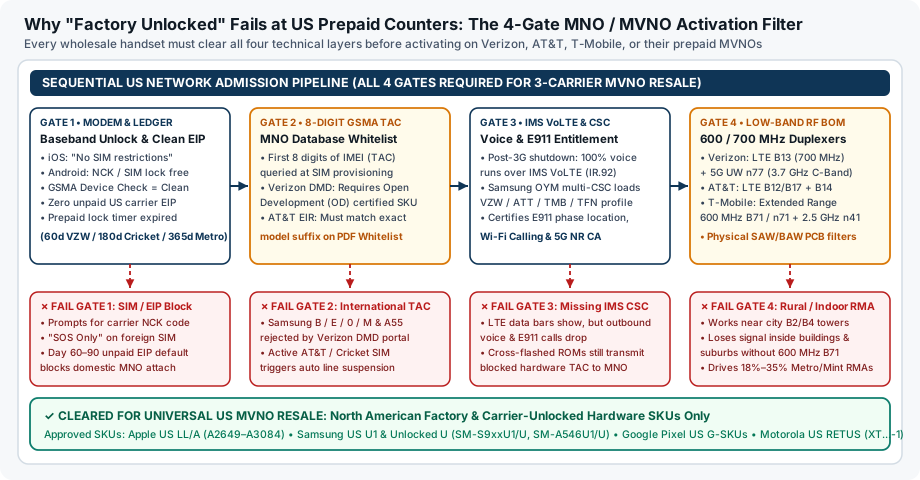
Takeaway: Never purchase a wholesale phone lot based solely on "Factory Unlocked" invoice wording; verify that every unit’s 8-digit IMEI TAC, firmware CSC, and low-band RF hardware clear all four US MNO activation gates.
2. What Unlocked Phones Work with Verizon & Verizon MVNOs (Visible, Total Wireless, US Mobile Warp, Spectrum/Xfinity)
For B2B buyers and prepaid storefront operators asking what unlocked phones work with Verizon, the decisive gatekeeper is Verizon’s Device Management Database (DMD). Every MVNO and cable wireless provider riding on Verizon’s radio access network—including Visible, Total Wireless, Straight Talk (Verizon SIM), TracFone, Page Plus, US Mobile (Warp 5G), Spectrum Mobile, and Xfinity Mobile—queries the exact same underlying Verizon DMD API during Verizon BYOD IMEI verification.
How Verizon’s DMD & Open Development (OD) Certification Filter Works
Verizon’s primary nationwide low-band coverage layer runs on LTE Band 13 (700 MHz Upper C Block: 746–757 MHz downlink / 776–787 MHz uplink), paired with mid-band LTE Bands 2 (1900 MHz PCS), 4/66 (AWS 1700/2100 MHz), 5 (850 MHz), and 5G Ultra Wideband on n77 (3.7 GHz C-Band) and n260/n261 (mmWave), as detailed in Verizon’s official BYOD network requirements.
While the Federal Communications Commission’s Upper 700 MHz C Block open-access rule in 47 CFR § 27.16(b) prohibits licensees from locking or blocking compliant devices solely to restrict competition, 47 CFR § 27.16(c) explicitly authorizes the licensee to require that connecting devices meet published technical and network interoperability standards. Verizon enforces that provision through its Open Development (OD) certification program:
- Before any unlocked phone model can activate on Verizon or a Verizon MVNO, the manufacturer must submit that exact regional hardware variant to Verizon’s Open Development labs to certify
Band 13spurious-emission masks (protecting adjacent public-safety channels),CDMA-lessIMS VoLTE provisioning, E911 location compliance, andn775G carrier aggregation. - Once certified, the OEM delivers the exact 8-digit GSMA TAC ranges for that North American SKU to Verizon, which loads them into the DMD whitelist.
- OEMs never pay to certify European (
B), Latin American (E/M), or Asian (0/N) regional variants through Verizon Open Development. Consequently, when a dealer enters the IMEI of a factory-unlockedSM-S928BorSM-A546Einto Verizon, Visible, Total Wireless, or Spectrum Mobile, the portal immediately returns “This device is not compatible with the Verizon network” and blocks eSIM download or new physical SIM activation.
The “Active Physical SIM Swap” Trap on Verizon MVNOs
Retail resellers occasionally attempt to bypass Verizon’s DMD check by activating a physical nano-SIM inside a DMD-approved iPhone or Samsung U1 handset and then hot-swapping that live SIM into an uncertified international phone. For a wholesale distributor, relying on physical SIM swaps is a critical operational failure:
- Zero eSIM Activation: Every US iPhone 14, 15, and 16 (
LL/A) and an increasing share of Visible, US Mobile, Spectrum, and Xfinity activations rely on eSIM provisioning, which requires the target handset’sIMEIandEIDto pass Verizon DMD validation in real time. - Broken
CDMA-Less& SMS Entitlement: When Verizon’s network detects an unknown non-DMD TAC on an active line, the subscriber profile often fails to provision theCDMA-lessfeature flag, causing inbound SMS text messages to vanish or dropping voice calls whenever the handset hands off betweenn77C-Band andBand 13LTE. - Strict IMEI-to-ICCID Tethering on TracFone / Total Wireless: Verizon Value brands (
Total Wireless,Straight Talk,TracFone) bind the active SIM card (ICCID) directly to the registeredIMEIin their billing system; swapping the SIM into a non-DMD IMEI triggers service mismatches or blocks line renewal.
US Model Families to Check Against the Destination MVNO’s BYOD Tool
- Apple iPhone (
LL/AUS Hardware Variants):- iPhone 16 / 16 Plus / 16 Pro / 16 Pro Max:
A3081,A3082,A3083,A3084 - iPhone 15 / 15 Plus / 15 Pro / 15 Pro Max:
A2846,A2847,A2848,A2849 - iPhone 14 / 14 Plus / 14 Pro / 14 Pro Max:
A2649,A2632,A2650,A2651 - iPhone 13 / 13 mini / 13 Pro / 13 Pro Max & SE (3rd Gen):
A2482,A2481,A2483,A2484,A2595 - Models to Reject for Verizon: Mainland China, Hong Kong, and Macao dual-physical-SIM models (
CH/AandZP/A, such asA2884,A2896,A3092,A3104) documented in Apple’s regional cellular band matrix. These units lack eSIM hardware, omitBand 71andmmWave, and carry TAC ranges excluded from Verizon DMD.
- iPhone 16 / 16 Plus / 16 Pro / 16 Pro Max:
- Samsung Galaxy (
U1Factory Unlocked & SIM-UnlockedUCarrier Models):- Galaxy S-Series & Z-Series Flagships:
SM-S921U1/U,SM-S926U1/U,SM-S928U1/U(S24 series);SM-S911U1/U,SM-S916U1/U,SM-S918U1/U(S23 series);SM-S901U1/U,SM-S906U1/U,SM-S908U1/U(S22 series);SM-F956U1/U,SM-F741U1/U(Z Fold6 / Flip6). - Galaxy A-Series Prepaid Core Stock:
SM-A546U1/U(A54 5G),SM-A356U1/U(A35 5G),SM-A256U1/U(A25 5G),SM-A156U1/U(A15 5G),SM-A146U1/U(A14 5G). - Models to Reject for Verizon: All
B,B/DS,E,E/DS,M,0, andNsuffixes, plus the Samsung Galaxy A55 5G (SM-A556E/SM-A556B)—which Samsung never launched in the United States and which has zero TAC registration in Verizon DMD.
- Galaxy S-Series & Z-Series Flagships:
- Google Pixel (
G-Series US/North American SKUs):- US factory-unlocked and Verizon-unlocked SKUs including Pixel 9 series (
G2YBB,GEC77,GR83Y,GGX8B), Pixel 8 / 8 Pro / 8a (GKWS6,G9BQD,G1MNW,GKV4X), and Pixel 7 / 7 Pro / 7a (GVU6C,GQML3,GE2AE,GFE4J,GWKK3). Reject Japanese (G0DZQ/G82U8FELICA variants where TACs differ) unless batch-verified against DMD.
- US factory-unlocked and Verizon-unlocked SKUs including Pixel 9 series (
- Motorola (
RETUSUS Retail Unlocked-1Variants):- North American retail unlocked models carrying the
RETUSsoftware channel and-1suffix—such as Moto G Stylus 5G 2024 (XT2419-1), Moto G Power 5G 2024 (XT2415-1), Moto G 5G 2024 (XT2417-1), and Razr+ 2024 (XT2451-1). Be cautious with carrier-specific prepaid derivatives (such as CricketXT2415-5or Dish/Boost variants), which often omit Verizon DMD registration even after SIM unlocking.
- North American retail unlocked models carrying the
Takeaway: For Verizon and its MVNOs (Visible, Total Wireless, US Mobile Warp, Spectrum/Xfinity), restrict wholesale purchasing strictly to US LL/A iPhones, Samsung U1/U models, US G-series Pixels, and RETUS -1 Motorolas whose 8-digit TACs clear Verizon’s DMD portal.
3. Unlocked Phones Compatible with AT&T & Cricket: The Post-3G Model-Suffix Whitelist
While Verizon blocks uncertified phones at the initial web-portal activation step, AT&T Postpaid, AT&T Prepaid, Cricket Wireless, Consumer Cellular (AT&T SIM), Boost Mobile (AT&T network SIMs), H2O Wireless, and Red Pocket (GSMA) enforce an even harsher mechanism on the live radio network: automated TAC inspection and immediate line suspension.
How AT&T’s Automated IMS / EIR Line Suspension Works
When AT&T shut down its 3G UMTS/HSPA+ network in February 2022, it transitioned to a closed, model-number-specific VoLTE HD Voice whitelist published in AT&T’s official Service Capabilities for Your Unlocked Device PDF and enforced through the AT&T BYOD compatibility portal.
Here is the exact failure sequence that catches wholesale buyers who supply non-whitelisted Android phones to Cricket or AT&T Prepaid storefronts:
- A store clerk or customer takes an active, working AT&T or Cricket nano-SIM card and inserts it into a brand-new, factory-unlocked Latin American Samsung Galaxy A54 5G (
SM-A546E/DS) or European Galaxy S23 Ultra (SM-S918B/DS). - Because the international phone physically supports AT&T’s mid-band
LTE Bands 2,4/66,5, and12, it initially camps on the tower and shows signal bars. - Within 30 seconds to 15 minutes, AT&T’s Equipment Identity Register (
EIR) and IMS entitlement server read the handset’s hardware-burned 8-digit IMEI TAC during the3GPP AttachandIMS Registrationhandshake. - Detecting that the
EorBsuffix TAC is not on AT&T’s approved VoLTE whitelist, AT&T’s core network transmits a termination SMS (“AT&T Free Msg: Your device is no longer supported because it is not compatible with the upgraded network”), blocks voice/data registration, and places an administrative suspension/hotline lock on the subscriber’s phone number until the customer calls support or visits a store to register a whitelisted IMEI.
Samsung U1 vs. U Firmware & Why Cross-Flashing B / E Phones Fails
To source Samsung wholesale phones for US multi-carrier resale without triggering AT&T line suspensions or Verizon DMD rejections, buyers must understand Samsung’s North American hardware and Country Specific Code (CSC) architecture documented in Samsung Knox E-FOTA firmware specifications:
- US Factory Unlocked (
U1Suffix — e.g.,SM-S928U1,SM-A546U1): Manufactured specifically for open US retail channels. Ships with the North AmericanOYMmulti-CSC package set to unbranded default codeXAA. When a customer inserts a Verizon (VZW), AT&T (ATT), Cricket (AIO), T-Mobile (TMB), or TracFone/Total (TFN) SIM card, the phone automatically loads that carrier’s exact IMS VoLTE profile, Wi-Fi Calling entitlement server, and 5G NR band-combination table without carrier splash screens or bloatware. - US Carrier-Branded Unlocked (
USuffix — e.g.,SM-S928U,SM-A546U): Identical motherboard, Qualcomm Snapdragon modem, RF filters, and FCC ID to theU1model, originally sold through Verizon, AT&T, T-Mobile, or UScellular. Once the carrier SIM lock is permanently removed (No SIM restrictions) and the original Equipment Installment Plan (EIP) is paid in full, modern One UI software (OYMmulti-CSC) dynamically reconfigures the active CSC (VZW↔ATT↔TMB) upon SIM swap. BothU1and unlockedUsuffixes are explicitly listed on AT&T’s PDF whitelist and pre-loaded in Verizon’s DMD. - Why Flashing
U1Firmware Onto a GlobalB,E, or0Unit Never Clears AT&T or Verizon: Overseas refurbishers frequently offer “Converted USU1” Samsung lots where technicians flash modified software or edit thebuild.propstring on a cheaper Latin American (E), Korean (N), or China/HK (0) phone so thatSettings > About phonedisplaysSM-S918U1. As we detail in our global vs. China phone versions verification guide, software flashing cannot alter the 8-digit GSMA TAC burned into the modem’s one-time-programmable (OTP) memory. When that cross-flashed phone connects to an AT&T or Verizon cell site, the baseband radio transmits its original hardware IMEI TAC—resulting in immediate AT&T line suspension and Verizon DMD rejection.
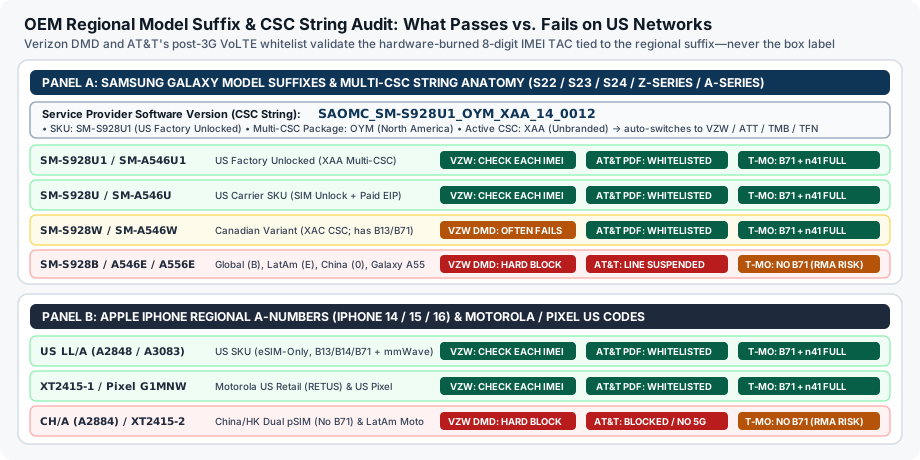
OEM Regional Sub-Model Suffix & Wholesale Procurement Audit Table
Takeaway: Before shipping any Android lot to AT&T or Cricket dealers, cross-check the exact model suffix against AT&T’s official Service Capabilities PDF; only U1, U, and select W Samsung suffixes prevent automated post-attach line suspensions.
4. Unlocked Phones for T-Mobile, Metro & Mint Mobile: The Band 71 / n71 (600 MHz) RMA Trap
Because T-Mobile does not enforce a restrictive model-suffix whitelist like AT&T or an Open Development database block like Verizon, inexperienced importers often treat T-Mobile, Metro by T-Mobile, Mint Mobile, Ultra Mobile, Tello, and US Mobile (Light Speed) as a safe dumping ground for international B, E, M, or global Chinese handsets (Xiaomi, Redmi, POCO, Realme).
In reality, selling non-North American unlocked phones into T-Mobile and Metro prepaid channels triggers one of the highest 14-day customer Return Merchandise Authorization (RMA) rates in the secondary phone trade—driven by missing Extended Range 600 MHz (LTE Band 71 / 5G n71) hardware.
Why International Phones Pass a 2-Minute Urban Counter Test—Then Fail Indoors
As documented in T-Mobile’s official network frequency architecture and evaluated by T-Mobile’s BYOD IMEI compatibility tool, T-Mobile operates a multi-layer spectrum grid:
- Dense Urban Mid-Band Capacity Layer:
LTE Band 2(1900 MHz PCS),LTE Band 4/66(1700/2100 MHz AWS), and Ultra Capacity 5GBand n41(2.5 GHz TDD). Almost every international GSM phone supportsBands 2and4/66alongside standard3GPP IR.92 VoLTE. When a buyer or dealer inserts a T-Mobile or Mint SIM inside an urban storefront located 400 meters from a mid-band macro tower, the phone attaches, shows LTE/5G bars, and completes a test call. - Foundational Indoor & Rural Coverage Layer (
Extended Range 600 MHz Band 71 / n71&700 MHz Band 12): High-frequency mid-band waves (1900–2500 MHz) attenuate rapidly when passing through brick walls, Low-E commercial window glass, grocery store interiors, residential ground floors, and suburban foliage. To maintain indoor building penetration and cover rural highway cells spaced 4 to 10 miles apart, T-Mobile relies on 600 MHz (LTE Band 71and5G Standalone n71:617–652 MHzuplink /663–698 MHzdownlink) and700 MHz Lower A Block(LTE Band 12).
Because the 600 MHz Band 71 band plan was created specifically by FCC Incentive Auction 1002 for North America, virtually zero European (B), Latin American (E/M), or Asian (0/Global ROM) handsets include 600 MHz RF duplexers or antenna tuners. When a retail customer buys an international SM-A546E or Redmi Note 13 Pro at a suburban Metro or Mint storefront and walks into their apartment, workplace, or rural highway commute, the phone drops from mid-band B2/B66 into a complete "No Service" or "Emergency Calls Only" dead zone. Furthermore, Metro by T-Mobile requires strict IMEI-to-ICCID registration in its dealer activation portal—where international IMEIs trigger partial-compatibility alerts and block self-service SIM swaps.
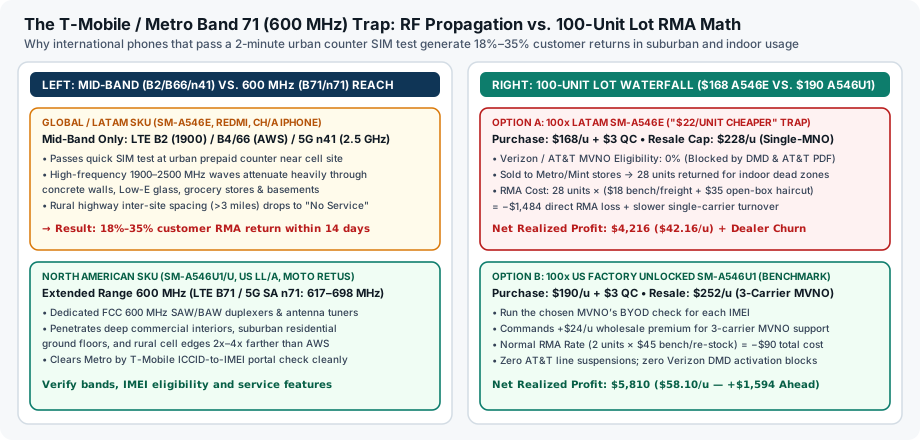
Quantitative Wholesale Margin & RMA Math: International SM-A546E vs. US SM-A546U1
To evaluate whether a cheaper international lot is worth buying for T-Mobile/Metro resale, apply the regional SKU net realized margin formula across your downstream dealer channel’s carrier mix and return costs:
Net_Lot_Profit = N × [ (P_resale − C_acq − C_verify) − (r_RMA × (C_restock + D_openbox)) ]
Where:
N: Total units in the wholesale lot (e.g.,100units).P_resale: Realizable wholesale/dealer resale price per unit (which commands a premium when a phone activates across all 3 US MNOs vs. single-network urban-only stock).C_acq: Landed acquisition cost per unit.C_verify: Per-unit intake diagnostics, NIST sanitization, and batch TAC/IMEI screening cost.r_RMA: 14-to-30-day customer/dealer RMA return rate driven by carrier rejection or indoor/ruralBand 71signal drops.C_restock: Two-way RMA shipping, bench re-testing, and repacking labor per returned phone.D_openbox: Price depreciation when a sealed or Grade A phone is returned opened (Grade A→Grade Bhaircut or non-US export liquidation discount).
Worked 100-Unit Lot Comparison (Conditional Storefront Distribution Example)
Consider a US regional distributor supplying multi-carrier prepaid storefronts under the following operating parameters:
- Option A (
100 ×Latin AmericanSM-A546E/DS): Quoted atC_acq = $168.00/unit($22/unit cheaper than US stock),C_verify = $3.00/unit, single-carrier T-Mobile/Metro dealer resale capP_resale = $228.00/unit. Because the lot has 0% eligibility on Verizon and AT&T and lacks600 MHz Band 71 / n71, suburban Metro/Mint dealers experience anr_RMA = 0.28(28%return rate), withC_restock = $18.00/unitandD_openbox = $35.00/unit:- Initial gross spread per unit before returns:
$228.00 − $168.00 − $3.00 = $57.00/unit($5,700.00on 100 units). - Expected RMA loss per unit:
0.28 × ($18.00 + $35.00) = 0.28 × $53.00 = $14.84/unit($1,484.00on 28 returned units). - Net Realized Lot Profit (Option A):
100 × ($57.00 − $14.84) = $4,216.00($42.16/unit), plus damaged dealer trust from AT&T/Verizon activation failures.
- Initial gross spread per unit before returns:
- Option B (
100 ×US Factory UnlockedSM-A546U1): Quoted atC_acq = $190.00/unit,C_verify = $3.00/unit, 3-carrier universal MVNO resale priceP_resale = $252.00/unit, normal baseline RMA rater_RMA = 0.02(2%), withC_restock + D_openbox = $45.00/unit:- Initial gross spread per unit before returns:
$252.00 − $190.00 − $3.00 = $59.00/unit($5,900.00on 100 units). - Expected RMA loss per unit:
0.02 × $45.00 = $0.90/unit($90.00on 2 returned units). - Net Realized Lot Profit (Option B):
100 × ($59.00 − $0.90) = $5,810.00($58.10/unit—+$1,594.00higher net profit per 100-unit lot than the “$22 cheaper” international SKU).
- Initial gross spread per unit before returns:
Rules of thumb: Never buy an unlocked handset for US T-Mobile, Metro, or Mint resale unless its factory specification sheet explicitly confirms both LTE Band 71 (600 MHz) and 5G NR n71 / n41. Any apparent invoice discount under $35 per unit on a non-Band-71 international phone is erased by two-carrier exclusion and suburban RMA returns.
Takeaway: Passing a quick T-Mobile SIM call test inside an urban warehouse only proves mid-band Band 2/4 voice attachment; require North American Band 71 / n71 (600 MHz) hardware on every lot sold to T-Mobile, Metro, and Mint resellers.
5. Wholesale Pre-Purchase Manifest & Batch IMEI Verification Protocol
To prevent mixed-region cartons, cross-flashed ROMs, and delayed carrier financial blocks from entering your warehouse, enforce a five-step verification protocol on every purchase order. Pair this workflow with our network band compatibility testing record and our ecoATM and carrier trade-in supply chain guide:
- Mandate Exact Regional Sub-Model Codes on the Proforma Invoice: Never sign a purchase order or release an escrow deposit against generic marketing descriptions like
"Samsung S23 Ultra 256GB Factory Unlocked"or"iPhone 15 Pro 128GB Unlocked Grade A". Require the contract to specifySM-S918U1(orSM-S918U),Apple Model A2848 (US LL/A), orMotorola XT2415-1 (RETUS). - Batch-Screen the 8-Digit GSMA TAC Column Before Wiring Funds: Request the full 15-digit IMEI packing list in CSV or Excel format prior to payment. Run a spreadsheet formula (
=LEFT(A2, 8)) to extract the 8-digit GSMA Type Allocation Code for every row. Verify that 100% of the TACs map to the contracted North American model suffix—identifying CanadianW, EuropeanB, or Latin AmericanEvariants mixed into a contracted USUlot. - Audit Both Physical and eSIM IMEIs (
IMEI 1&IMEI 2) PlusEID: Modern USLL/AiPhones andU1/USamsung flagships carry dual SIM profiles (IMEI 1andIMEI 2) plus a 32-digit eSIM identifier (EID). As covered in our bulk IMEI verification guide, a handset whoseIMEI 1is clean can still have an active carrier lease or blacklist flag attached toIMEI 2—or vice versa—which will block Verizon DMD eSIM activation. - Inspect the Samsung
Service Provider Software Version(CSC) String at Dock Intake: On Android sample inspection, navigate toSettings > About phone > Software information > Service provider software version. Confirm that the string matches North American multi-CSC architecture (for example,SAOMC_SM-S928U1_OYM_XAA_14_0012orSAOMC_SM-S928U_OYN_VZW_14_0012), that the bootloader model matches the rear housing laser engraving, and that the Knox Warranty Bit reads0x0. - Check the originating carrier’s current unlock requirements. Record the carrier, purchase/activation date, financing status and confirmed unlock result for each unit. Use Verizon’s device unlocking policy for Verizon stock and the named MVNO’s own policy for branded prepaid stock. Keep this check separate from the destination network’s BYOD eligibility check.
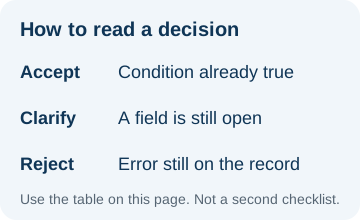
Wholesale Manifest Accept / Clarify / Reject Decision Matrix
Takeaway: Require the exact regional model suffix (LL/A, U1, U, RETUS) on the proforma invoice and run a batch 8-digit TAC lookup across the entire IMEI spreadsheet before releasing any wholesale wire transfer.
Key takeaways
- Baseband SIM unlock ('No SIM restrictions') does not guarantee US activation; Verizon DMD and AT&T's post-3G VoLTE whitelist filter devices by their 8-digit IMEI Type Allocation Code (TAC).
- Verizon and its MVNOs require LTE Band 13 (700 MHz Upper C Block), 5G n77 (C-Band), and Verizon Open Development TAC registration—blocking international Samsung B/E/0 and China/HK iPhones.
- AT&T and Cricket enforce a strict sub-model suffix whitelist ('Service Capabilities' PDF) where SM-S918U1/U passes but international SM-S918B or SM-A546E triggers immediate line suspension.
- T-Mobile and Metro allow most GSM VoLTE TACs to attach in cities, but international SKUs missing 600 MHz Band 71 / n71 suffer indoor/rural dead zones and 18%–35% storefront RMA rates.
- Always audit wholesale manifests by full model suffix, active Samsung CSC string (XAA/VZW/ATT/TMB), and bulk 8-digit TAC lookup before wiring funds.
Frequently asked questions
What unlocked phones work with Verizon and Verizon MVNOs like Visible or Total Wireless?
To activate on Verizon Postpaid, Verizon Prepaid, Visible, Total Wireless, Straight Talk (Verizon SIM), US Mobile Warp 5G, Spectrum Mobile, or Xfinity Mobile, an unlocked phone must have a clean SIM-free baseband, physical LTE Band 13 (700 MHz) and 5G n77 hardware, and an 8-digit IMEI Type Allocation Code (TAC) registered in Verizon's Device Management Database (DMD). Approved hardware families include US Apple iPhones (LL/A regional models such as A2649–A2651, A2846–A2849, and A3081–A3084), North American Samsung Galaxy U1 Factory Unlocked and unlocked U carrier models (such as SM-S928U1/U and SM-A546U1/U), US Google Pixel G-series SKUs, and US Retail Unlocked Motorola RETUS models (ending in -1).
Why does a factory-unlocked international Samsung (B, E, or 0 suffix) get blocked on AT&T and Cricket?
Since decommissioning its 3G UMTS network in February 2022, AT&T enforces a strict model-suffix VoLTE whitelist across AT&T Postpaid, AT&T Prepaid, Cricket Wireless, Boost Mobile (AT&T SIM), H2O Wireless, and Consumer Cellular. AT&T's Equipment Identity Register reads the hardware-burned 8-digit IMEI TAC during network attachment. Because Samsung's international B, B/DS, E, F, M, and 0 suffixes (as well as models never released in the US like the Galaxy A55 SM-A556E) are excluded from AT&T's approved whitelist PDF, inserting an active AT&T or Cricket SIM triggers an automated IMS voice block and immediate subscriber line suspension.
What is the difference between Samsung U1 and U models when buying wholesale unlocked phones?
Both U1 and U suffixes designate North American Samsung Galaxy hardware sharing identical Qualcomm RF front-end filters (including Verizon Band 13, AT&T Band 12/14, and T-Mobile 600 MHz Band 71 / n71) and approved US TAC ranges. A U1 model (such as SM-S928U1) is sold factory unlocked directly by Samsung with unbranded XAA firmware and zero carrier bloatware. A U model (such as SM-S928U) originated at a US carrier (Verizon, AT&T, or T-Mobile); once its SIM lock is removed and its Equipment Installment Plan (EIP) is paid off, its OYM multi-CSC firmware dynamically loads the new carrier's VoLTE, Wi-Fi Calling, and 5G profile whenever a different US SIM is inserted.
Why do global Android phones lose signal indoors on T-Mobile, Metro, and Mint Mobile?
T-Mobile and its MVNOs (Metro by T-Mobile, Mint Mobile, Ultra Mobile, Tello, and US Mobile Light Speed) rely on Extended Range 600 MHz (LTE Band 71 and 5G Standalone n71) to penetrate concrete buildings, suburban homes, and rural highways. Because the 600 MHz Band 71 spectrum allocation is specific to North America, global and Latin American handsets (including Xiaomi/Redmi/POCO Global, Samsung E/B/M variants, and China/HK iPhones) omit 600 MHz RF duplexers. Those phones pass a 2-minute urban storefront test on mid-band LTE Band 2 or Band 4/66, but drop to No Service indoors and in rural areas—driving 18% to 35% customer RMA returns.
Can flashing US U1 firmware onto a global B or E Samsung phone make it pass Verizon or AT&T IMEI checks?
No. Verizon's Device Management Database (DMD) and AT&T's Equipment Identity Register (EIR) validate the first 8 digits of the hardware IMEI (the GSMA Type Allocation Code), which is permanently assigned to the factory motherboard at manufacture. Even if a supplier cross-flashes modified software or edits the displayed model string in Settings, the cellular modem transmits its original international B, E, or 0 IMEI TAC during the 3GPP attach handshake, resulting in immediate rejection by Verizon's BYOD portal and automated line suspension on AT&T and Cricket.
How do wholesale buyers screen a 500-unit IMEI manifest for US MVNO compatibility before paying?
Before wiring a deposit, require the supplier to list the exact regional sub-model suffix (for example, SM-S918U1, A2848 LL/A, or XT2415-1) on the proforma invoice and provide the full 15-digit IMEI list in spreadsheet format. Extract the first 8 digits (TAC) of every IMEI to verify that 100% of units belong to approved North American hardware allocations rather than mixed Canadian (W), European (B), or Latin American (E/M) stock. Finally, run a batch carrier financial and SIM-lock check to confirm zero unpaid US Equipment Installment Plans (EIP) and no active prepaid unlock timers.
Sources and methodology
- Bring Your Own Device (BYOD) — Check IMEI Compatibility & Activate Unlocked Phones — Verizon Accessed October 25, 2026.
- Bring Your Own Device (BYOD) Using FAQs — Network & Band Requirements — Verizon Support Accessed October 25, 2026.
- Service Capabilities for Your Unlocked Device — Phones Tested and Approved for the AT&T Network (PDF) — AT&T Official Support Accessed October 25, 2026.
- Bring Your Own Device (BYOD) to AT&T — Unlocked Phone Compatibility — AT&T Accessed October 25, 2026.
- T-Mobile Network Evolution & Frequency Bands (Extended Range 600 MHz Band 71 / n71 & Ultra Capacity n41) — T-Mobile Support Accessed October 25, 2026.
- Bring Your Own Phone (BYOD) — T-Mobile IMEI Compatibility Checker — T-Mobile Accessed October 25, 2026.
- iPhone — View Countries with Supported 5G and LTE Networks (Regional Model Number & Band Matrix) — Apple Inc. Accessed October 25, 2026.
- Knox E-FOTA — Firmware and Country Specific Code (CSC) Architecture — Samsung Knox Documentation Accessed October 25, 2026.
- 47 CFR § 27.16 — Network access requirements for Block C in the 746–757 and 776–787 MHz bands — eCFR / Federal Communications Commission Accessed October 25, 2026.
- GSMA Type Allocation Code (TAC) Allocation & IMEI Structure — GSMA Accessed October 25, 2026.
- How to unlock your iPhone for use with a different carrier — Apple Support Accessed October 25, 2026.
Update history
- — First published. Official sources on this page were accessed on this date unless a later note says otherwise.
Factual corrections after publication are listed on the corrections page. Editorial responsibilities and review methods are described in the editorial policy.