
Phone Sourcing

eSIM vs Physical SIM on Wholesale Phone Manifests

Direct answer

On a wholesale phone manifest, the operational difference in eSIM vs physical SIM hardware is whether a handset relies exclusively on an embedded digital SIM without a SIM tray, combines a single physical nano-SIM tray with eSIM, or uses a two-sided Dual nano-SIM tray. Because Model and Manufacturer are optional additional columns on B-Stock's Mobile Manifest Template, buyers must audit the exact regional model number before wiring funds.

Open the decision record

Compare eSIM vs physical SIM on wholesale phone manifests: verify regional iPhone and Google Pixel model numbers, SIM tray hardware, and port engravings before payment.

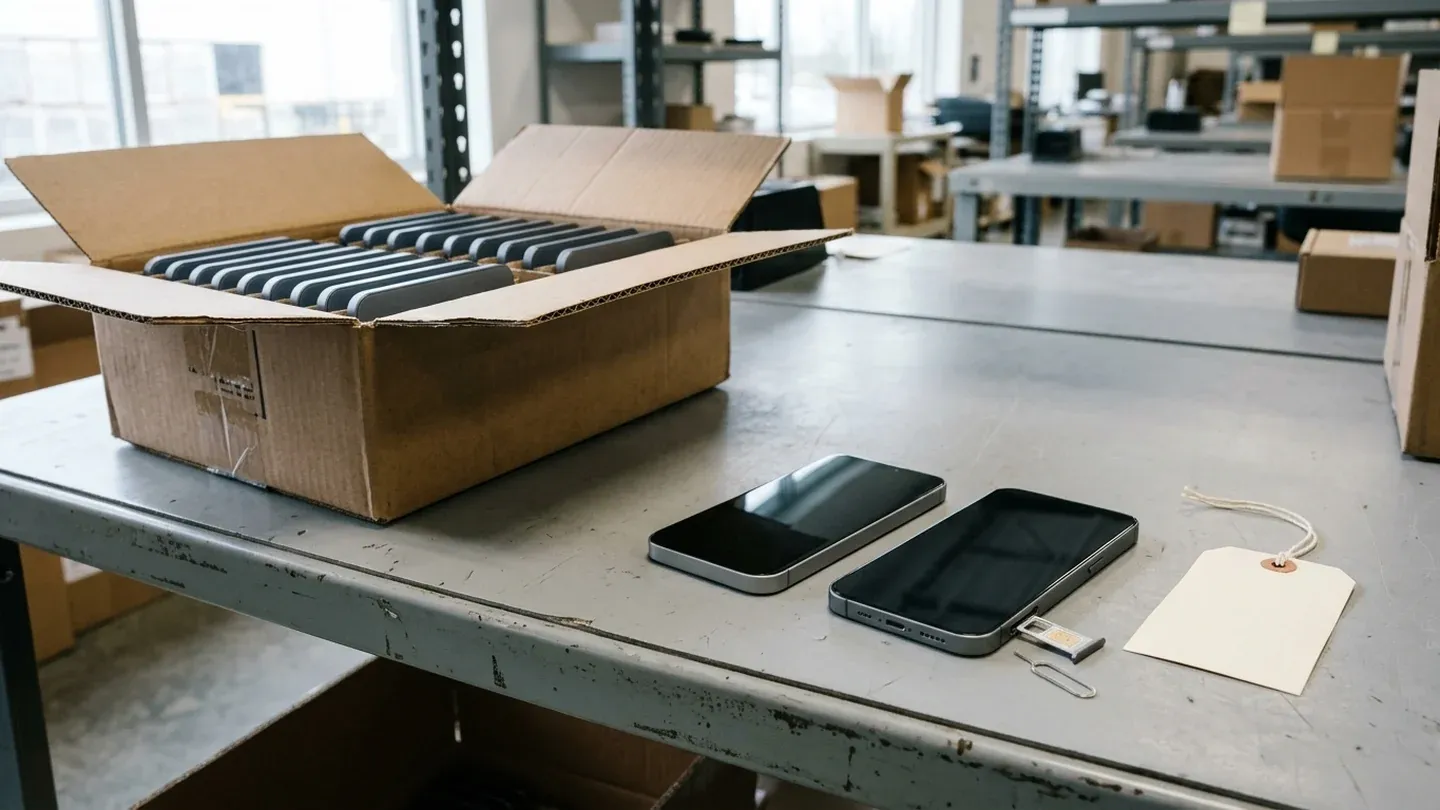
Open cardboard shipping box of smartphones on a receiving workbench beside two face-down handsets, a SIM-eject tool, an inspection tag, and a partially ejected SIM tray.
In the United States, recent iPhone models have no SIM tray, whereas models in other countries or regions feature a SIM tray on the left side that holds a physical nano-SIM card.

On a wholesale phone manifest, evaluating eSIM vs physical SIM hardware determines whether a shipment can activate on your destination market’s cellular networks or arrives as unsellable dead stock. Across cross-border wholesale phone sourcing workflows, a generic supplier line item such as an unlocked flagship phone conceals three incompatible hardware designs: pure eSIM-only handsets with no physical card slot, hybrid handsets with a left-side physical nano-SIM tray plus eSIM, and China mainland handsets with a two-sided Dual nano-SIM tray.

Scroll horizontally to view all columns.
Hardware & Manifest Dimension Pure eSIM-Only Hardware Tier Hybrid Single Nano-SIM + eSIM Tier Dual Physical Nano-SIM Tier
Physical SIM Slot & Reader If an iPhone model does not have a SIM tray, it supports eSIM only. Holds a single physical nano-SIM card in a side SIM tray alongside built-in eSIM. In China mainland, Hong Kong, and Macao, certain iPhone models feature Dual SIM with two nano-SIM cards in a two-sided tray.
Apple iPhone Regional Examples iPhone 14, iPhone 15, and iPhone 16 in the United States; iPhone 17, iPhone 17e, and iPhone 18 Pro in the United States, Canada, Japan, Mexico, and listed regions; iPhone Air and iPhone Duo worldwide. iPhone 14, iPhone 15, and iPhone 16 outside the United States and China/HK/Macao; iPhone 17 and iPhone 18 Pro in Europe and other countries or regions. iPhone 14, iPhone 15, and iPhone 16 in China mainland, Hong Kong, and Macao; iPhone 16e and iPhone 17 series in China mainland only.
Google Pixel Regional Examples US models of Pixel 10 (GLBW0), Pixel 10 Pro (G4QUR), Pixel 10 Pro XL (GUL82), Pixel 11 (GPQQ7), Pixel 11 Pro (G7SWN), and Pixel 11 Pro XL (GBC0H) use Dual eSIM (2 active eSIMs; stores 8 or more eSIMs). Rest-of-World ([ROW]) Pixel 10 and Pixel 11 models, plus Pixel 10a (US GE1GQ, JP GV0BP, ROW G4H7L), Pixel 10 Pro Fold (Global except JP GU0NP, JP GM66V), Pixel 11 Pro Fold (GZDQ6), and Pixel 9a (US GXQ96, ROW GTF7P) models use Dual SIM (Single Nano SIM and eSIM). Not used on Google Pixel phones; Pixel 6 through Pixel 9 and foldable or A-series Pixel 10 and Pixel 11 models use Dual SIM (Single Nano SIM and eSIM).
External Axxxx Engraving Location On an iPhone without a SIM tray, the model number is engraved inside the USB-C or Lightning connector on the upper display side. On an iPhone 8 or later model that has a SIM tray, the model number is engraved inside the SIM tray slot on the upper display side. On an iPhone 8 or later model that has a SIM tray, the model number is engraved inside the SIM tray slot on the upper display side.

How Do eSIM and Physical SIM Differ on Smartphone Hardware and Wholesale Manifests?

At the cellular radio layer, there is no difference in reception or data speed between an eSIM and a physical SIM card. The procurement risk lies in the physical board assembly, remote provisioning requirements, and how liquidation manifests omit regional sub-model codes.
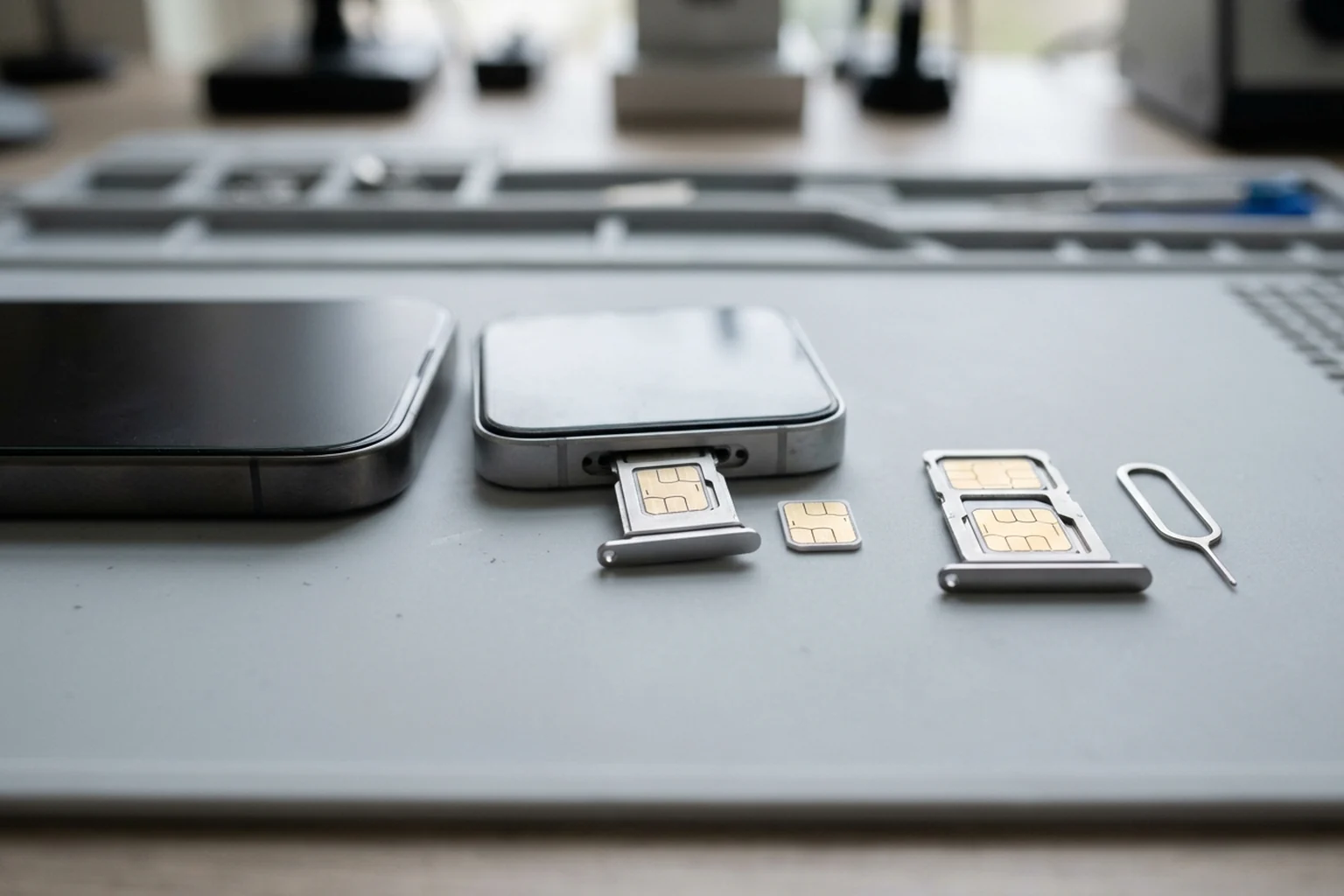
Two face-down smartphones on a grey workbench mat showing a partially ejected single nano-SIM tray beside a loose nano-SIM card, a two-nano-SIM tray, and a SIM-eject tool.
In China mainland, Hong Kong, and Macao, Dual nano-SIM iPhone trays hold one nano-SIM card in the bottom of the tray and a second nano-SIM card in the top tray.

Removable 4FF Nano-SIM vs Soldered eUICC Under GSMA SGP.22

  • Removable Physical nano-SIM Hardware: Apple introduced the nano-SIM card format with the iPhone 5 in 2012, and the nano-SIM is the smallest physical card format at 12.3 by 8.8 millimetres. Use only the SIM tray that came with your device—for example, a SIM tray from an iPhone 6s will not fit in an iPhone 7. Damage to the SIM tray or device caused by a modified SIM card is not covered by the Apple hardware warranty.
  • Embedded eSIM (eUICC) Architecture: According to Apple Support, an eSIM is an industry-standard digital SIM built into the iPhone, eliminating the need for a physical SIM card and enabling users to manage up to eight or more eSIMs on an iPhone XS, iPhone XS Max, iPhone XR, or later. Under the GSMA SGP.22 standard for remote SIM provisioning (RSP), devices securely download, store, and manage mobile network profiles without physical SIM cards using three main components: the eUICC (which stores multiple operator profiles securely), the SM-DP+ (which prepares and delivers profiles to devices), and the SM-DS (which lets devices find and download available profiles).
  • On-Device LPA & Multi-IMSI / SoftSIM Distinction: Under the Android Open Source Project (AOSP) eUICC architecture, the Local Profile Assistant (LPA) serves as the bridge between the remote SM-DP+ (Subscription Manager Data Preparation+) service and the eUICC chip, and Android 10 or higher supports devices with multiple eSIMs. Unlike proprietary Multi-IMSI solutions that update the IMSI inside an existing SIM profile, eSIM is a GSMA-defined remote SIM provisioning technology that downloads complete interoperable carrier profiles to a dedicated hardware security element, whereas SoftSIM is purely software-based and iSIM integrates SIM functionality directly into the device’s main chipset.
  • Dual SIM Dual Standby (DSDS) Operation: iPhone 13 models and later support Dual SIM with two active eSIMs simultaneously, in addition to a physical nano-SIM and an eSIM on tray-equipped models. Dual SIM iPhones use Dual SIM Dual Standby (DSDS) technology, meaning both SIMs can make and receive voice calls and send and receive SMS, MMS, RCS, and iMessage, while the iPhone uses one cellular data network at a time.

Why Standard Wholesale & Auction Manifests Conceal SIM Hardware

In B-Stock’s official Mobile Manifest Template (last updated 01/18/2022), the core manifest fields are Category, Item Description, Qty, Retail Per Unit, Total Retail, and Condition, while UPC, Manufacturer, and Model are listed only as optional additional columns and custom columns are visible only after the manifest file is downloaded. Furthermore, B-Stock’s manifest rules allow cell phones to be listed in New, Used - Good (Grade A or B), Used - Fair (Grade C, D, or E), and Salvage, restricting user-locked devices (remote, FMIP, iCloud) to Salvage while permitting carrier-locked devices in any grade. When buyers bid from a generic summary description without auditing the signed-in manifest columns—a failure mode detailed in Understanding Phone Auction Manifests—they have zero visibility into whether a lot contains US eSIM-only units or international physical-tray units.


Which iPhone Models Are eSIM-Only vs Physical SIM Tray Across US, International, and China Lots?

Wholesalers must never generalize regional SIM tray rules from one iPhone generation to the next. Apple’s hardware matrix divides secondary market inventory into three distinct generational regimes.

1. iPhone 14 (2022), iPhone 15 (2023), and iPhone 16 / 16e (2024–2025): US-Only Tray Removal

On iPhone 14, iPhone 14 Plus, iPhone 14 Pro, iPhone 14 Pro Max, iPhone 15, iPhone 15 Plus, iPhone 15 Pro, iPhone 15 Pro Max, iPhone 16, iPhone 16 Plus, iPhone 16 Pro, iPhone 16 Pro Max, and iPhone 16e, there is no SIM tray in the United States, whereas models in other countries or regions have a SIM tray on the left side that holds a physical nano-SIM card. Specifically, iPhone 14 and iPhone 15 models sold in Canada, Guam, Japan, Mexico, Saudi Arabia, U.S. Virgin Islands, and other countries and regions, along with iPhone 16 and iPhone 16e models sold in Bahrain, Canada, Iraq, Guam, Japan (on iPhone 16 series), Jordan, Kuwait, Mexico, Oman, Qatar, Saudi Arabia, United Arab Emirates, U.S. Virgin Islands, and other countries and regions, include a left-side physical nano-SIM tray. Meanwhile, models sold in China mainland, Hong Kong, and Macao for the iPhone 14, iPhone 15, and iPhone 16 series feature Dual SIM with two physical nano-SIM cards, whereas on iPhone 16e, Dual physical nano-SIM (A3410) applies to China mainland only while Hong Kong and Macao iPhone 16e units use Dual SIM with an eSIM.

2. iPhone 17 (2025), iPhone 17e (2026), and iPhone 18 Pro (2026): Regional eSIM-Only Expansion

Starting with the iPhone 17 family in 2025 and continuing with iPhone 17e, iPhone 18 Pro, and iPhone 18 Pro Max in 2026, Apple eliminated the physical SIM tray in the United States, Puerto Rico, Bahrain, Canada, Guam, Japan, Kuwait, Mexico, Oman, Qatar, Saudi Arabia, United Arab Emirates, and U.S. Virgin Islands. Wholesalers who historically sourced Canadian, Japanese, Mexican, or Dubai/GCC iPhone lots to obtain a physical nano-SIM slot will receive pure eSIM-only hardware on these generations unless they specifically purchase European or Rest-of-World (“other countries and regions”) model codes.

In China mainland, only five iPhone models support eSIM: iPhone 18 Pro (model A3715), iPhone 18 Pro Max (model A3718), iPhone Duo (model A3721), iPhone 17e (model A3635), and iPhone Air (model A3518), while all other iPhone models—including those purchased outside of China mainland—are unable to install an eSIM profile from carriers in China mainland. On those five supported China mainland models, users can activate and store up to two eSIMs by visiting a China Mobile, China Telecom, or China Unicom store for an ID check, and eSIMs from non-China mainland carriers cannot be installed while located in China mainland.

3. iPhone Air (2025), iPhone Duo (2026), and iPhone 13 / iPhone SE (3rd Gen) Baseline

Every regional variant of iPhone Air (2025) and iPhone Duo (2026) has no SIM tray in any country or region worldwide. Conversely, all regional variants of iPhone 13, iPhone 13 mini, iPhone 13 Pro, and iPhone 13 Pro Max (2021) have a left-side physical nano-SIM tray with the IMEI etched on the SIM tray, and all variants of iPhone SE (3rd generation) (2022) have a right-side physical nano-SIM tray with the IMEI etched on the SIM tray. Note that in Hong Kong and Macao, iPhone 13 mini, iPhone 12 mini, iPhone SE (2nd and 3rd generation), and iPhone XS use Dual SIM with an eSIM rather than two physical nano-SIM cards.

Complete Apple iPhone Regional Axxxx Model Number & SIM Tray Matrix

Scroll horizontally to view all columns.
iPhone Model & Year US & Regional eSIM-Only Model Numbers (No SIM Tray) International Single Nano-SIM + eSIM Model Numbers (Side SIM Tray) China Mainland / HK / Macao Model Numbers
iPhone Duo (2026) All regions worldwide have no SIM tray with bottom USB-C: A3447 (United States, Puerto Rico), A3719 (Bahrain, Canada, Guam, Japan, Kuwait, Mexico, Oman, Qatar, Saudi Arabia, United Arab Emirates, and U.S. Virgin Islands), A3721 (China mainland), A3720 (other countries and regions). None — there is no SIM tray on any regional variant of iPhone Duo. A3721 (China mainland — no SIM tray).
iPhone 18 Pro Max (2026) No SIM tray in listed regions: A3473 (USA, Puerto Rico), A3716 (Japan, Guam, US Virgin Islands, Canada, Mexico, Saudi Arabia, UAE, Oman, Kuwait, Bahrain, Qatar). Left-side physical nano-SIM tray and bottom USB-C: A3717 (other countries and regions). A3718 (China mainland).
iPhone 18 Pro (2026) No SIM tray in listed regions: A3472 (USA, Puerto Rico), A3713 (Japan, Guam, US Virgin Islands, Canada, Mexico, Saudi Arabia, UAE, Oman, Kuwait, Bahrain, Qatar). Left-side physical nano-SIM tray and bottom USB-C: A3714 (other countries and regions). A3715 (China mainland).
iPhone 17e (2026) No SIM tray in listed regions: A3575 (United States, Puerto Rico, Bahrain, Canada, Guam, Japan, Kuwait, Mexico, Oman, Qatar, Saudi Arabia, United Arab Emirates, and U.S. Virgin Islands). Left-side physical nano-SIM tray and bottom USB-C: A3634 (other countries and regions). A3635 (China mainland).
iPhone 17 Pro Max (2025) No SIM tray in listed regions: A3257 (United States, Puerto Rico), A3525 (Bahrain, Canada, Guam, Japan, Kuwait, Mexico, Oman, Qatar, Saudi Arabia, United Arab Emirates, and U.S. Virgin Islands). Left-side physical nano-SIM tray and bottom USB-C: A3526 (other countries and regions). A3527 (China mainland).
iPhone 17 Pro (2025) No SIM tray in listed regions: A3256 (United States, Puerto Rico), A3522 (Bahrain, Canada, Guam, Japan, Kuwait, Mexico, Oman, Qatar, Saudi Arabia, United Arab Emirates, and U.S. Virgin Islands). Left-side physical nano-SIM tray and bottom USB-C: A3523 (other countries and regions). A3524 (China mainland).
iPhone 17 (2025) No SIM tray in listed regions: A3258 (United States, Puerto Rico), A3519 (Bahrain, Canada, Guam, Japan, Kuwait, Mexico, Oman, Qatar, Saudi Arabia, United Arab Emirates, and U.S. Virgin Islands). Left-side physical nano-SIM tray and bottom USB-C: A3520 (other countries and regions). A3521 (China mainland).
iPhone Air (2025) All regions worldwide have no SIM tray with bottom USB-C: A3260 (United States, Puerto Rico, Bahrain, Canada, Guam, Kuwait, Mexico, Oman, Qatar, Saudi Arabia, United Arab Emirates, and U.S. Virgin Islands), A3516 (Japan), A3518 (China mainland), A3517 (other countries and regions). None — there is no SIM tray on any regional variant of iPhone Air. A3518 (China mainland — no SIM tray).
iPhone 16e (2025) No SIM tray in the United States: A3212 (United States, Puerto Rico). Left-side physical nano-SIM tray and bottom USB-C: A3408 (Bahrain, Canada, Iraq, Guam, Jordan, Kuwait, Mexico, Oman, Qatar, Saudi Arabia, United Arab Emirates, and U.S. Virgin Islands), A3409 (other countries and regions). A3410 (China mainland).
iPhone 16 Pro Max (2024) No SIM tray in the United States: A3084 (United States, Puerto Rico). Left-side physical nano-SIM tray and bottom USB-C: A3295 (Bahrain, Canada, Iraq, Guam, Japan, Jordan, Kuwait, Mexico, Oman, Qatar, Saudi Arabia, United Arab Emirates, U.S. Virgin Islands), A3296 (other countries and regions). A3297 (China mainland, Hong Kong, Macao).
iPhone 16 Pro (2024) No SIM tray in the United States: A3083 (United States, Puerto Rico). Left-side physical nano-SIM tray and bottom USB-C: A3292 (Bahrain, Canada, Iraq, Guam, Japan, Jordan, Kuwait, Mexico, Oman, Qatar, Saudi Arabia, United Arab Emirates, U.S. Virgin Islands), A3293 (other countries and regions). A3294 (China mainland, Hong Kong, Macao).
iPhone 16 Plus (2024) No SIM tray in the United States: A3082 (United States, Puerto Rico). Left-side physical nano-SIM tray and bottom USB-C: A3289 (Bahrain, Canada, Iraq, Guam, Japan, Jordan, Kuwait, Mexico, Oman, Qatar, Saudi Arabia, United Arab Emirates, U.S. Virgin Islands), A3290 (other countries and regions). A3291 (China mainland, Hong Kong, Macao).
iPhone 16 (2024) No SIM tray in the United States: A3081 (United States, Puerto Rico). Left-side physical nano-SIM tray and bottom USB-C: A3286 (Bahrain, Canada, Iraq, Guam, Japan, Jordan, Kuwait, Mexico, Oman, Qatar, Saudi Arabia, United Arab Emirates, U.S. Virgin Islands), A3287 (other countries and regions). A3288 (China mainland, Hong Kong, Macao).
iPhone 15 Pro Max (2023) No SIM tray in the United States: A2849 (United States, Puerto Rico). Left-side physical nano-SIM tray and bottom USB-C: A3105 (Canada, Guam, Japan, Mexico, Saudi Arabia, and U.S. Virgin Islands), A3106 (other countries and regions). A3108 (China mainland, Hong Kong, Macao).
iPhone 15 Pro (2023) No SIM tray in the United States: A2848 (United States, Puerto Rico). Left-side physical nano-SIM tray and bottom USB-C: A3101 (Canada, Guam, Japan, Mexico, Saudi Arabia, and U.S. Virgin Islands), A3102 (other countries and regions). A3104 (China mainland, Hong Kong, Macao).
iPhone 15 Plus (2023) No SIM tray in the United States: A2847 (United States, Puerto Rico). Left-side physical nano-SIM tray and bottom USB-C: A3093 (Canada, Guam, Japan, Mexico, Saudi Arabia, and U.S. Virgin Islands), A3094 (other countries and regions). A3096 (China mainland, Hong Kong, Macao).
iPhone 15 (2023) No SIM tray in the United States: A2846 (United States, Puerto Rico). Left-side physical nano-SIM tray and bottom USB-C: A3089 (Canada, Guam, Japan, Mexico, Saudi Arabia, and U.S. Virgin Islands), A3090 (other countries and regions). A3092 (China mainland, Hong Kong, Macao).
iPhone 14 Pro Max (2022) No SIM tray in the United States: A2651 (United States, Puerto Rico). Left-side physical nano-SIM tray: A2893 (Canada, Guam, Japan, Mexico, Saudi Arabia, and U.S. Virgin Islands), A2895 (Armenia, Belarus, Kazakhstan, Kyrgyzstan, Russia), A2894 (other countries and regions). A2896 (China mainland, Hong Kong, Macao).
iPhone 14 Pro (2022) No SIM tray in the United States: A2650 (United States, Puerto Rico). Left-side physical nano-SIM tray: A2889 (Canada, Guam, Japan, Mexico, Saudi Arabia, and U.S. Virgin Islands), A2891 (Armenia, Belarus, Kazakhstan, Kyrgyzstan, Russia), A2890 (other countries and regions). A2892 (China mainland, Hong Kong, Macao).
iPhone 14 Plus (2022) No SIM tray in the United States: A2632 (United States, Puerto Rico). Left-side physical nano-SIM tray: A2885 (Canada, Guam, Japan, Mexico, Saudi Arabia, and U.S. Virgin Islands), A2887 (Armenia, Belarus, Kazakhstan, Kyrgyzstan, Russia), A2886 (other countries and regions). A2888 (China mainland, Hong Kong, Macao).
iPhone 14 (2022) No SIM tray in the United States: A2649 (United States, Puerto Rico). Left-side physical nano-SIM tray: A2881 (Canada, Guam, Japan, Mexico, Saudi Arabia, and U.S. Virgin Islands), A2883 (Armenia, Belarus, Kazakhstan, Kyrgyzstan, Russia), A2882 (other countries and regions). A2884 (China mainland, Hong Kong, Macao).
iPhone SE (3rd generation) (2022) None — all variants have a SIM tray on the right side with the IMEI etched on the SIM tray. Right-side physical nano-SIM tray: A2595 (United States, Canada, Puerto Rico, U.S. Virgin Islands, Guam, Mexico, Saudi Arabia), A2782 (Japan), A2784 (Russia, Belarus, Kazakhstan, Armenia, Kyrgyzstan), A2783 (other countries and regions). A2785 (China mainland).
iPhone 13 Pro Max (2021) None — all variants have a SIM tray on the left side with the IMEI etched on the SIM tray. Left-side physical nano-SIM tray: A2484 (United States), A2641 (Canada, Japan, Mexico, Saudi Arabia), A2645 (Armenia, Belarus, Kazakhstan, Kyrgyzstan, Russia), A2643 (other countries and regions). A2644 (China mainland, Hong Kong, Macao).
iPhone 13 Pro (2021) None — all variants have a SIM tray on the left side with the IMEI etched on the SIM tray. Left-side physical nano-SIM tray: A2483 (United States), A2636 (Canada, Japan, Mexico, Saudi Arabia), A2640 (Armenia, Belarus, Kazakhstan, Kyrgyzstan, Russia), A2638 (other countries and regions). A2639 (China mainland, Hong Kong, Macao).
iPhone 13 (2021) None — all variants have a SIM tray on the left side with the IMEI etched on the SIM tray. Left-side physical nano-SIM tray: A2482 (United States), A2631 (Canada, Japan, Mexico, Saudi Arabia), A2635 (Armenia, Belarus, Kazakhstan, Kyrgyzstan, Russia), A2633 (other countries and regions). A2634 (China mainland, Hong Kong, Macao).
iPhone 13 mini (2021) None — all variants have a SIM tray on the left side with the IMEI etched on the SIM tray. Left-side physical nano-SIM tray: A2481 (United States), A2626 (Canada, Japan, Mexico, Saudi Arabia), A2630 (Armenia, Belarus, Kazakhstan, Kyrgyzstan, Russia), A2628 (other countries and regions). A2629 (China mainland).

Notice that US iPhone models such as Model A3258 (iPhone 17) also include 5G mmWave bands n258 (26 GHz), n260 (39 GHz), and n261 (28 GHz) in Apple’s regional cellular matrix. Because SIM form-factor compatibility and RF band support are separate engineering checks, always pair this manifest check with Network Band Compatibility.


How Do US vs Rest-of-World Google Pixel Lots Split eSIM vs Physical SIM Hardware?

Wholesalers sourcing Android liquidation stock cannot assume every Android flagship includes a physical nano-SIM slot. Google’s official hardware specifications document a strict US ([US]) versus Rest-of-World ([ROW]) SIM hardware split on non-foldable Pixel 10 and Pixel 11 flagships, while keeping a physical nano-SIM slot on foldable, A-series, and older Pixel models.

Scroll horizontally to view all columns.
Google Pixel Generation [US] Hardware Models & SIM Specification [ROW] / Global Hardware Models & SIM Specification Wholesale Manifest Control
Pixel 11 / 11 Pro / 11 Pro XL Dual eSIM (2 active eSIMs; stores 8 or more eSIMs) — no nano-SIM slot on Pixel 11 (GPQQ7), Pixel 11 Pro (G7SWN), and Pixel 11 Pro XL (GBC0H). Dual SIM (Single Nano SIM and eSIM) on Pixel 11 (GUJ0N), Pixel 11 Pro (GM45K), and Pixel 11 Pro XL (G4HCD). US non-foldable Pixel 11 flagships (GPQQ7, G7SWN, GBC0H) are eSIM-only; require Gxxxx code on manifests before exporting to physical-SIM markets.
Pixel 11 Pro Fold Dual SIM (Single Nano SIM and eSIM) across [US and ROW] (GZDQ6). Dual SIM (Single Nano SIM and eSIM) across [US and ROW] (GZDQ6). Retains physical nano-SIM + eSIM across both US and ROW.
Pixel 10 / 10 Pro / 10 Pro XL Dual eSIM (2 active eSIMs; stores 8 or more eSIMs) — no nano-SIM slot on Pixel 10 (GLBW0), Pixel 10 Pro (G4QUR), and Pixel 10 Pro XL (GUL82). Dual SIM (Single Nano SIM and eSIM) on Pixel 10 (GL066, GK2MP), Pixel 10 Pro (GN4F5, GEHN3), and Pixel 10 Pro XL (GYPW4, G45RY). US non-foldable Pixel 10 flagships (GLBW0, G4QUR, GUL82) are eSIM-only; ROW variants retain the physical nano-SIM slot.
Pixel 10 Pro Fold & Pixel 10a Dual SIM (Single Nano SIM and eSIM) on Pixel 10 Pro Fold ([Global except JP] GU0NP) and Pixel 10a ([US] GE1GQ). Dual SIM (Single Nano SIM and eSIM) on Pixel 10 Pro Fold ([Global except JP] GU0NP, [JP] GM66V) and Pixel 10a ([JP] GV0BP, [ROW] G4H7L). Both foldable (Pixel 10 Pro Fold) and A-series (Pixel 10a) retain a physical nano-SIM slot across US, JP, and ROW.
Pixel 9 Series (9, 9 Pro, 9 Pro XL, 9 Pro Fold, 9a) & Pixel 8 / 7 / 6 Series Dual SIM (Single Nano SIM and eSIM): Pixel 9 (G2YBB), Pixel 9 Pro (GR83Y), Pixel 9 Pro XL (GGX8B), and Pixel 9a (GXQ96). Dual SIM (Single Nano SIM and eSIM): Pixel 9 (GUR25), Pixel 9 Pro (GEC77), Pixel 9 Pro XL (GZC4K), Pixel 9 Pro Fold Rest of world (GGH2X, JP GC15S), and Pixel 9a (GTF7P, JP G3Y12). All Pixel 6 through Pixel 9 generations include a physical nano-SIM slot plus eSIM in both US and international markets.

When purchasing multi-brand Android manifests that mix US carrier trade-ins with Asian gray-market stock, combine this Gxxxx SIM-tray check with the factory firmware and Play Protect verification steps in Global vs China Phone Versions.


How Do You Audit SIM Tray Hardware, Port Engravings, and TACs Before Releasing Payment?

To prevent mixed-lot surprises, procurement and warehouse teams should execute a five-step verification sequence spanning pre-payment spreadsheet review and physical receiving inspection.
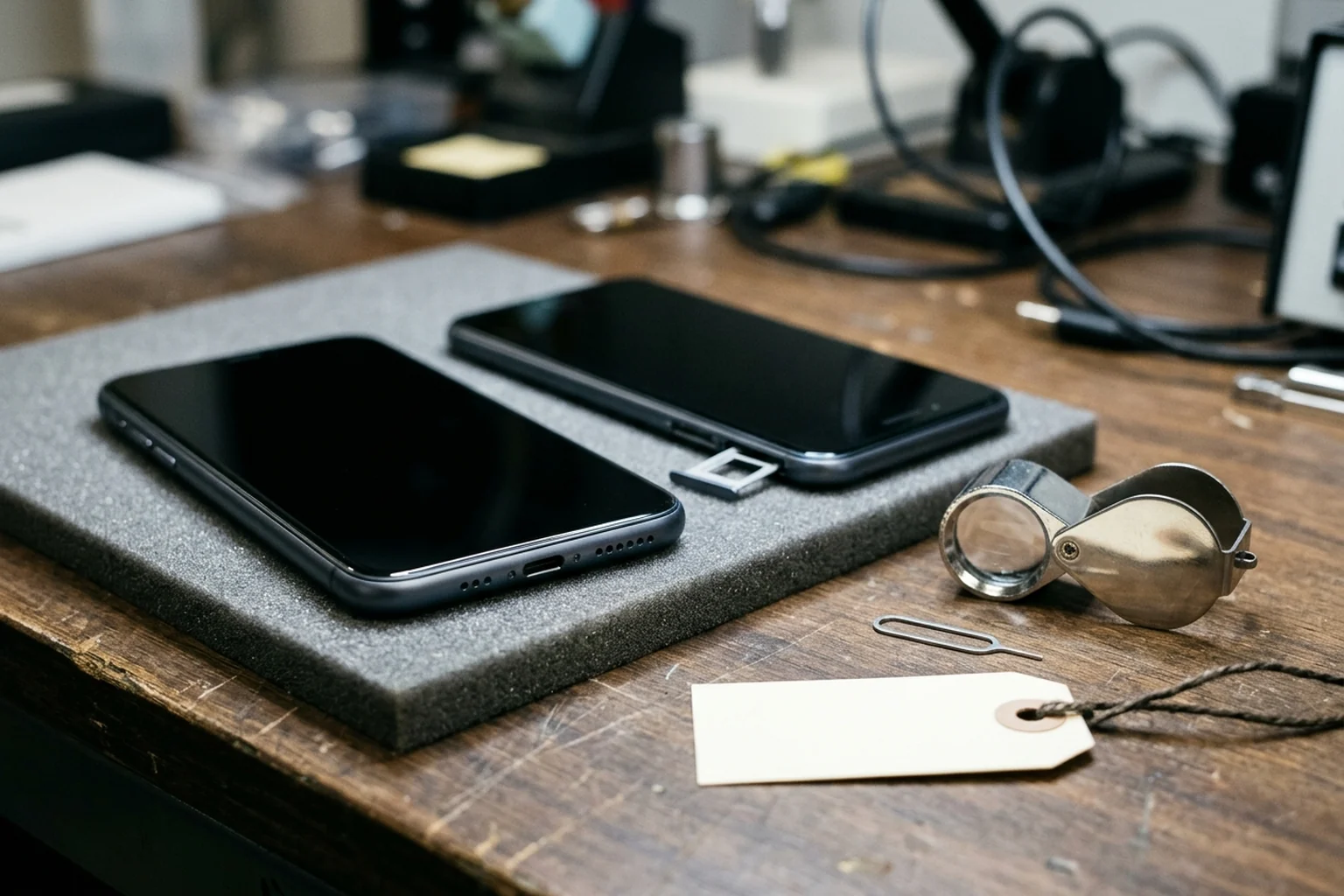
Two smartphones on a workbench pad showing a bottom USB-C connector and an ejected side SIM tray beside a folding magnifier loupe, a SIM-eject tool, and an inspection tag.
On an iPhone without a SIM tray, look inside the USB-C or Lightning connector on the upper display side under bright overhead light to find the hardware model number.
  1. Require Optional Model and Part Number Columns on the Pre-Bid Manifest: Because B-Stock’s Mobile Manifest Template (01/18/2022) treats Model and Manufacturer as optional additional columns and hides custom columns until the manifest file is downloaded, never wire funds on a summary line item that omits the regional model number.
  2. Audit the 8-Digit GSMA TAC Across the 15-Digit IMEI Spreadsheet: Under 3GPP and GSMA rules, the Type Allocation Code (TAC) is the 8-digit number for 3GPP devices that identifies the device make and model and forms the first part of the 15-digit IMEI (which is embedded into the device at the time of manufacture), and the same TAC cannot be used for different device models. Because different device models require different TACs and the same TAC cannot be used for different device models, grouping the first 8 digits of the supplier’s 15-digit IMEI list separates different allocated device models.
  3. Toggle Part Number to Axxxx Model Number in iOS Settings: On powered iPhones, open Settings > General > About; to the right of Model Number, iOS initially displays the part number, and tapping the part number reveals the A-number model number.
  4. Inspect the Internal SIM Slot or USB-C / Lightning Connector on Unpowered Units:
    • On an iPhone 8 or later model that has a SIM tray, remove the SIM tray and look inside the slot under bright light overhead—the hardware model number is engraved on the upper side (the side with the display). On iPhone SE (3rd generation) and iPhone 13 Pro Max models, the IMEI is etched on the SIM tray. On Dual nano-SIM models, place the first SIM card into the bottom of the tray aligned by the notch, and insert the other SIM card into the top tray.
    • On an iPhone without a SIM tray, look inside the USB-C or Lightning connector under bright light overhead—the hardware model number is engraved on the upper side of the connector, on the side with the display.
  5. Verify "No SIM restrictions" and Reject Modified SIM Trays: Using an eSIM cannot bypass a carrier lock; to use two different carriers in Dual SIM mode, the carrier must unlock the iPhone or both plans must be from the same carrier. In Settings > General > About, verify that "No SIM restrictions" appears next to Carrier Lock (Apple cannot unlock an iPhone for use with a different carrier—only the current carrier can unlock it), and integrate this step into your Carrier Lock Check and Bulk Phone QC Checklist. Finally, reject any handset with a cut or modified SIM card or altered tray, as damage caused by a modified SIM card is not covered by the Apple hardware warranty and might prevent connection to a cellular network.

Wholesale Manifest Model-Suffix, SIM Form-Factor & Target Market Matching Sheet

Before signing a proforma invoice or releasing escrow, attach the verification fields below to your purchase order using the Phone Wholesale RFQ Template.
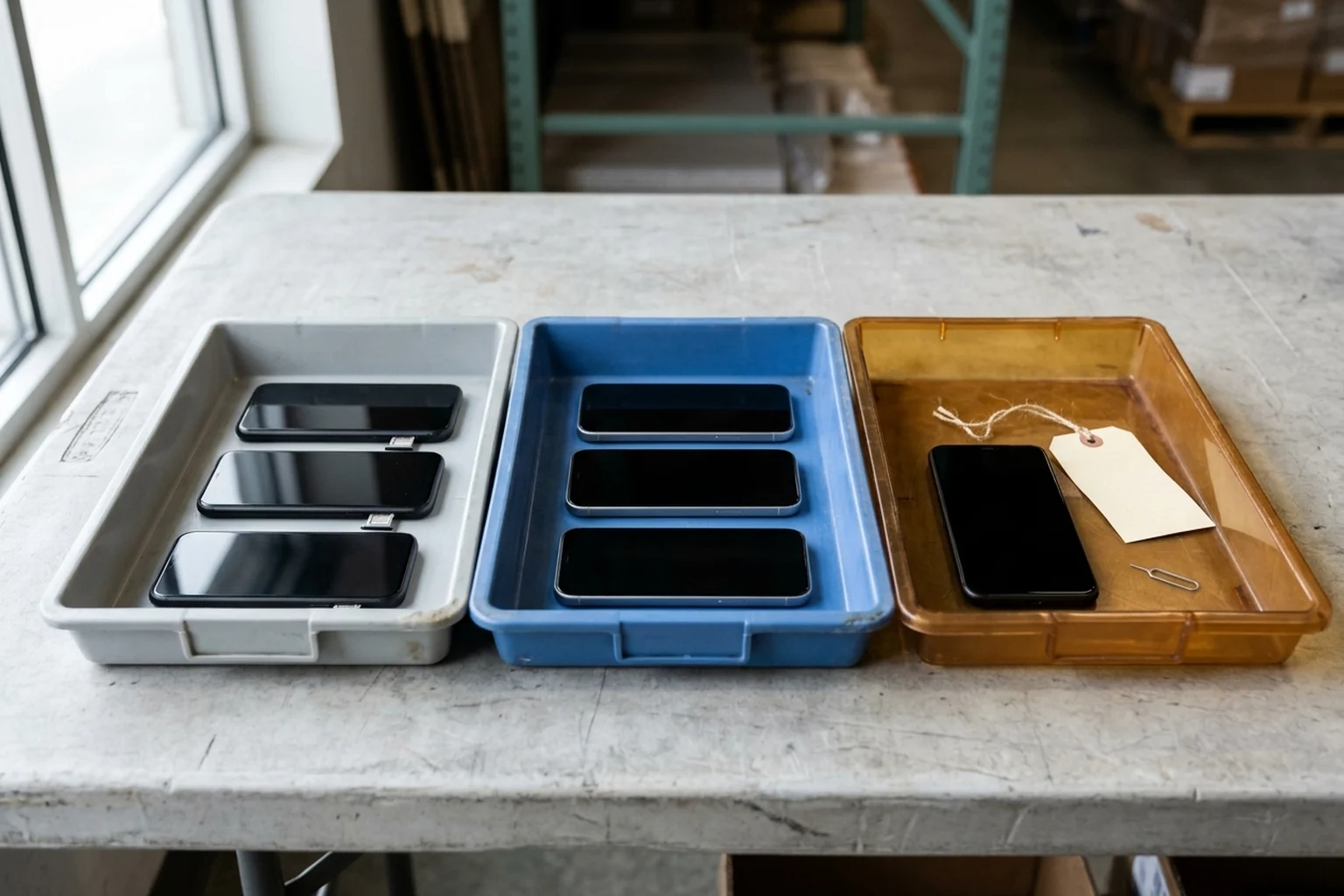
Plastic sorting trays on a warehouse receiving bench separating unpowered smartphones by SIM tray hardware configuration.
If an iPhone model does not have a SIM tray, it supports eSIM only, requiring receiving benches to segregate eSIM-only handsets from physical SIM-tray units.
Scroll horizontally to view all columns.
Verification Field Mandatory Pre-Payment Specification Receiving Dock Pass / Quarantine Gate
Exact Hardware Model Code (Axxxx / Gxxxx) Require the seller to declare the exact hardware model number on every manifest line item rather than generic model names. Quarantine any unit whose internal SIM-slot engraving or upper USB-C / Lightning connector engraving does not match the invoiced model number.
SIM Hardware Tier Declaration Specify whether the lot is pure eSIM-only (no SIM tray), hybrid left-side physical nano-SIM + eSIM, or China mainland Dual physical nano-SIM. If an iPhone model does not have a SIM tray, it supports eSIM only; route eSIM-only stock away from prepaid physical nano-SIM resale orders.
2025–2026 Regional eSIM-Only Territory Check For iPhone 17, iPhone 17 Pro, iPhone 17 Pro Max, iPhone 17e, iPhone 18 Pro, and iPhone 18 Pro Max, treat Canadian, Japanese, Mexican, and GCC (A3519, A3522, A3525, A3575, A3713, A3716) lots as no-SIM-tray (eSIM-only) stock. Require European / Rest-of-World model numbers (A3520, A3523, A3526, A3634, A3714, A3717) whenever your buyer requires a left-side physical nano-SIM tray on iPhone 17 or iPhone 18 Pro series.
China Mainland eSIM & Dual SIM Boundary Note that in China mainland, only A3715 (iPhone 18 Pro), A3718 (iPhone 18 Pro Max), A3721 (iPhone Duo), A3635 (iPhone 17e), and A3518 (iPhone Air) support China mainland carrier eSIMs, while foreign models cannot install China mainland carrier eSIM profiles. Do not ship non-China eSIM-only iPhones into China mainland resale channels, as eSIMs from non-China mainland carriers cannot be installed while located in China mainland and foreign models cannot install China mainland carrier eSIM profiles.
8-Digit TAC & Carrier Lock Gate Require the 15-digit IMEI list prior to shipment so the 8-digit TAC (one device model per TAC) can be grouped by hardware model, and require "No SIM restrictions" under Carrier Lock. Quarantine any device where Settings > General > About > Carrier Lock does not display "No SIM restrictions", or where a cut or modified SIM card has damaged the SIM tray.

Key takeaways

  • If an iPhone model does not have a SIM tray, it supports eSIM only.
  • On iPhone 14, iPhone 15, and iPhone 16 series, United States and Puerto Rico models have no SIM tray, while models in other countries or regions retain a left-side SIM tray that holds a physical nano-SIM card.
  • On iPhone 17, iPhone 17e, and iPhone 18 Pro series, there is no SIM tray in the United States, Puerto Rico, Bahrain, Canada, Guam, Japan, Kuwait, Mexico, Oman, Qatar, Saudi Arabia, United Arab Emirates, and U.S. Virgin Islands.
  • Every regional variant of iPhone Air and iPhone Duo has no SIM tray anywhere in the world, while China mainland iPhone 14, iPhone 15, iPhone 16, and iPhone 17 models use two physical nano-SIM cards.
  • During receiving QC, inspectors verify the hardware model number inside the SIM slot on tray-equipped phones or inside the upper display side of the USB-C or Lightning connector on models without a SIM tray.

Frequently asked questions

Can a US eSIM-only iPhone be used with a physical nano-SIM card in international resale markets?

No. If an iPhone model does not have a SIM tray, it supports eSIM only. Damage to the SIM tray or device caused by a modified SIM card is not covered by the Apple hardware warranty and might prevent connection to cellular networks.

Do Canadian, Japanese, and Dubai (UAE) iPhones always have a physical nano-SIM tray?

No. While models for Canada, Guam, Japan, Mexico, Saudi Arabia, and U.S. Virgin Islands on iPhone 14 and iPhone 15 series (plus Bahrain, Iraq, Jordan, Kuwait, Oman, Qatar, and United Arab Emirates on iPhone 16 series) have a left-side physical nano-SIM tray, there is no SIM tray on iPhone 17, iPhone 17 Pro, iPhone 17 Pro Max, iPhone 17e, iPhone 18 Pro, and iPhone 18 Pro Max models sold in the United States, Puerto Rico, Bahrain, Canada, Guam, Japan, Kuwait, Mexico, Oman, Qatar, Saudi Arabia, United Arab Emirates, and U.S. Virgin Islands.

Where is the hardware model number engraved on an eSIM-only iPhone without a SIM tray?

On an iPhone without a SIM tray, look inside the USB-C or Lightning connector under bright overhead light; the model number is engraved on the upper side of the connector, on the side with the display.

Can foreign eSIM-only iPhones download a China mainland carrier eSIM profile?

No. In China mainland, only iPhone 18 Pro (model A3715), iPhone 18 Pro Max (model A3718), iPhone Duo (model A3721), iPhone 17e (model A3635), and iPhone Air (model A3518) support eSIM, and other iPhone models—including those purchased outside of China mainland—are unable to install an eSIM profile from carriers in China mainland.

Does provisioning an eSIM bypass a carrier lock on a wholesale phone lot?

No. Using an eSIM cannot bypass a carrier lock. To use two different carriers or activate another carrier's plan, Settings > General > About must display No SIM restrictions next to Carrier Lock, and only the current carrier can unlock the iPhone.

Sources and methodology

  1. Apple Support — Identify your iPhone model (HT201296 / 108044) — Apple Inc. Accessed October 28, 2026.
  2. Apple Support — About eSIM on iPhone & Use Dual SIM with an eSIM or Two nano-SIM Cards — Apple Inc. Accessed October 28, 2026.
  3. Apple Support — Find the model number and remove or switch the SIM card in your iPhone — Apple Inc. Accessed October 28, 2026.
  4. Apple Support — Use eSIM on iPhone in China mainland & How to unlock your iPhone for use with a different carrier — Apple Inc. Accessed October 28, 2026.
  5. Google Pixel Help — Pixel phone hardware tech specs (Pixel 6 through Pixel 11 Pro Fold) — Google LLC Accessed October 28, 2026.
  6. Android Open Source Project (AOSP) — Implementing eUICC & Pelion GSMA SGP.22 Specification — Google / Pelion Accessed October 28, 2026.
  7. GSMA TAC Allocation Resource Guide & B-Stock Mobile Manifest Template — GSMA / B-Stock Solutions Accessed October 28, 2026.

Update history

  1. — First published. Official sources on this page were accessed on this date unless a later note says otherwise.

Factual corrections after publication are listed on the corrections page. Editorial responsibilities and review methods are described in the editorial policy.
About the author

Editorial Team

PhoneBulk publishes source-based procurement guides that distinguish official requirements, seller statements and proposed buyer checks. Each article states its method and limits.