
Key takeaways
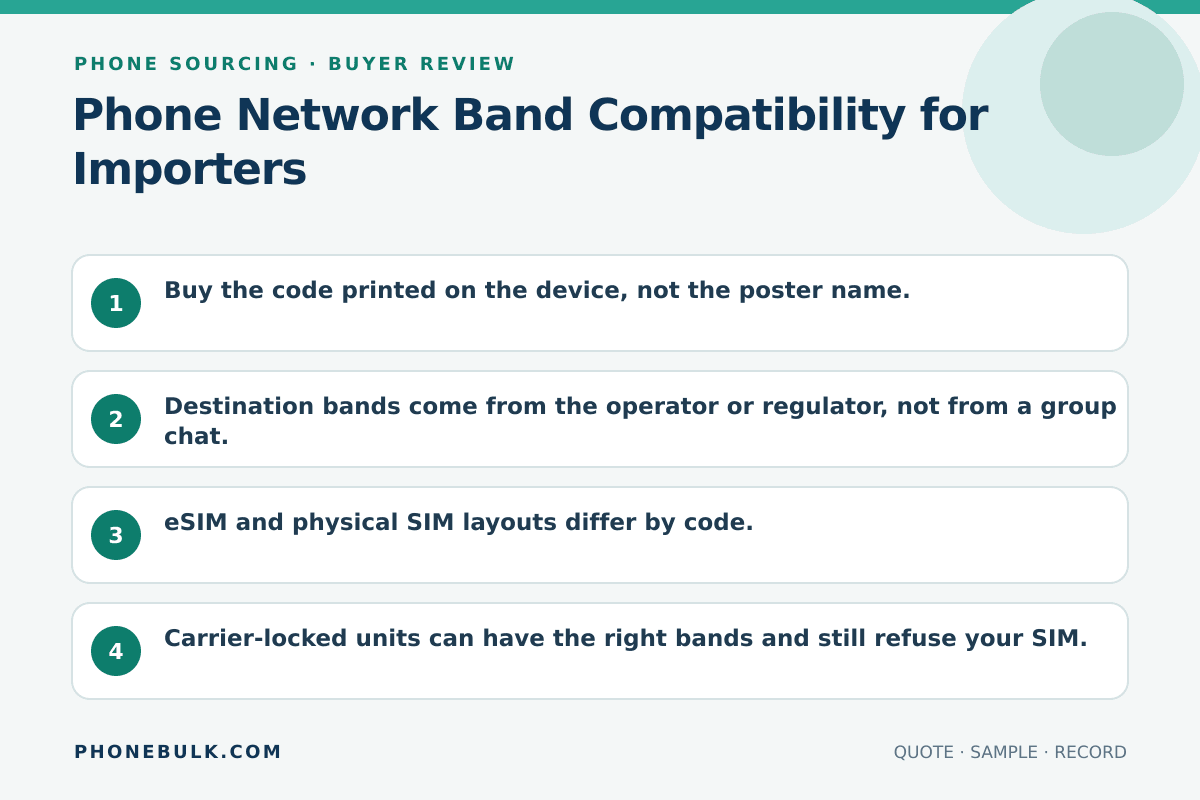
- Buy the code printed on the device, not the poster name.
- Destination bands come from the operator or regulator, not from a group chat.
- eSIM and physical SIM layouts differ by code.
- Carrier-locked units can have the right bands and still refuse your SIM.
- One failed attach is a Reject for that SKU, not a 2 percent quality note.
A phone that will not attach is unsellable, even when the glass is Grade A. Bands live on the model code.
Who this guide is for
Importers who already know the destination country and still get “global compatible” on the quote. Pair this page with global vs China versions.
What compatibility is not
- A brand reputation
- A GMS install
- A “world phone” slogan
- A charger that fits the wall
GMS and Play Protect decide Google-app eligibility. They do not list LTE or NR bands. Carrier lock is a SIM policy. Apple documents that only the current carrier can unlock an iPhone. A locked phone can support the band and still refuse the SIM.
In the United States, the FCC equipment-authorization program is how radio devices are authorized for market. An authorization for one code is not a promise that a different regional code will attach on your operator.
How to test a SKU
- Read the model code from the device and the box.
- Open the manufacturer’s spec for that exact code.
- List the destination operator’s published bands. Use the operator or regulator, not a screenshot from a forum.
- Insert a local SIM, or the closest roaming SIM you trust, and watch attach, voice, and data.
- Record eSIM versus physical SIM. A code without eSIM is a different product for some channels.
- Repeat on a second unit if the first is a sample from a mixed carton.
Accept / Clarify / Reject
| Evidence | Accept | Clarify | Reject |
|---|---|---|---|
| Code + operator band overlap + live attach | Matches the RFQ | Spec only, no SIM | Wrong code after payment |
| “Global” | Code listed | Word only | China radio sold as global |
| Carrier lock | Named and priced | “Easy unlock” | Locked, sold unlocked |
| eSIM required | Present and tested | Not mentioned | Missing on a promised SKU |
What to put in the RFQ
- Destination country and operators you must support
- Required bands if you already know the gap
- eSIM yes / no
- Unlocked or named carrier
- Model code, not only the marketing name
Do not paste an unofficial world band chart into the order as if it were law. Charts go stale. Codes do not.
Related guides
Frequently asked questions
Is every global firmware phone compatible with every country?
No. Global is a software family, not one radio. Two global codes can miss a local low-band.
Can I rely on a third-party spec website?
Use it only as a hint. Confirm against the manufacturer’s spec for that code and a live SIM test.
Sources and methodology
- Check and fix Play Protect certification status — Google Play Help Accessed August 22, 2026.
- How to unlock your iPhone for use with a different carrier — Apple Support Accessed August 22, 2026.
- Equipment Authorization — Federal Communications Commission Accessed August 22, 2026.
- Android Google Mobile Services — Android / Google Accessed August 22, 2026.
Update history
- — First published. Official sources on this page were accessed on this date unless a later note says otherwise.
Factual corrections after publication are listed on the corrections page. There is no separate reviewer identity on this desk. See the editorial policy.

About the author
Frank Dean
Frank Dean researches manufacturer, standards, and trade documents for PhoneBulk, then turns them into accept / clarify / reject buying guidance for resellers.
- Source-backed wholesale research
- Claim-level fact review
- Separation of official rule and trade practice