Bidding on automated retail trade-in kiosk lots using carrier-grade assumptions will cost a wholesale buyer margin when hidden board faults, iOS 18 component locks, and delayed carrier payment defaults hit the warehouse bench. Automated cash kiosks at big-box retailers and carrier upgrade hubs operate on fundamentally different intake incentives, hold timelines, and failure distributions.
This procurement and teardown guide maps the end-to-end B2B supply chain behind ecoATM retail kiosks—including ecoATM Walmart and grocery deployments—into actionable trade in phone auction wholesale underwriting rules. It pairs with our broader phone reseller guides and institutional phone-sourcing guides so buyers price cosmetic glass damage, component serialization, and post-hold IMEI drift before submitting a binding auction bid.
1. How Retail Trade-In Kiosks (ecoATM at Walmart & Kroger) Feed the B2B Wholesale Pipeline
When a consumer walks up to an ecoATM Walmart, Kroger, or shopping-mall kiosk, the machine executes a four-stage hardware and compliance sequence documented in ecoATM’s consumer intake workflow and ecoATM’s law-enforcement security architecture:
- Government ID & Three-Camera Facial Biometric Verification: Before any cash is dispensed, the kiosk scans a state or federal government photo ID and captures live facial biometrics across three high-resolution internal security cameras. Remote verification agents validate that the live seller matches the credential and check the seller against repeat-offender velocity thresholds.
- Optical Chamber Imaging & Electronic Port Interrogation: Once placed inside the motorized evaluation bay, calibrated optical cameras inspect front digitizer glass cracks, rear housing fractures, and active LCD/OLED illumination defects (dead pixels, backlight bleed, burn-in). Simultaneously, physical Lightning or USB-C probes read device descriptors, model SKU, storage capacity, battery telemetry, and the hardware IMEI/MEID.
- Real-Time GSMA Lost/Stolen Screening: The kiosk queries the GSMA Device Check global IMEI registry in real time to block handsets already reported lost or stolen by participating mobile network operators.
- Mandatory 15-to-30-Day Statutory Secondhand-Dealer Hold: Because automated cash kiosks operate legally as automated secondhand dealers, local municipal and state ordinances require every purchased phone to remain locked inside an internal serialized bin or secure regional vault for 15 to 30+ days. During this window, law-enforcement agencies review transaction logs, ID scans, facial images, and serial numbers to recover stolen property before any device enters commercial circulation.
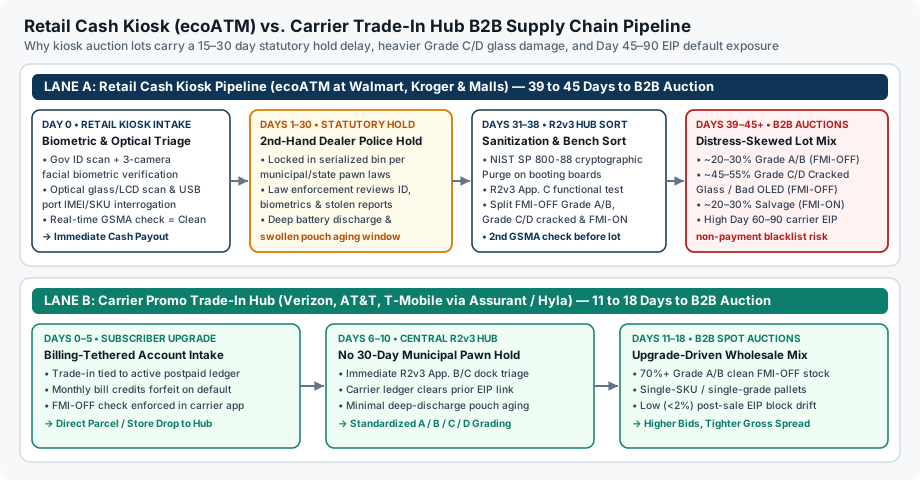
For B2B wholesalers, that 39-to-45-day physical pipeline creates two structural realities that never appear on a consumer trade-in page. First, a flagship model dropped into a kiosk during a new-release month reaches the wholesale auction block five to six weeks later—after secondary spot prices have already depreciated by 4% to 7%. Second, handsets with marginal lithium-ion cells sit uncharged at 0% state-of-charge during the statutory hold, increasing the share of deep-discharge PMIC lockups and swollen battery pouches in lower-grade lots.
Takeaway: Separate retail cash kiosk lots from carrier upgrade trade-in lots in your purchasing ledger; kiosk supply carries a 30-day statutory hold lag, higher physical glass damage, and elevated post-intake financial default risk.
2. Inside the Central Sorting Hub: How Kiosk Inventory Is Graded for Wholesale Auctions
Once a kiosk batch clears its municipal police hold, armored logistics routes transport the sealed bins to centralized processing facilities certified under the SERI R2v3 Responsible Recycling Standard. At the central hub, warehouse technicians reconcile the kiosk’s 3-minute optical intake estimate against full bench diagnostics under R2v3 Appendix C (Test and Repair).
Kiosk optical cameras excel at detecting surface glass fractures and basic LCD illumination, but a 180-second retail kiosk session cannot stress-test:
- 5G Cellular Baseband & RF Power Amplifiers under sustained thermal load;
- Rear Camera OIS (Optical Image Stabilization) Actuators that exhibit high-frequency micro-jitters or focus hunting;
- TrueDepth Face ID Flood Illuminator & Dot Projector corrosion from prior liquid ingress;
- Intermittent PMIC / Tristar / Hydra Charging IC Faults that allow a phone to boot on kiosk cable power but fail rapid PD charging or drain overnight.
Central sorting hubs split cleared kiosk volume into three primary trade in phone auction wholesale streams. Buyers who have already studied how to read a phone auction manifest should map every kiosk auction lot into these exact operational buckets and isolate them in their phone inventory planning records:
Takeaway: Never treat a kiosk optical intake grade as a warehouse functional pass; require the signed-in line-item manifest to confirm whether Grade C/D lots have functional OLED displays beneath cracked front glass.
3. Grade C/D (FMI-OFF) Refurbishment vs. FMI-ON Salvage Teardown Margins Under iOS 18
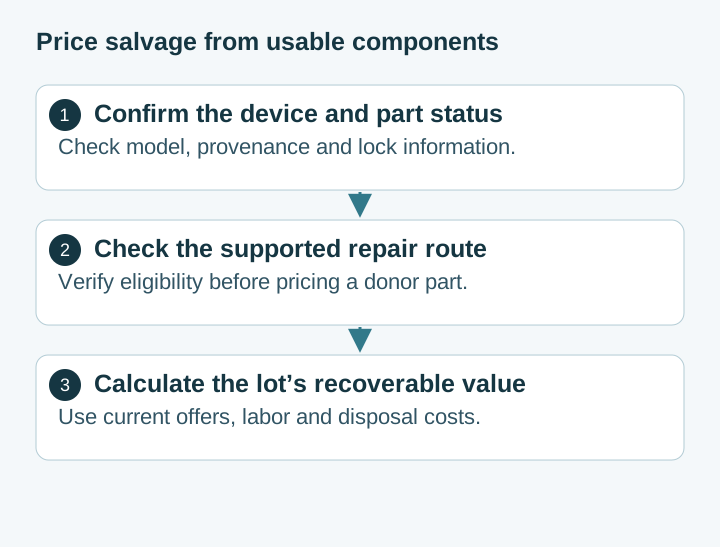
For kiosk salvage, verify component eligibility before reusing a historical bid model. Apple’s iPhone Parts and Service History architecture and Activation Lock security specification fundamentally reordered the spread between Stream 2 (FMI-OFF Grade C/D) and Stream 3 (FMI-ON Salvage) across iPhone 12 through iPhone 16 models running iOS 18.
How Component Lock Status Changes a Salvage Bid
Apple’s Repair Assistant guidance explains that a protected part may require the associated Apple Account information to finish a repair. Supported models and parts vary. Confirm the actual component, donor provenance and repair route before assigning reusable-part value to a salvage unit.
Separate three questions in the bid worksheet: whether a part can be physically removed intact, whether it is eligible for the intended repair, and what a buyer currently offers for it. A component policy can change the usable-parts list; the monetary effect depends on the model, condition, labor and transaction prices.
For an unlocked damaged handset, assess whether repair is practical and price the required work. For locked or uncertain donor stock, resolve component eligibility before assuming display, battery or camera revenue. Keep uncertain proceeds separate from confirmed recoverable value.
Use current offers for the specific lot and subtract the expected handling, testing, repair and disposal costs. Record the date and assumptions next to the bid. Compare lots on that basis rather than applying a universal percentage loss to every locked phone.
Conditional 100-Unit Kiosk Refurbishment Calculation (iPhone 14 Pro 128GB)
The table below models an illustrative 100-unit wholesale auction comparison between a Grade C/D Cracked-Glass (FMI-OFF) kiosk lot and an FMI-ON Kiosk Salvage lot after iOS 18 component serialization:
Takeaway: Shift capital out of FMI-ON kiosk salvage auctions into FMI-OFF Grade C/D cracked-glass lots; never pay for OLED, camera, or battery pull value on an iCloud-locked iPhone 12 or newer.
4. Delayed Carrier EIP Blacklists & The Kiosk Auction Bid Discount Formula
Even when a wholesaler restricts bidding strictly to FMI-OFF kiosk lots, a second trap lurks inside domestic carrier-locked and recent unlocked handsets: delayed Equipment Installment Plan (EIP) financial defaults.
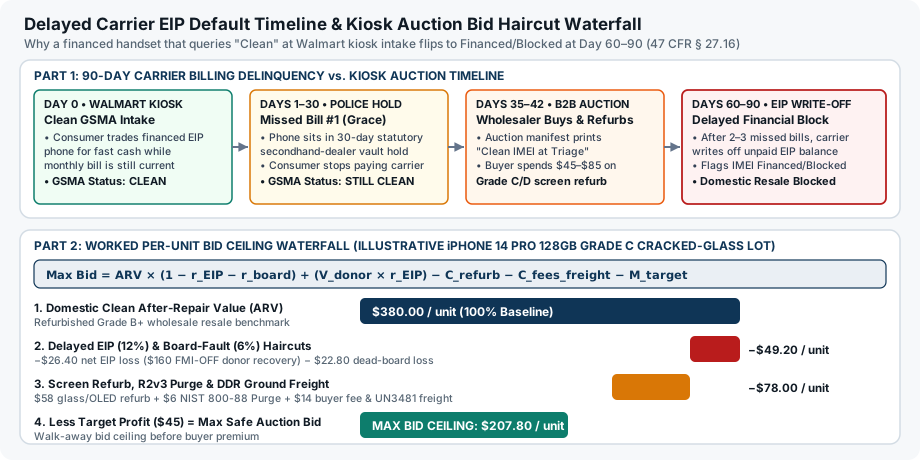
Under the FCC’s network access and handset unlocking framework in 47 CFR § 27.16 alongside CTIA carrier unlocking commitments, US mobile network operators restrict device unlocking and domestic network activation when a handset carries an unpaid installment balance or fraud/default flag. Here is how the 90-day delinquency clock creates post-auction losses on kiosk stock:
- Day 0 (Kiosk Drop-Off at Walmart/Kroger): A consumer finances a $1,000 smartphone on a 24- or 36-month carrier EIP. Two months later, needing immediate cash, the consumer sells the phone at a retail kiosk while their monthly carrier statement is still current. At intake, the kiosk queries GSMA Device Check and receives a Clean response.
- Days 1–30 (Statutory Police Hold): The phone sits inside the locked kiosk vault. The consumer misses Billing Statement #1. Because telecom carriers grant a 30-to-60-day past-due grace period before charging off an account, the IMEI still queries Clean when the phone exits the police hold at Day 31.
- Days 35–42 (B2B Wholesale Auction & Refurbishment): The central sorting hub re-checks the IMEI (still Clean on GSMA), lists the lot as
"Clean IMEI at Triage", and sells it at auction. The winning wholesaler receives the pallet and invests $38 to $92 per unit in screen refurbishment. - Days 60–90 (Carrier Write-Off & Financial Block): After two to three consecutive missed bills, the carrier charges off the delinquent EIP contract and flags the IMEI as Financed / Non-Payment Blocked (or files a delayed carrier insurance loss claim). If the phone is still sitting in the wholesaler’s warehouse—or has just been sold to a downstream retail buyer—it triggers an immediate RMA return.
The Quantitative Kiosk Auction Bid Ceiling Formula
To prevent delayed EIP defaults and hidden kiosk board faults from wiping out net spread, calculate your walk-away maximum bid before opening the auction bidding window:
Max_Bid_Per_Unit = [ARV × (1 − r_EIP − r_board)] + (V_donor × r_EIP) − C_refurb − C_fees_freight − M_target
Where each variable is defined on your pre-bid worksheet:
ARV: Domestic After-Repair Wholesale Resale Value for a tested, clean, functional unit.r_EIP: Expected post-hold delayed carrier EIP financial default rate (typically 0.08 to 0.18 [8%–18%] on carrier-locked kiosk lots under 24 months old; 0.02 to 0.04 on 3-year-old models).r_board: Unseen logic-board defect rate missed by 3-minute kiosk optical/USB diagnostics (typically 0.04 to 0.07 [4%–7%] on drop-damaged Grade C/D cracked-glass lots).V_donor: Residual recovery value of an EIP-blocked (FMI-OFFbut domestic network-blocked) handset when harvested as a cleanFMI-OFFgenuine parts donor foriOS 18 Repair Assistantor routed to compliant R2v3 international secondary channels.C_refurb: Per-unit refurbishment labor, glass/OLED parts, andNIST SP 800-88sanitization verification cost.C_fees_freight: Auction buyer premium, inbound hazmat ground freight, and manifest variance allowance.M_target: Required net dollar profit per unit.
Worked Calculation (Illustrative iPhone 14 Pro 128GB Grade C Cracked-Glass Kiosk Lot)
ARV=$380.00r_EIP=0.12(12% delayed carrier EIP default rate)r_board=0.06(6% hidden board/Face ID fault rate)V_donor=$160.00(cleanFMI-OFFOLED + rear camera + housing donor recovery value)C_refurb=$64.00($58 blended glass/OLED rework + $6 NIST erasure & QC)C_fees_freight=$14.00M_target=$45.00
Step-by-step arithmetic:
- Clean functional revenue contribution:
$380.00 × (1 − 0.12 − 0.06) = $380.00 × 0.82 = $311.60 - EIP-defaulted
FMI-OFFdonor recovery contribution:$160.00 × 0.12 = $19.20 - Expected gross realized value per unit:
$311.60 + $19.20 = $330.80 - Deduct refurbishment, fees/freight, and target margin:
$330.80 − $64.00 − $14.00 − $45.00 = $207.80
Rules of thumb: If r_EIP exceeds 10% on a recent carrier-locked kiosk lot, run a paid carrier financial-eligibility check on every IMEI immediately upon warehouse receipt before investing screen refurbishment labor; if a unit already shows an active unpaid EIP contract, divert it straight to your clean FMI-OFF donor harvesting bench rather than spending $58 refurbishing a phone that will block before resale. Plug your own lot assumptions directly into our bulk phone profit calculator and reconcile lot-level failure reserves with our phone reseller profit margins worksheet.
Takeaway: Never bid on a kiosk Grade C/D auction lot assuming 100% of “Clean at Intake” IMEIs will stay clean at Day 75; deduct r_EIP and r_board upfront and verify carrier financial eligibility before starting screen repairs.
5. R2v3 Sanitization (NIST SP 800-88) & Swollen-Battery Freight Rules (49 CFR § 173.185)
Wholesale buyers handling Grade C/D and salvage kiosk pallets face two mandatory regulatory compliance gates at the warehouse dock: data sanitization on damaged or non-booting devices and hazardous-materials ground transport for swollen lithium-ion batteries.
Sanitizing Cracked or Dead Kiosk Boards (SERI R2v3 Appendix B & NIST SP 800-88 Rev. 1)
Although retail kiosks instruct consumers to wipe their devices before insertion, a high percentage of Grade C/D cracked-screen phones arrive at central sorting hubs and downstream wholesale benches with black displays, drained batteries, and live consumer personal data still stored on NAND flash.
Under NIST SP 800-88 Rev. 1 Guidelines for Media Sanitization and Appendix B (Data Sanitization) of the SERI R2v3 Standard, a basic menu reset (Clear) is insufficient for commercial resale compliance:
- Cryptographic
Purge(Functional & DFU-Capable Boards): On modern iOS (Secure Enclave) and Android (File-Based Encryption) handsets, wholesalers must execute a verified cryptographicPurge—driving a full DFU/recovery firmware restore and cryptographic key destruction through certified sanitization software (such as Blancco, Phonecheck, or NSYS) that logs an auditable, tamper-proof erasure certificate tied to the hardware IMEI and serial number. - Physical
Destroy(Dead PMIC / Non-Booting Logic Boards): When a water-damaged or drop-damaged kiosk board has a shorted power rail or dead NAND and cannot enter DFU mode to verify cryptographicPurge, you may not sell that intact logic board into uncertified public scrap markets. Under R2v3 Appendix B/C, the board must either be repaired on a controlled bench until cryptographicPurgesucceeds and generates a certificate, or the NAND/board must be routed to physicalDestroy(mechanical shredding, disintegration, or certified smelter recovery).
Ground-Only Hazmat Packaging for Swollen Kiosk Batteries (PHMSA 49 CFR § 173.185(f))
Because kiosk trade-ins sit inside unconditioned retail enclosures and 30-day statutory hold vaults in a deeply discharged state, Grade D and salvage kiosk pallets routinely contain handsets with swollen, gaseous lithium-ion pouch cells that push the display assembly out of the frame.
Under the US Department of Transportation’s Pipeline and Hazardous Materials Safety Administration (PHMSA) regulations in 49 CFR § 173.185(f), any lithium-ion cell or battery contained in equipment (UN3481) that is swollen, bloated, punctured, leaking, or identified as having a potential safety defect is legally classified as a Damaged, Defective, or Recalled (DDR) battery:
- Strict Air Transport Ban: Swollen or DDR lithium-ion batteries (
UN3481DDR) are strictly forbidden for transport aboard passenger or cargo aircraft under both49 CFR § 173.185(f)and IATA Dangerous Goods Regulations Special Provision A154. Never book express air courier labels for kiosk salvage pallets or RMA returns containing swollen pouches. - Packing Group I Ground-Only Packaging: DDR devices shipped via highway or rail freight must be segregated from standard used-phone pallets. Each unit or battery must be placed in an individual, non-metallic inner packaging surrounded by non-combustible, electrically non-conductive cushioning and absorbent material, sealed inside a Packing Group I performance-tested outer drum or box (
4G,1A2,1H2), and visibly marked on the exterior:"Damaged/Defective Lithium-Ion Batteries — Forbidden for Transport by Aircraft". Review our wholesale phone shipping guide before scheduling inbound LTL freight on salvage kiosk lots.
Takeaway: Enforce a two-track dock gate on every kiosk auction shipment: log a NIST SP 800-88 cryptographic Purge certificate for every booting IMEI, and quarantine any swollen pouch battery for 49 CFR § 173.185(f) ground-only Packing Group I disposal or transport.
Key takeaways
- Retail cash kiosks hold collected devices for 15 to 30 days under state and municipal secondhand-dealer ordinances before central R2v3 sorting.
- Kiosk B2B auction lots skew heavily toward Grade C/D cracked-glass (FMI-OFF) and FMI-ON salvage compared to carrier upgrade trade-in hubs.
- Apple iOS 18 Component Activation Lock blocks Repair Assistant calibration on displays, batteries, and cameras pulled from FMI-ON kiosk salvage.
- Financed phones that pass GSMA Device Check at a Walmart kiosk can still flip to Financed/Blocked at Day 60–90 when the seller defaults on their carrier EIP.
- Swollen lithium-ion pouches in aged kiosk salvage lots fall under PHMSA 49 CFR § 173.185(f) DDR rules and require ground-only Packing Group I transport.
Frequently asked questions
Where do phones sold at an ecoATM Walmart kiosk go?
After a consumer trades in a phone for cash at an ecoATM kiosk inside Walmart, Kroger, or a shopping mall, the device is locked inside an internal serialized collection bin and held for 15 to 30 days to satisfy local secondhand-dealer law-enforcement inspection rules. Once the statutory hold expires, units are transported to a central R2v3-certified sorting facility, sanitized under NIST SP 800-88 standards, graded into functional (Grade A/B), repairable cracked-glass (Grade C/D), or FMI-ON salvage streams, and sold in bulk to registered B2B phone wholesalers and refurbishers via closed wholesale auctions.
Can individual resellers buy phones directly out of a local ecoATM kiosk?
No. Retail kiosk enclosures are physically sealed, armored collection vaults accessible only to authorized field technicians and law-enforcement compliance teams. B2B buyers acquire cleared kiosk inventory by registering with centralized wholesale auction platforms and direct institutional tender channels after supply clears the mandatory municipal hold period and central warehouse triage.
Why do ecoATM wholesale auction lots have higher Grade C/D and salvage ratios than carrier trade-in lots?
Carrier trade-in programs at Verizon, AT&T, and T-Mobile incentivize postpaid subscribers to return clean, working Grade A/B phones by offering $600 to $1,000 in multi-year bill credits. Immediate-cash retail kiosks attract impulse and distress liquidations, including devices with shattered front or rear glass, bleeding OLED panels, degraded batteries, or forgotten iCloud locks that fail carrier promo eligibility.
How does iOS 18 affect the value of FMI-ON salvage lots from trade-in kiosks?
A part protected by Activation Lock may require the associated Apple Account information to complete repair. Check the exact phone model, component, software requirements and documented lock status before pricing a donor part. Estimate recoverable value from the usable parts and current offers for that lot.
Why does a kiosk phone with a clean GSMA check at intake get blacklisted 60 days later?
At the moment a seller drops a financed phone into a Walmart kiosk, their monthly carrier billing account is often still current, so GSMA Device Check returns a Clean status. If that seller stops paying their Equipment Installment Plan (EIP) after taking the kiosk cash, the carrier takes 60 to 90 days (two to three missed billing cycles) to charge off the account and flag the IMEI as Financed/Blocked—often after the phone has cleared the 30-day police hold and entered a wholesaler's warehouse.
Can wholesale lots containing swollen kiosk batteries be shipped by air freight?
No. Under PHMSA 49 CFR § 173.185(f) and IATA Special Provision A154, lithium-ion batteries that are swollen, bloated, punctured, or thermally compromised are classified as Damaged, Defective, or Recalled (DDR) and are strictly forbidden on cargo or passenger aircraft. They must move via highway ground freight inside Packing Group I performance-tested containers with non-combustible, electrically non-conductive cushioning.
Sources and methodology
- Law Enforcement & Kiosk Security – ecoATM — ecoATM Accessed October 25, 2026.
- How it works – ecoATM — ecoATM Accessed October 25, 2026.
- iPhone Parts and Service History - Apple Support — Apple Support Accessed October 25, 2026.
- Activation Lock for iPhone and iPad - Apple Support — Apple Support Accessed October 25, 2026.
- R2v3 Standard – Sustainable Electronics Recycling International — SERI Accessed October 25, 2026.
- NIST SP 800-88 Rev. 1: Guidelines for Media Sanitization — NIST Accessed October 25, 2026.
- GSMA Device Check - Official Global IMEI Blacklist & Registry — GSMA Accessed October 25, 2026.
- 47 CFR § 27.16 — Network access requirements for Block C — eCFR / Federal Communications Commission Accessed October 25, 2026.
- 49 CFR § 173.185 — Lithium cells and batteries — eCFR / PHMSA DOT Accessed October 25, 2026.
Update history
- — First published. Official sources on this page were accessed on this date unless a later note says otherwise.
Factual corrections after publication are listed on the corrections page. Editorial responsibilities and review methods are described in the editorial policy.