
Key takeaways
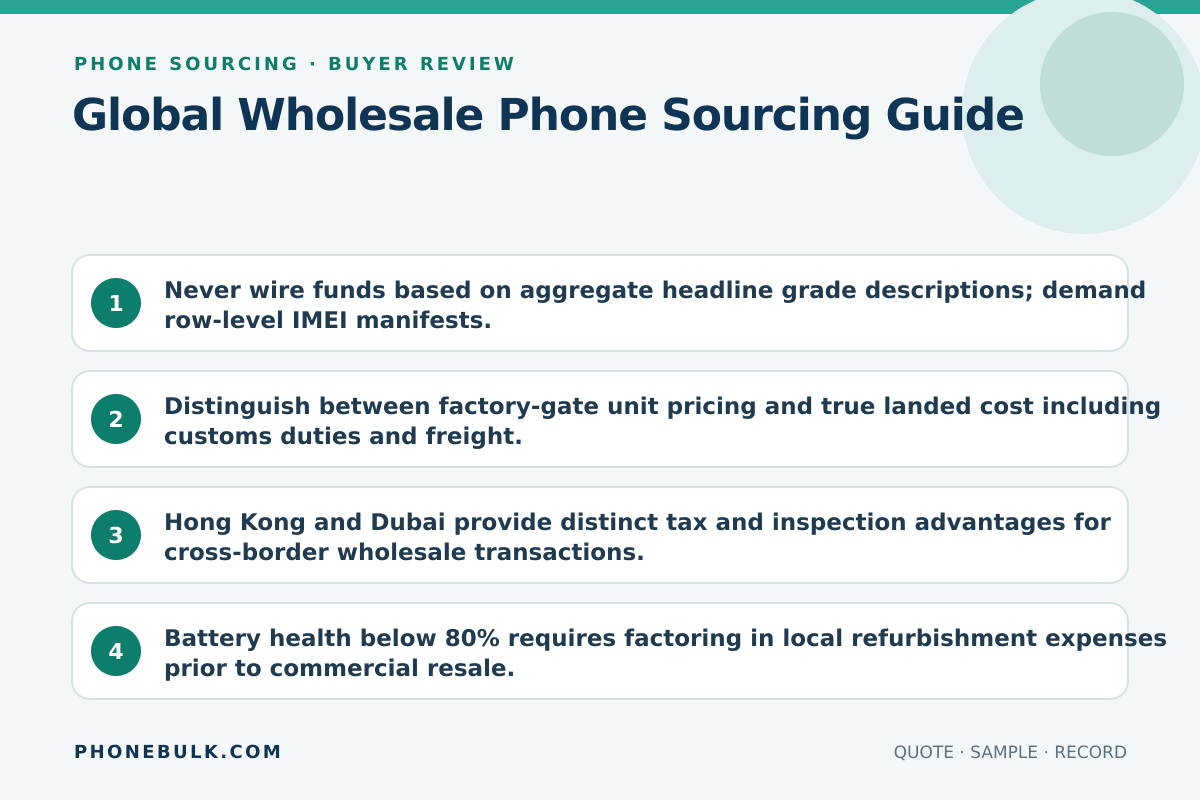
- Never wire funds based on aggregate headline grade descriptions; demand row-level IMEI manifests.
- Distinguish between factory-gate unit pricing and true landed cost including customs duties and freight.
- Hong Kong and Dubai provide distinct tax and inspection advantages for cross-border wholesale transactions.
- Battery health below 80% requires factoring in local refurbishment expenses prior to commercial resale.
Sourcing pre-owned and refurbished mobile devices at scale is one of the most profitable yet operationally volatile sectors in consumer electronics distribution. For wholesale distributors, repair depot chains, and e-commerce refurbishers, navigating international supply channels demands rigorous diligence.
This global wholesale phone sourcing guide covers the end-to-end procurement lifecycle—from evaluating free-trade auction hubs to managing hazardous cargo air freight and mitigating counterpart counter-party fraud. Check our foundational wholesale phone buying guide and wholesale phone shipping guide for additional workflow details.
1. The Global Wholesale Sourcing Map: Hong Kong vs. Dubai
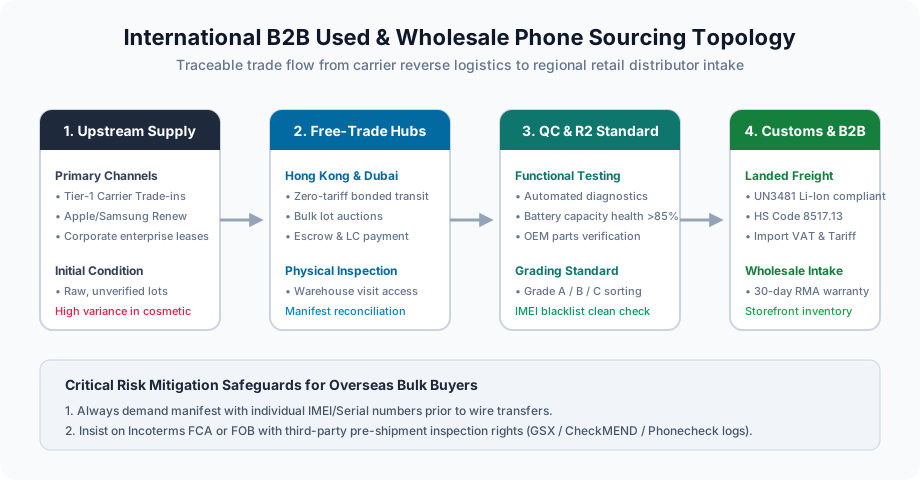
When enterprise buyers decide to how to buy wholesale cell phones overseas, trade routes generally funnel through two dominant duty-free transit hubs:
Hong Kong: The Volume Clearinghouse
- Source Origin: Over 70% of carrier trade-ins and insurance return inventories originating from North America, Japan, and Western Europe flow through Hong Kong warehouses.
- Auction Formats: Major recyclers sell inventory via weekly blind-bid auctions or pre-graded lots.
- Logistics Dynamics: Zero import/export tariffs, highly developed air cargo connectivity, and proximity to regional electronics testing centers make it the premier destination for bulk pallet buyers.
Dubai: The Regional Distribution Gateway
- Source Origin: Acts as a re-export hub servicing the Middle East, Eastern Europe, Central Asia, and Africa.
- Inventory Characteristics: Often features smaller, more negotiable mixed-model lots (MOQs starting around 50–100 units rather than full 1,000+ unit crates).
- Payment & Settlement: Well-established banking corridors supporting both USD wire transfers and structured trade finance.
2. Manifest Verification & Cosmetic Grading Standards
One of the costliest errors when businesses import used phones wholesale is relying on subjective supplier grade labels like “Grade A Mint” or “Like New.” A resilient purchasing protocol insists on standardized grading frameworks—cross-reference our wholesale phone grading standards and rigorous bulk phone QC checklist before approving purchase orders. Always verify counter-parties with our supplier verification checklist.
| Cosmetic Grade | Physical Condition Criteria | Functional Expectation |
|---|---|---|
| Grade A (Pristine) | Zero scratches visible at arm’s length; no screen micro-abrasions; housing flawless. | 100% fully functional; OEM parts intact; battery health ≥ 85%. |
| Grade B (Light Wear) | Minor hairline scratches on screen or back glass; no deep gouges or frame dents. | 100% functional; Touch ID/Face ID verified; battery health ≥ 80%. |
| Grade C (Heavy Wear) | Visible paint chipping, corner dings, noticeable screen scratches. | Fully functional core motherboard; clean IMEI; ready for budget retail or housing swap. |
Red Flags to Eliminate Before Wire Transfer
- Refusal of Row-Level IMEI Lists: Never accept aggregate purchase orders that say “100x iPhone 15 Grade A”. Demand an itemized manifest specifying exact storage capacity, original carrier lock status, and IMEI identifiers.
- Missing Blacklist Verification: Every device must be pre-cleared against GSMA, CheckMEND, or official carrier databases to ensure no units are flagged as lost, stolen, or tied to unpaid carrier equipment installment plans (EIP).
- Third-Party Inspection Inaccessibility: If an overseas trading company refuses to allow an independent inspection team (such as SGS or local depot agents) to physically verify carton seals and count stock in their bonded facility, cancel the order.
3. Landed Cost Calculation & Customs Clearance
Professional procurement teams evaluate bids through Landed Cost rather than factory-gate unit prices:
$$ ext{Landed Cost per Unit} = ext{Unit FOB Price} + ext{Air Freight} + ext{Insurance} + ext{Customs Tariffs} + ext{Defect Rate Loss}$$
- HS Code Classification: Mobile phones generally fall under Harmonized System Code 8517.13.00. While many jurisdictions exempt smartphones from primary tariffs under the Information Technology Agreement (ITA), local value-added taxes (VAT/GST) and handling fees must be escrowed.
- Lithium Battery Hazardous Cargo (UN3481): Bulk air freight of devices with installed batteries requires UN3481 PI967 compliance. Airlines limit battery charge levels (State of Charge < 30%) and enforce drop-tested packaging regulations to prevent thermal runaway incidents in transit.
- RMA & Defect Allowance: Negotiate a structured Return Merchandise Authorization (RMA) window (typically 30 to 45 days from port arrival). Standard contracts should include a 2%–3% DOA credit or replacement guarantee on motherboards with unadvertised faults.
By treating international smartphone procurement as a disciplined supply chain process rather than a speculative trade, volume buyers secure consistent margins and protect downstream retail reputation.
Frequently asked questions
How do enterprise buyers verify wholesale phone suppliers overseas?
Legitimate suppliers provide verified company registration, allow third-party physical warehouse inspections, accept secure escrow or Letters of Credit (LC), and furnish verifiable diagnostic reports (such as Phonecheck or NSYS).
What is the difference between sourcing phones in Hong Kong versus Dubai?
Hong Kong remains the primary auction and transit hub for carrier trade-in lots from North America and Japan with zero import duty. Dubai serves as the gateway for Middle East, African, and European re-export routes with flexible lot sizes.
What regulations govern international shipping of bulk used mobile phones?
Air cargo requires strict IATA lithium-ion battery compliance under UN3481 (PI967 section II). Pallets must be accompanied by accurate Material Safety Data Sheets (MSDS) and hazardous cargo manifests.
Update history
- — First published. Official sources on this page were accessed on this date unless a later note says otherwise.
Factual corrections after publication are listed on the corrections page. There is no separate reviewer identity on this desk. See the editorial policy.

About the author
Frank Dean
Frank Dean researches manufacturer, standards, and trade documents for PhoneBulk, then turns them into accept / clarify / reject buying guidance for resellers.
- Source-backed wholesale research
- Claim-level fact review
- Separation of official rule and trade practice