A courier total and an airport rate are not the same product. Compare them only after both quotes name the chargeable weight and the operator has accepted the batteries.
Which lots this page covers
Fifty to about one thousand phones, batteries installed, one destination, moved by air. Spare batteries packed beside the phones, batteries shipped alone, and sea freight use a different classification. Start with shipping wholesale phones for that configuration check. This page does not quote DHL, FedEx, or an airline.
Read the paper before the price
A courier line, including a DHL or FedEx express service when that is the name on the quote, should show an integrator, a chargeable weight, and whether delivery is to a door or held for pickup. An air waybill should show an airline or forwarder, an origin airport, a per-kilogram line, and separate handling lines. If the paper only says “door to door” or “air cargo,” stop and ask which of those two products it is.
Chargeable weight is the weight the quote bills. It is the higher of the weighed kilograms and the volumetric kilograms the carrier prints. Do not substitute a per-phone catalog weight.
A charter is a third product: the forwarder is booking aircraft space, not a consolidated air waybill. It does not change the packing instruction. Use it only when the contract names the same lithium configuration and the operator has accepted that cargo.
Lithium acceptance comes first
The IATA 2026 Battery Guidance Document classifies lithium-ion batteries contained in equipment as UN 3481, packing instruction 967. For those phones, a reduced state of charge is recommended, not a universal mandatory limit. Do not copy the stricter state-of-charge rule from batteries that are packed with equipment or shipped alone.
Batteries shipped by themselves are a different entry, UN 3480. The same guidance forbids that entry as cargo on passenger aircraft and says the operator is not obligated to carry a consignment even if a state approval exists. A cheaper charter rumor does not override that.
Accept the freight comparison only after the operator’s written acceptance matches the actual cartons: phones with batteries inside, or a different configuration you have named.
Demonstration arithmetic, not a tariff
These inputs are round numbers chosen on October 11, 2026 so the arithmetic is visible. They are not a market survey. Replace every rate with the quote in your file.
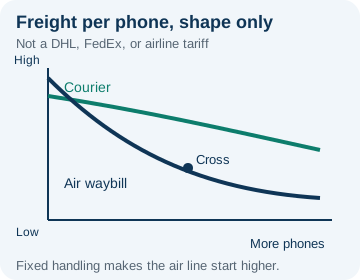
Courier total is the higher of the minimum and chargeable kilograms times the courier rate: max(90, 55 × 9) = $495, or $4.95 per phone.
Air-waybill freight is the higher of the airline minimum and chargeable kilograms times the air rate, then add the fixed handling: max(150, 55 × 4) + 220 = $440, or $4.40 per phone. At this demonstration point the air waybill is lower per phone.
The same formulas at 20 phones and 12 kg chargeable weight: courier max(90, 12 × 9) = $108, or $5.40 per phone. Air max(150, 12 × 4) + 220 = $370, or $18.50 per phone. Here the courier is lower because the air handling has not been spread out.
Quote decisions
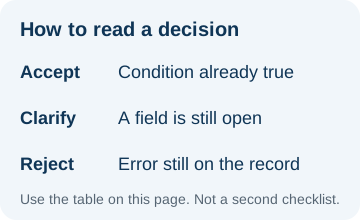
Accept means both numbers are already on the quote and the lithium acceptance matches the cartons. Clarify means a field is still open. Reject means the paper still has an error. Check Reject first.
Courier versus air waybill
- Accept. Both quotes show chargeable weight, the all-in total, and written operator acceptance of UN 3481 packing instruction 967 for batteries installed in the phones. You have divided each total by sellable phones.
- Clarify. Weight, volumetric basis, handling lines, or the operator’s lithium acceptance is missing. A per-kilogram teaser with no minimum is still open.
- Reject. The comparison uses a catalog weight, mixes spare batteries into a phone-only booking, or treats a door-to-door slogan as an air-waybill rate.
Charter
- Accept. The charter contract names the battery configuration, the operator has accepted it, and the all-in aircraft cost is divided by the same sellable count.
- Clarify. The forwarder has not said whether this is a charter or a consolidated air waybill.
- Reject. The pitch is a lower per-kilogram rumor, or it claims the charter skips the packing instruction.
Keep the freight result beside the Incoterm and named place. A term that says who pays carriage does not classify the batteries. Put the accepted totals into the landed-cost calculator only after the lithium line is closed.
Related guides
- Shipping wholesale phones — classify the batteries before you compare these rates.
- Incoterms for phone importers — name who pays carriage separately from who accepts the cargo.
- Landed-cost calculator — add the accepted freight to the other landed lines.
Key takeaways
- Use the weighed chargeable kilograms on the quote, not a catalog weight.
- Divide the all-in freight by sellable phones, not by cartons.
- Phones with the battery installed are UN 3481, packing instruction 967, on the IATA 2026 air-cargo guidance.
- A door-to-door slogan with no weight and no lithium acceptance is not a comparable rate.
- A charter does not relax the packing instruction. The operator still has to accept the cargo.
Frequently asked questions
Is DHL or FedEx always cheaper than an air waybill for 100 phones?
No. The crossover depends on the chargeable weight and the fixed handling on the air waybill. Replace the demonstration rates below with the two quotes in front of you.
Can a charter skip the lithium paperwork?
No. IATA’s 2026 guidance says an operator is not obligated to carry a consignment even when a state approval exists. Write the same battery configuration into the charter contract.
Sources and methodology
- Battery Guidance Document, revised for 2026 (67th IATA DGR), PI 967 page 14 and operator acceptance pages 16–17 — International Air Transport Association Accessed October 11, 2026.
- IATA lithium batteries — International Air Transport Association Accessed October 11, 2026.
Update history
- — First published. Official sources on this page were accessed on this date unless a later note says otherwise.
Factual corrections after publication are listed on the corrections page. Editorial responsibilities and review methods are described in the editorial policy.

About the author
Frank Dean
Frank Dean researches manufacturer, standards, and trade documents for PhoneBulk, then turns them into accept / clarify / reject buying guidance for resellers.
- Source-backed wholesale research
- Claim-level fact review
- Separation of official rule and trade practice