
A used iPhone sold as healthy when the battery is already past Apple’s stated design point wastes the return window, and a battery service whose fee exceeds the resale spread turns the repair into a loss. The cycle count and the service fee answer different questions. Write both before the unit moves.
Maximum Capacity is Apple’s estimate of charge relative to a new battery. The 80 percent figure is the capacity Apple says the battery is designed to retain at a stated cycle count under ideal conditions, not a Grade A rule. On the US page “iPhone Battery and Performance,” retrieved 20 October 2026, iPhone 14 models and earlier are designed to retain 80 percent at 500 complete charge cycles, and iPhone 15 models at 1,000. The companion page for iPhone 11 and later states the 1,000-cycle design point for iPhone 15 models and later. Out of warranty, that same performance page says Apple offers battery service for a charge. The US repair page retrieved the same day did not print a dollar fee.
Which number belongs on the lot sheet?
Keep the model family next to the cycle count. A 600-cycle iPhone 13 and a 600-cycle iPhone 15 are not at the same design point.
How to read Maximum Capacity, and why it is not a lab capacity test, is already set out in battery health for wholesale phones. This page starts where that one stops: whether service recovers more than the as-is bid.
A charging setup shows that the unit can take power. It does not show Maximum Capacity, cycle count, or a service fee.
When does the service fee beat the as-is bid?
Net of service = resale spread − service fee − handling.
Resale spread = expected bid after a completed battery service − as-is bid for the same unit, same grade and lock state otherwise. Handling is labor, parts freight, and days the unit is unsellable, entered in the same currency. If the covering plan pays the battery, the service fee in this sum is zero and handling remains.
Worked example, labeled as a worksheet assumption, not an Apple price and not a bid this site recorded:
- As-is bid = 200
- Bid after service = 280
- Spread = 280 − 200 = 80
- Service fee on the record = 99
- Handling = 6
- Net = 80 − 99 − 6 = −25
On that sheet, service destroys 25 per unit. Selling or discounting as-is avoids the loss. Change only the fee: if the same unit’s plan replaces the battery at no extra charge, fee = 0 and net = 80 − 0 − 6 = 74. Service is then the higher path on the same assumed spread.
Rules of thumb. If cycle count exceeds 500 on an iPhone 14 or earlier, the unit is past the cycle count at which Apple says the battery is designed to retain 80 percent under ideal conditions. Read the percentage anyway; the count does not calculate it. If cycle count exceeds 1000 on an iPhone 15 or later, apply the same reading to that family’s design point. If the resale spread is below the service fee, the net is negative before handling, so leave the battery and reprice the unit.
The profit-margin worksheet is where the per-unit net joins freight, fees, and failed units. Do not add this battery net a second time as a separate “repair reserve” on top of the same dollars.
What a cycle is, and what a third-party swap does to the reading
Apple defines one complete charge cycle as use of an amount that represents 100 percent of battery capacity, not a single session on the charger. On the performance page, a complete cycle is normalized between 80 percent and 100 percent of original capacity to account for the expected decline. Apple’s lithium-ion page, retrieved the same day, illustrates that with two partial days: 75 percent of capacity one day and 25 percent the next day add to one cycle.
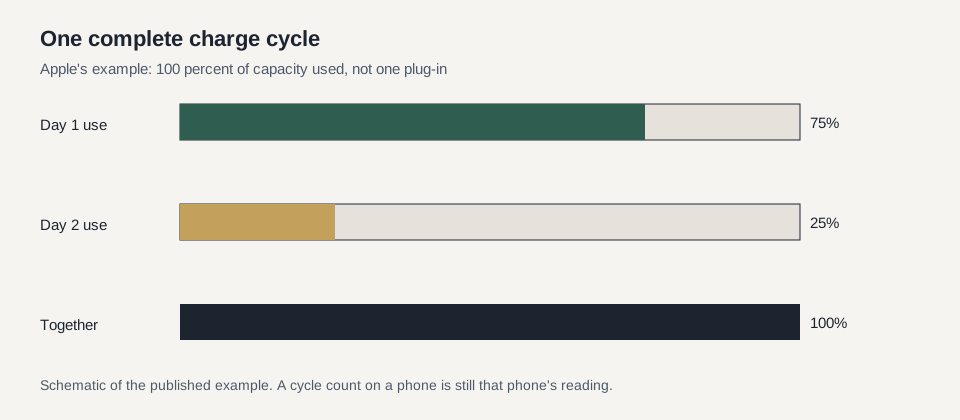
Schematic of Apple’s 75 percent plus 25 percent example. It is not a screenshot from a phone in this lot.
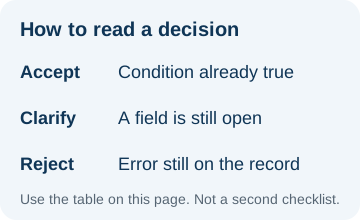
A replacement battery does not, by itself, make the unit the cosmetic grade on the carton. Apple’s parts guidance says health details might not be accurate when the battery is unverified, and a new Apple battery can still show Finish Repair until the repair is completed. Those states belong in the clarify column of the battery-health record, not in the “serviced, so bid the healthy price” column.
Two physical groups. The photo does not identify which tray is past a cycle threshold or which tray has a paid service pending.
Where the money leaks if the threshold is skipped
Count these as separate lines. None of them is a percentage Apple publishes.
- Paid service on a covered unit. The repair page’s below-80-percent line is a no-extra-charge benefit in the AppleCare-style block. Paying a shop fee on top of that coverage is a double spend.
- Healthy bid on an unverified percentage. The next buyer disputes the reading. The unit comes back, and the spread you booked never arrives.
- One threshold for mixed models. An iPhone 13 at 600 cycles and an iPhone 15 at 600 cycles do not share a design point. One bin price for both hides the older family’s position past 500 cycles.
- Holding cost. Units waiting on service are not the sellable quantity in the margin worksheet. Enter the days.
- Air return of a damaged battery. Ordinary air cargo rules for phones are in the shipping guide, including the IATA limit on safety-defective batteries. A low capacity percentage is not, by itself, that safety defect. Do not book the return as if it were.
There is no sourced US out-of-warranty dollar fee in the pages retrieved for this guide. Put the fee from the service record into F. Do not backfill a price from memory.
File the model family, Maximum Capacity, cycle count, part label, fee, and the net with the reseller guides. The refurbished phones page is the process claim that sits beside a battery swap; a swap alone does not create that claim.
Method and sources
Cycle design points are from Apple’s “iPhone Battery and Performance” page and the “iPhone 11 and later” battery page, both retrieved 20 October 2026. The below-80-percent no-extra-charge line is from Apple’s iPhone battery-replacement page the same day, in the benefits block that also describes AppleCare coverage. The 75/25 cycle example is from Apple’s “Why Lithium-ion?” page, retrieved 20 October 2026. Dollar amounts in the worked example are assumptions, marked as such, because the retrieved US repair page did not include a fee table.
Key takeaways
- Record model family before applying 500 or 1,000 cycles.
- Below 80 percent is an AppleCare battery-service line on Apple's repair page, not a grade name.
- Net of service equals resale spread minus fee minus handling.
- An unverified battery makes the percentage a poor input to that sum.
Frequently asked questions
Is 80 percent the cutoff that forces a battery replacement on every used iPhone?
No. Apple states 80 percent as the capacity its batteries are designed to retain at 500 or 1,000 complete cycles under ideal conditions, depending on the model family. A reseller floor is a commercial choice written on the order.
Does a cycle count above 500 mean the battery is under 80 percent?
No. The design point is capacity at a cycle count under ideal conditions. A unit can sit above 80 percent past that count, or below 80 percent before it. Read the percentage and the count as separate fields.
Sources and methodology
- iPhone battery and performance — Apple Support Accessed October 20, 2026.
- About the battery and performance of iPhone 11 and later — Apple Support Accessed October 20, 2026.
- iPhone battery replacement service — Apple Support Accessed October 20, 2026.
- About genuine iPhone batteries — Apple Support Accessed October 20, 2026.
- Why Lithium-ion? — Apple Accessed October 20, 2026.
Update history
- — First published. Official sources on this page were accessed on this date unless a later note says otherwise.
- — First publication. Cycle design points and the below-80-percent service line are from Apple pages retrieved the same day. Dollar figures in the worksheet are labeled assumptions.
Factual corrections after publication are listed on the corrections page. Editorial responsibilities and review methods are described in the editorial policy.