
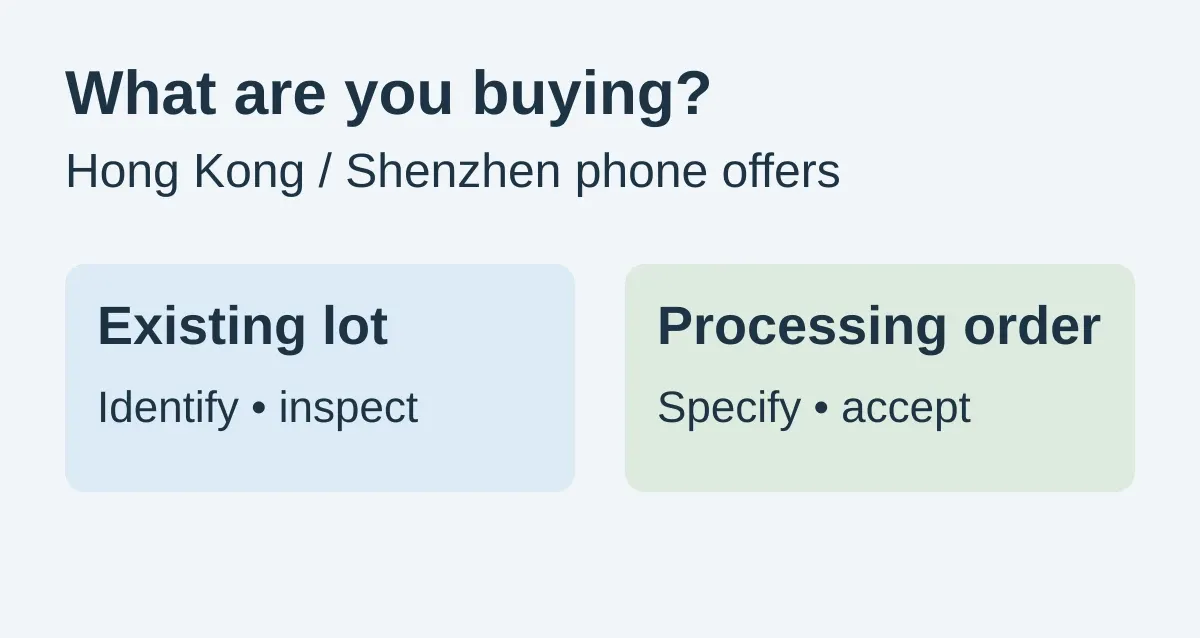
A useful Hong Kong versus Shenzhen comparison starts with two offers: an existing phone lot sold by bid, and phones supplied to an agreed processing specification. The first asks whether you can establish the lot’s condition before committing. The second asks whether a supplier can document the work and deliver the agreed result. Either model can exist in either city.
Do not equate “Hong Kong stock” with untouched carrier returns or “Huaqiangbei stock” with a particular refurbishment quality. A warehouse address does not establish where phones came from or what happened to them. For the wider market choice, see our China, Hong Kong and Dubai sourcing comparison. This guide focuses on the narrower contract and inspection differences.
What the available evidence actually establishes
Hong Kong operator Guang Yi publishes a bidding arrangement with lot lists, an onsite inspection stage and collection arrangements. Its published categories span several stock conditions and also include main boards and accessories. That is a concrete example of a lot-based buying process, not evidence that every auction supplies pristine, unlocked or directly traceable carrier inventory. We have not verified the operator’s current stock or its performance; check the terms attached to the particular sale.
Shenzhen’s official historical account of Huaqiangbei describes the development of a concentrated electronics production, wholesale and retail ecosystem. That establishes industrial context. It does not certify a particular repair shop, component’s authenticity or finished phone. Where a seller offers sorting, repair or repacking, evaluate the stated work as a separate purchase obligation.
Compare the offer, inspection point and acceptance evidence
The following is a buyer’s comparison framework, not a claim that all sellers in either city use these terms.
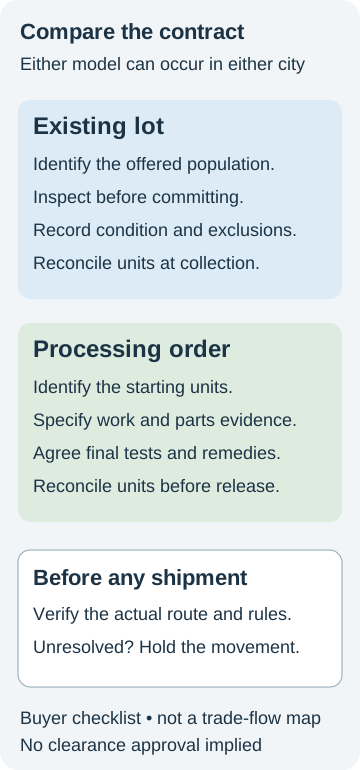
| Question | Existing auction or mixed lot | Processing or refurbishment order |
|---|---|---|
| What is the deliverable? | The identified lot in its stated condition | Units meeting an agreed final specification |
| When can the buyer inspect? | Ask what access is allowed before bidding and before collection | Agree checks at intake, after work and before release |
| What defines the phone population? | Lot reference, dated list, unit identifiers and exclusions | Intake list plus a record of substitutions and rejected units |
| What is the critical uncertainty? | Unknown faults or inconsistent descriptions within the lot | Undocumented parts or work, substitutions, and variation in final output |
| What should the price cover? | Ask about fees, collection, storage and any testing charges | Separate parts, labor, sorting, packaging and rework obligations |
| What resolves a disagreement? | The sale’s written condition, discrepancy and claim terms | The agreed specification, test records and acceptance remedy |
For a Hong Kong auction offer, tie every claim to the lot
Use the phone supplier verification checklist to establish who is making the offer. Before bidding, request the final version of the lot list and establish which document controls if an earlier draft differs. Ask whether the lot can be inspected, how sampling works, whether selected phones can be powered on, and whether photographed units are the same units offered for collection.
A practical lot record should request:
- The seller’s legal identity, invoice issuer, stock location and authority to sell.
- Model and regional variant, storage, quantity and identifiers linked to the offered population.
- The meaning of each condition label, including what was tested and what remains unknown.
- Declared account or carrier restrictions, missing parts, repairs and excluded units.
- Written payment, pickup, shortage, misdescription and return terms.
These are requested purchase protections, not a promise that an auctioneer must provide them. If access or remedies are limited, decide whether you can evaluate that uncertainty before bidding. Do not invent a defect allowance to make an unverified lot fit the budget.
Keep the accepted list, bid reference, invoice and collection record together. If the seller substitutes units, require a revised record and a decision on whether the revised lot is acceptable before release.
For a Shenzhen processing quote, separate the work into accountable stages
A seller may quote for ready-to-sell stock, act as a broker, or arrange work through another company. Ask which entity owns the phones, which performs the work, and which remains responsible for the final specification. An address in an electronics district answers none of those questions by itself.
Use a processing schedule rather than relying on a label such as “premium refurbished”:
| Stage | What to specify or request |
|---|---|
| Intake and sorting | Identify the starting units; separate units rejected from the agreed work |
| Repair | Record authorized operations and replaced components against each unit |
| Parts selection | Define the requested part category and the evidence needed to support any authenticity claim |
| Final testing | Agree functions, test method, reported results and criteria for acceptance |
| Cosmetics and packing | Approve the stated finish, accessories, labeling and packing requirements |
| Release | Reconcile the final manifest, rework list and sign-off before dispatch |
The table is an editorial procurement template. It does not imply that a listed workshop has these capabilities. A sample can help clarify the requested finish, but it cannot establish the condition of an entire order. Record how the remaining units will be checked and how failed units will be handled.
Keep the customs route separate from the commercial comparison
Hong Kong Customs describes Hong Kong as a free port without customs tariffs on imports and exports, while retaining customs control over cargo. That does not make the buyer’s complete route tax-free. Its declaration guidance also requires accurate import/export declarations for non-exempt articles within 14 days of import or export.
Write down the actual route: present stock location, any proposed processing location, export point and destination. A Hong Kong purchase shipped directly to your destination and a proposal to move stock into mainland China for work are different transactions. Obtain route-specific confirmation from the relevant authorities and your appointed clearance provider before contracting for a movement. This article does not determine mainland import eligibility or destination taxes.
Condition matters too. Hong Kong EPD’s May 2026 guidance, pages 2–3, explains that all electrical and electronic waste imports/exports fall under permit controls introduced in January 2025. Equipment proved to be non-waste is treated differently. Its criteria include functionality, fitness for direct use, appropriate protection in transit, and evidence of a second-hand sales outlet; testing reports may be requested. It also directs traders to verify legality with the relevant importing and exporting authorities.
Therefore, do not treat “for repair” or “untested” as equivalent to documented reusable equipment. Resolve classification and movement requirements before shipment; a commercial refurbishment plan does not itself establish permission to move the goods.
Put both quotations on the same acceptance basis
Ask both sellers to quote the same intended result: the same model mix and regional variants, defined functional and cosmetic requirements, inspection access, packing, delivery point, and responsibility for nonconforming units. List unresolved items beside the quotation instead of converting them into assumed savings.
Our suggested decision rule is:
- Consider the lot purchase when you can assess the identified stock and accept the written sale terms without depending on undocumented repair yield.
- Consider the processing contract when the work, parts evidence, final testing and rework responsibility are explicit and verifiable.
- Hold either offer when stock identity, authority to sell, final acceptance or the proposed shipment route remains unresolved.
Choose the offer whose evidence supports your resale requirements. The city name cannot substitute for that evidence.
Sources and methodology
- Bidding arrangement — Guang Yi Company Limited Accessed October 7, 2026.
- China's No. 1 electronics street: Huaqiangbei — Shenzhen Government Online / Shenzhen Archives Accessed October 7, 2026.
- Cargo clearance — Hong Kong Customs and Excise Department Accessed October 7, 2026.
- Import and export declaration — Hong Kong Customs and Excise Department Accessed October 7, 2026.
- Introduction to import and export permit control on electrical and electronic waste, May 2026 — Hong Kong Environmental Protection Department Accessed October 7, 2026.
Update history
- — First published. Official sources on this page were accessed on this date unless a later note says otherwise.
Factual corrections after publication are listed on the corrections page. There is no separate reviewer identity on this desk. See the editorial policy.