
A refurbished vs used phone B2B margin and warranty comparison can expose work and claim costs hidden by the lot label. Choose the route whose documented condition, remaining preparation work and enforceable supplier remedy support your resale plan after all costs.
Refurbished stock can transfer repair and preparation work to the supplier, provided that work is documented and meets the order. Used stock may leave more preparation with the reseller. Neither label establishes a margin or a warranty duration. Compare the same model, condition target and resale channel, then separate your customer’s remedy from the recovery you can actually obtain from the wholesale supplier.
The parent refurbished phones wholesale guide explains process evidence. This comparison turns those records into cost and warranty decisions.
Compare the work transferred with the lot
Ask what has been completed and what remains before resale. “Used” describes prior ownership; a refurbishment claim needs an agreed scope and evidence. These buying categories do not establish a universal grade.
A higher acquisition cost can be justified by work genuinely removed from your operation. A lower acquisition cost can be viable when you have the capacity and evidence to complete the remaining work. Neither conclusion follows from the condition label alone.
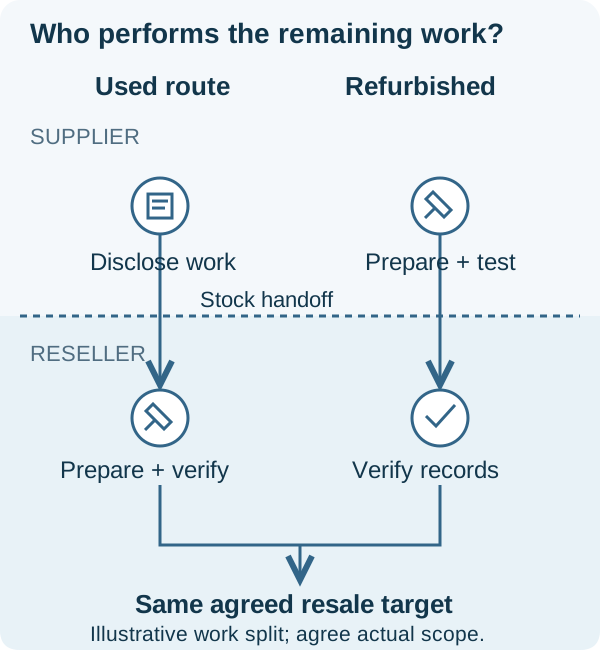
Compare where work is performed against the same resale specification; the routes do not imply equal condition or cost.
Use Amazon Renewed only within its stated scope
Amazon’s public US Renewed seller page, accessed October 19, 2026, provides a specific program example. It requires relevant selling experience and a quality process: inspection, repair, cleaning, testing and repackaging where applicable to meet original manufacturer specifications. Its application calls for qualifying invoices and sample product/packaging images; the seller must back the Renewed Guarantee and is responsible for claims.
Those are program requirements, not proof that a particular wholesale lot qualifies. The public seller page does not establish your supplier’s B2B warranty duration, transfer rights or a predicted return rate. Obtain the applicable written program and order terms for the actual transaction rather than treating a marketplace badge as your supplier contract.
Calculate contribution using the same cost boundary
Compare expected contribution per sold phone after preparation and after-sale costs, using your own documented inputs. Keep unsellable units and delayed credits visible at lot level so dividing only by the best units does not conceal losses.
Contribution per sold phone = net resale revenue − acquisition allocation − inbound allocation − inspection labor − repair labor and parts − accessories and packaging − selling and fulfillment costs − after-sale provision − carrying costs.
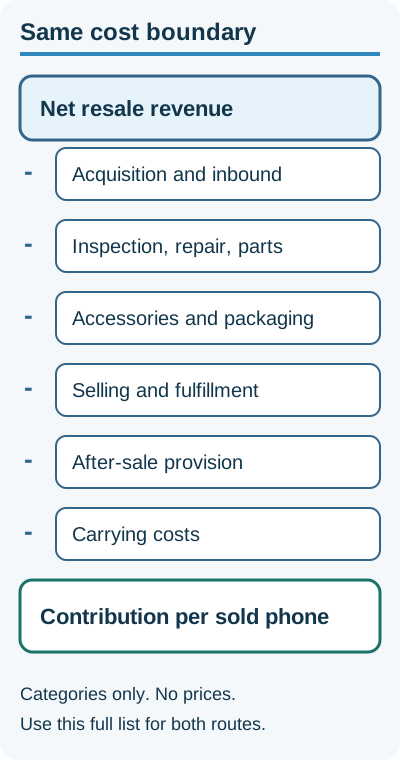
The same cost categories apply to both routes. The boxes are categories, not prices.
Use a consistent currency and period throughout. Net resale revenue should already exclude discounts and refunds if those are accounted for there. The after-sale provision should then include only incremental costs not already deducted, such as claim handling, unrecovered repair expense and return freight. Avoid charging the same refund twice.
If comparable return records are unavailable, show conditional scenarios with explicit assumptions. Do not present a chosen return percentage as measured experience. A refurbishment premium is supportable only when the documented work saved or other expected benefits justify its effect on contribution.
Compare the supplier clock with your customer obligation
A warranty is useful only when you can invoke it for the covered fault while the claim window remains open. Record the warrantor, beneficiary, clock start, covered faults, exclusions, notification deadline, required evidence, remedy, freight payer and settlement process for each route.
Keep distinct contracts distinct: the wholesale supplier’s remedy to your business, your resale promise to the customer, and any applicable marketplace guarantee. Confirm whether rights transfer and whether repair or resale changes coverage. Do not assume the supplier reimburses the remedy you promise downstream.
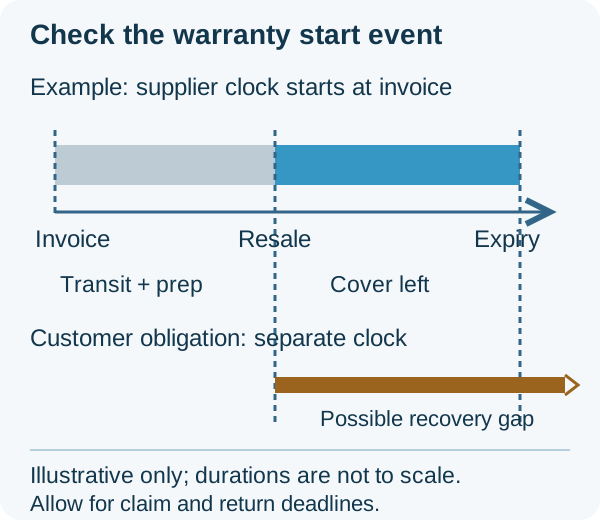
Illustrative invoice-start warranty: transit and preparation consume the supplier clock before resale. Check the actual contractual start event.
Define the timing for each route:
Supplier cover remaining at resale, in days = max(0 days, supplier warranty duration in days − elapsed days from its contractual start to resale).
Hypothetical numeric example — October 19, 2026 worksheet: Assume a supplier warranty of 60 calendar days from invoice and 20 calendar days between invoice and resale, including transit and preparation. Remaining cover = max(0 days, 60 days − 20 days) = 40 calendar days at resale, before allowing time for notification or return. These assumed terms illustrate the formula; they are not an Amazon requirement or a supplier offer.
Buyer rule, defined October 19, 2026: If remaining supplier cover is less than the recovery period your resale plan requires, under the contract’s actual start event and claim procedure, choose renegotiated coverage or explicitly fund the gap before committing. Otherwise your customer obligation can continue after supplier recovery becomes unavailable. Include any return-arrival deadline in that comparison; a notification deadline and a warehouse-receipt deadline consume time differently.
Include the hidden costs of recovering a claim
A replacement promise can still leave you paying diagnostic labor, return handling, freight, temporary replacement stock and the cost of waiting for a credit. Check whether the supplier requires the whole phone back, permits local repair, or substitutes credit for cash recovery. These terms change the provision in the contribution equation.
Use the DOA, warranty and returns guide to distinguish receipt failures from later faults and assign the claim evidence and freight costs. Treat a supplier recovery as recoverable only within its documented scope; retain a separate allowance for costs you bear yourself.
Make the route decision from records
Choose refurbished stock when its evidenced process removes work you would otherwise need and its contract supports the resale plan. Choose used stock when the remaining work fits your capacity and its fully costed contribution is preferable. Hold either decision when lock status, parts policy, required testing or claim rights remain unresolved.
Keep a comparison sheet for each quoted route with the same resale specification, remaining work, cost inputs, warranty clock and open exceptions. This makes the choice reviewable based on actual supplier quotes rather than assumed market prices or a universal margin advantage.
Method and sources
Updated October 2026. Program statements come only from Amazon’s linked public US Renewed seller page retrieved October 19, 2026. Cost boundaries, contract checks and threshold rules are editorial decision tools; the calendar-day calculation is explicitly hypothetical. PhoneBulk publishes independent buying guidance and does not sell, stock or certify phones.
Sources and methodology
- Amazon Renewed seller requirements — Amazon Accessed October 19, 2026.
Update history
- — First published. Official sources on this page were accessed on this date unless a later note says otherwise.
Factual corrections after publication are listed on the corrections page. Editorial responsibilities and review methods are described in the editorial policy.

About the author
Frank Dean
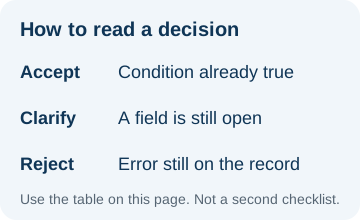
Frank Dean researches manufacturer, standards, and trade documents for PhoneBulk, then turns them into accept / clarify / reject buying guidance for resellers.
- Source-backed wholesale research
- Claim-level fact review
- Separation of official rule and trade practice